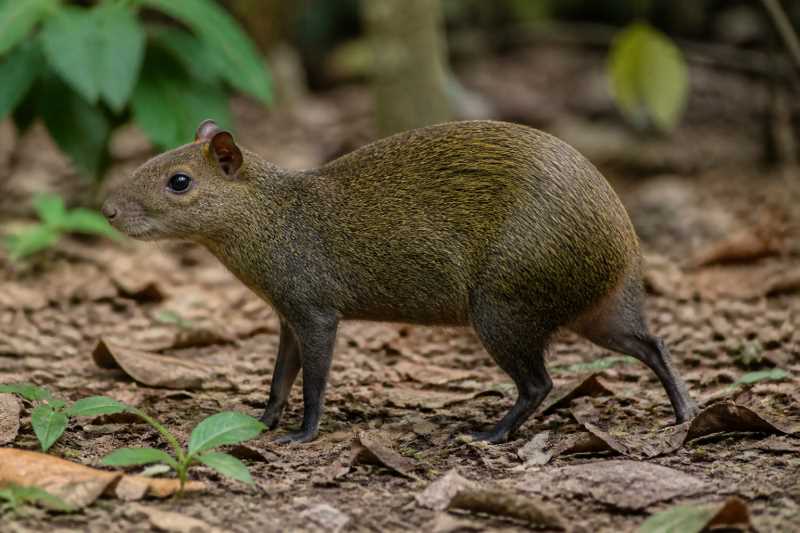
Central American Agouti (Dasyprocta punctata)
Introduction
The Central American agouti, scientifically named Dasyprocta punctata, is a fascinating rodent species that plays a crucial role in the ecosystems of Central and South America. Known for their striking appearance and ecological importance, these mammals serve as both seed dispersers and prey for larger predators, thus maintaining the balance of their habitats. This article delves into various aspects of the Central American agouti, providing an in-depth look at their physical characteristics, habitats, behaviors, and conservation status.
Physical Description
The Central American agouti is a medium-sized rodent, typically weighing between 2 to 4 kilograms (4.4 to 8.8 pounds) and measuring about 50 to 76 centimeters (19.7 to 29.9 inches) in length, including their short tails. They possess a robust body covered with coarse fur, which varies in color from reddish-brown to black, often exhibiting a grizzled pattern due to the mix of lighter and darker hairs. Their hind legs are noticeably longer than their front legs, giving them a distinctive posture and the ability to make impressive leaps.
Agoutis have small, rounded ears and large eyes that are well-adapted for their primarily crepuscular and nocturnal lifestyles. Their sharp, chisel-like incisors are adapted for gnawing on hard seeds and nuts, a significant component of their diet. The combination of these physical characteristics makes the Central American agouti a unique and easily recognizable member of the rodent family.
Range and Habitat
The Central American agouti is widely distributed across a range of countries, including southern Mexico, throughout Central America, and into the northern regions of South America, such as Colombia and Venezuela. They thrive in a variety of habitats, from tropical rainforests and deciduous forests to secondary growth areas and plantations. Their adaptability to different environments has allowed them to persist despite changes in land use.
These rodents are primarily ground-dwellers and prefer areas with dense vegetation that provide cover from predators. They are often found near water sources, such as rivers and streams, which offer abundant food resources and hydration. Their ability to adapt to both forested and open environments makes them resilient, yet they still face threats from habitat destruction and fragmentation.
Behavior and Diet
Central American agoutis are primarily solitary creatures, although they may be seen in pairs, especially during the breeding season. They are diurnal to crepuscular, with most of their activity occurring during the early morning and late afternoon hours. Agoutis communicate with a series of vocalizations, including barks and whistles, which are used to warn of potential threats or to signal distress.
Their diet is omnivorous, consisting mainly of fruits, seeds, nuts, and leaves. They are known for their role as seed dispersers, as they often carry seeds away from the parent plant and bury them in the ground, a behavior known as scatter-hoarding. This not only helps in forest regeneration but also ensures a food supply for the agouti during leaner times. Occasionally, they may consume insects or small vertebrates, supplementing their primarily herbivorous diet.
Identification Tips (Field Recognition Cues)
When attempting to identify the Central American agouti in the wild, consider the following field recognition cues:
- Size and Shape: Look for a medium-sized rodent with a robust body, short tail, and long hind legs compared to the front legs.
- Fur Coloration: Note the coarse fur with a grizzled pattern, typically a mix of reddish-brown to black.
- Behavior: Observe their movement patterns, including their characteristic hopping gait and tendency to be active during early morning or late afternoon.
- Vocalizations: Listen for their distinctive barks and whistles, especially if you suspect the presence of predators nearby.
- Habitat: Search in areas with dense vegetation near water sources, as these are preferred agouti habitats.
Conservation Status (with Threats and Protections)
The Central American agouti is currently classified as Least Concern on the IUCN Red List, indicating that it is not at immediate risk of extinction. However, this status does not mean the species is free from threats. Habitat destruction due to agricultural expansion, logging, and urbanization poses significant challenges to their populations. Additionally, hunting for their meat and fur remains a concern in some regions.
Conservation efforts for the Central American agouti include habitat protection and restoration initiatives, as well as legal protections in certain countries. Protected areas and national parks play a vital role in safeguarding their natural habitats. Furthermore, increased awareness and education about the ecological importance of agoutis can help reduce hunting pressures and promote coexistence with local communities.
Frequently Asked Questions
1. What is the role of Central American agoutis in their ecosystem?
Central American agoutis are crucial for seed dispersal in their ecosystems. By burying seeds and nuts, they facilitate forest regeneration and plant diversity. Their role as prey also supports the biodiversity of predators in their habitats.
2. Are Central American agoutis endangered?
Currently, Central American agoutis are not endangered and are classified as Least Concern by the IUCN. However, they face threats from habitat loss and hunting, which could impact their populations if not managed.
3. How can I identify a Central American agouti in the wild?
Look for a medium-sized rodent with reddish-brown to black grizzled fur, a robust body, long hind legs, and a characteristic hopping gait. They are often found in forested areas near water sources.
4. What do Central American agoutis eat?
Their diet primarily consists of fruits, seeds, nuts, and leaves. They may also consume insects and small vertebrates on occasion.
5. Where can Central American agoutis be found?
Central American agoutis are found from southern Mexico through Central America and into northern South America, favoring tropical and deciduous forests as well as secondary growth areas.
Related posts