Introduction
The Bicolor-spined Porcupine, scientifically known as Coendou bicolor, is an intriguing species of New World porcupines that captivates both researchers and wildlife enthusiasts. Found in the dense tropical forests of South America, this porcupine species is renowned for its distinctive spines and arboreal lifestyle. In this comprehensive article, we delve into various aspects of the Bicolor-spined Porcupine, from its physical characteristics to its behavior, habitat, and conservation status.
Physical Description
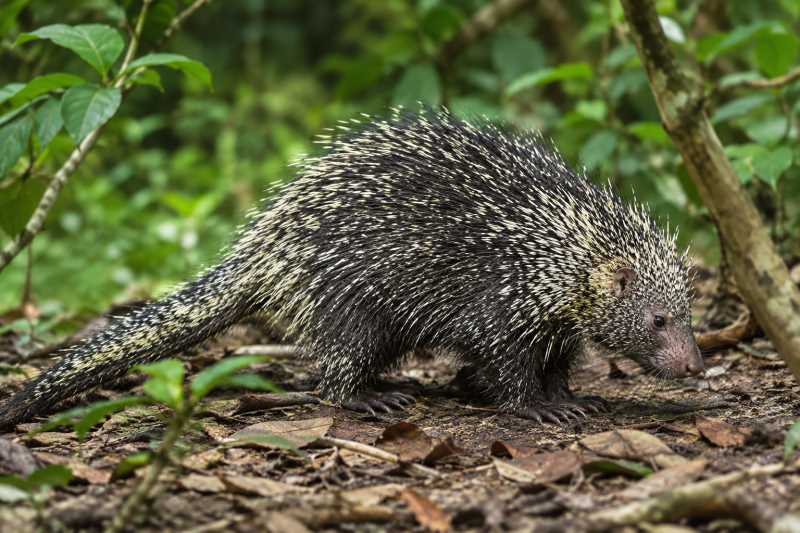
The Bicolor-spined Porcupine is a medium-sized rodent characterized by its unique bicolored spines, which serve as its most distinguishing feature. These spines are primarily black and white, providing the porcupine with a striking appearance. The body length of an adult Coendou bicolor ranges from 30 to 45 centimeters, with a prehensile tail that can measure up to 33 centimeters long, aiding in its arboreal navigation.
The dense spines cover the porcupine’s back and sides, acting as an effective deterrent against predators. Unlike Old World porcupines, the spines of the Bicolor-spined Porcupine are not barbed, but they are still capable of inflicting painful injuries. Beneath the spines, the porcupine has a soft undercoat that provides warmth and additional protection.
Their face is relatively short, with small, rounded ears and large, expressive eyes adapted for nocturnal activities. The feet are equipped with strong claws, essential for gripping tree branches as they maneuver through the forest canopy.
Range and Habitat
The Bicolor-spined Porcupine is native to the tropical rainforests of South America, with its range extending through countries such as Peru, Ecuador, Colombia, and Brazil. These porcupines thrive in dense, humid forests where they can exploit the abundant canopy cover for feeding and shelter.
Primarily arboreal, Coendou bicolor spends most of its life in the trees, rarely descending to the forest floor. This adaptation helps them avoid many terrestrial predators and facilitates access to a diverse range of food sources. They are most commonly found in lowland and montane forests, often at elevations up to 2,000 meters.
Behavior and Diet
The Bicolor-spined Porcupine is predominantly nocturnal, becoming active at dusk to forage for food. As solitary creatures, they spend the daytime hours resting in tree hollows or nestled among dense foliage.
Their diet is primarily herbivorous, consisting of leaves, fruits, seeds, and bark. They are known to be selective feeders, often preferring young leaves and fruits rich in nutrients. The prehensile tail plays a crucial role in their feeding behavior, allowing them to stabilize themselves as they reach for food.
Despite their solitary nature, Bicolor-spined Porcupines communicate with each other through vocalizations and scent marking. During the mating season, males may become more vocal and engage in displays to attract females.
Identification Tips
Identifying the Bicolor-spined Porcupine in the wild can be challenging due to its nocturnal habits and arboreal lifestyle. However, several field recognition cues can aid in their identification:
- Spines: The bicolor pattern of black and white spines is a hallmark feature.
- Tail: Look for the distinctive prehensile tail, which is often curled around branches.
- Silhouette: At dusk or dawn, observe the rounded silhouette against the treetops.
- Vocalizations: Listen for their low-frequency grunts and whines, especially during the breeding season.
Conservation Status
The Bicolor-spined Porcupine is currently classified as "Least Concern" by the International Union for Conservation of Nature (IUCN), indicating that the species is not facing an immediate threat of extinction. However, like many forest-dependent species, it faces challenges due to habitat destruction and fragmentation.
Deforestation for agriculture, logging, and urban expansion poses the greatest threat to their habitat. Conservation efforts are focused on preserving the tropical rainforest ecosystems that sustain these porcupines and other wildlife.
Protected areas and national parks across their range provide some level of habitat security. Continued efforts to promote sustainable land use practices and raise awareness about the importance of protecting rainforest habitats are essential for the long-term conservation of the Bicolor-spined Porcupine.
Frequently Asked Questions
1. What is the primary diet of the Bicolor-spined Porcupine?
The Bicolor-spined Porcupine primarily feeds on leaves, fruits, seeds, and bark. They are selective feeders, often choosing nutrient-rich young leaves and fruits. Their prehensile tail aids in stabilizing them as they forage in the trees.
2. How does the Bicolor-spined Porcupine protect itself from predators?
The primary defense mechanism of the Bicolor-spined Porcupine is its bicolored spines, which deter predators. When threatened, it will raise its spines and may also emit vocal warnings. Its arboreal lifestyle helps avoid many ground-based predators.
3. Where can the Bicolor-spined Porcupine be found?
This species is native to the tropical rainforests of South America, particularly in countries like Peru, Ecuador, Colombia, and Brazil. They are typically found in lowland and montane forests at elevations up to 2,000 meters.
4. Are Bicolor-spined Porcupines social animals?
Bicolor-spined Porcupines are generally solitary, coming together primarily during the mating season. They communicate through vocalizations and scent markings but prefer to forage and rest alone.
5. Why is the Bicolor-spined Porcupine important to its ecosystem?
As herbivores, Bicolor-spined Porcupines play a crucial role in their ecosystem by aiding in seed dispersal and contributing to the health of the forest canopy. Their feeding habits help in maintaining plant diversity and forest regeneration.
Related posts