Azara’s Night Monkey (Aotus azarae): A Comprehensive Guide
Introduction
Azara’s night monkey (Aotus azarae) is a fascinating species belonging to the family Aotidae. Known for its nocturnal habits and distinctive appearance, this primate has captured the interest of researchers and wildlife enthusiasts alike. Named after the Spanish naturalist Félix de Azara, Azara’s night monkey is a part of the owl monkey genus, recognized for its large, expressive eyes adapted for low-light environments. This article delves into the various aspects of Aotus azarae, from its physical traits to its conservation status, providing a thorough understanding of this unique creature.
Physical Description
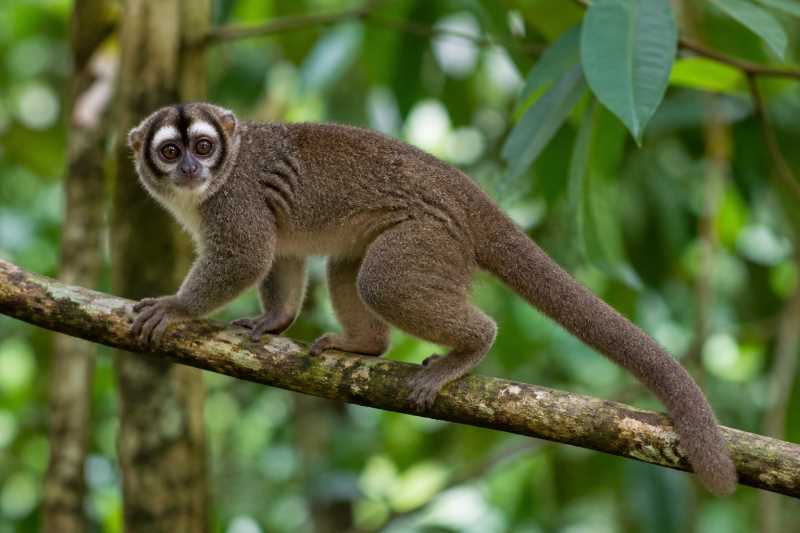
Azara’s night monkey is a small to medium-sized primate, typically weighing between 0.8 to 1.2 kilograms (1.8 to 2.6 pounds) and measuring about 24 to 37 centimeters (9.4 to 14.6 inches) in body length, with a tail almost equal in length to its body. Its most striking feature is its large, round eyes, adapted for nocturnal vision. These eyes lack a reflective layer, or tapetum lucidum, which is common in other nocturnal animals, making Aotus azarae unique among its peers.
The fur of Azara’s night monkey is soft and dense, varying in coloration from grayish-brown to reddish-brown, with a lighter underbelly. The face is marked by a distinct white mask-like pattern, with dark circles around the eyes and a narrow white stripe running from the forehead to the nose.
Range and Habitat
Azara’s night monkey is primarily found in the subtropical and tropical forests of South America, with its range spanning across Bolivia, Paraguay, Argentina, and Brazil. This species prefers dense, humid forests, including primary and secondary growth forests, riverine forests, and gallery forests. They are arboreal, spending most of their time in the tree canopy, where they find safety from predators and abundant food resources.
Behavior and Diet
As a nocturnal species, Azara’s night monkey is most active during the night, with peak activity occurring around dusk and dawn. They are social animals, typically living in small family groups consisting of a mating pair and their offspring. Communication within these groups is facilitated through a variety of vocalizations, body postures, and scent-marking behaviors.
The diet of Azara’s night monkey is predominantly frugivorous, with fruits making up the majority of their intake. However, they are also known to eat leaves, flowers, and small insects, especially when fruit is scarce. Their foraging behavior is influenced by the seasonal availability of food, and they have been observed to adapt their diet based on the abundance of resources.
Identification Tips
When trying to identify Azara’s night monkey in the field, there are several key features to look for:
- Large, Round Eyes: Adapted for nocturnal vision, these are the most prominent feature.
- Distinct Facial Markings: Look for the white mask-like pattern and dark circles around the eyes.
- Soft, Dense Fur: Typically grayish-brown to reddish-brown with a lighter underbelly.
- Nocturnal Activity: Most active during the night, especially at dusk and dawn.
- Social Groups: Usually found in small family groups in the tree canopy.
Conservation Status
The conservation status of Azara’s night monkey is currently classified as "Least Concern" by the International Union for Conservation of Nature (IUCN). However, like many wildlife species, they face several threats that could impact their populations in the future. These threats include habitat destruction due to deforestation, illegal hunting for the pet trade, and disease transmission from humans.
Conservation efforts are in place to mitigate these threats, such as habitat protection and restoration projects, as well as legal protections in several countries within their range. Continued research and monitoring are essential to ensure the long-term survival of Azara’s night monkey.
Frequently Asked Questions
What is the lifespan of Azara’s night monkey?
Azara’s night monkey can live up to 20 years in the wild, although their lifespan can be shorter due to predation and environmental pressures. In captivity, they have been known to live slightly longer due to controlled conditions and absence of predators.
How does Azara’s night monkey communicate with its group?
Communication among Azara’s night monkeys involves a combination of vocalizations, including hoots and whistles, as well as facial expressions and body postures. Scent marking is also a crucial part of their communication, used to establish territory and convey reproductive status.
Are Azara’s night monkeys endangered?
Currently, Azara’s night monkey is not considered endangered, as it is classified as "Least Concern" by the IUCN. However, they do face threats from habitat loss and hunting, which could potentially impact their populations if not managed properly.
What adaptations allow Azara’s night monkey to thrive at night?
Azara’s night monkey has several adaptations for nocturnal life, including large eyes for enhanced night vision, acute hearing to detect predators and prey, and a keen sense of smell. These adaptations allow them to navigate and forage effectively in the dark.
What role does Azara’s night monkey play in its ecosystem?
As primarily frugivorous animals, Azara’s night monkeys play a crucial role in seed dispersal, aiding in forest regeneration and plant diversity. Their presence in the ecosystem supports a healthy balance of predator-prey dynamics.
Related posts