Introduction
The Yellow-legged Tinamou (Crypturellus noctivagus) is a secretive, ground-dwelling bird endemic to Brazil. It belongs to the tinamou family, Tinamidae, and is usually treated as having two subspecies. The nominate form is associated mainly with Atlantic Forest habitats, while C. n. zabele occurs principally in the Caatinga and adjacent dry woodland of north-eastern Brazil. It is more often detected by its distinctive call than seen.
Physical Description
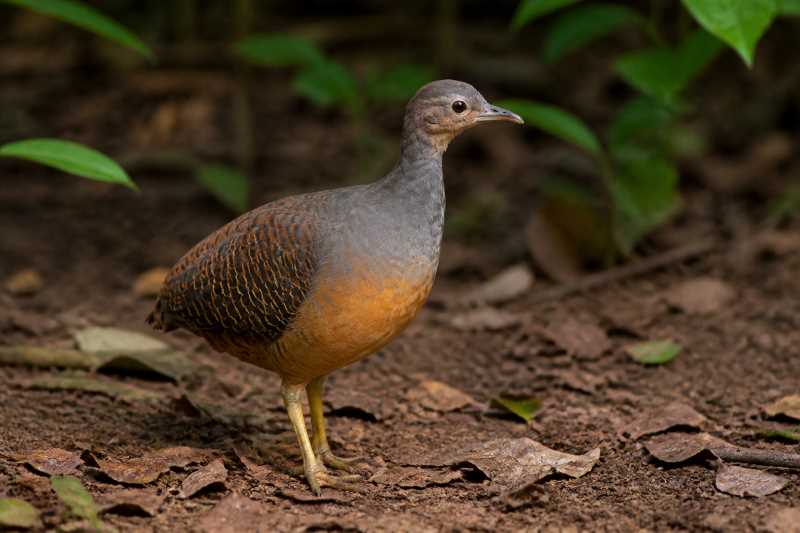
The Yellow-legged Tinamou is a medium-sized tinamou, measuring approximately 29 to 32 cm in length. It has a compact, rounded body, a short tail, short rounded wings and strong legs suited to walking through dense vegetation and leaf litter.
Its plumage is generally greyish brown, rufous brown and finely barred, providing effective camouflage on the forest floor. The underparts are paler than the back, and the upperparts may show darker barring and mottling. The legs are yellowish, although their colour can appear subdued in shade or under forest cover.
The sexes are broadly similar in appearance, as is typical of many tinamous. Females may be slightly larger or more richly coloured, but field separation by sex is unreliable. Juveniles are generally duller and less sharply marked than adults.
Range and Habitat
The Yellow-legged Tinamou is endemic to Brazil. Crypturellus noctivagus noctivagus occurs mainly in the Atlantic Forest region, from southern Bahia through south-eastern Brazil and southwards into Paraná, Santa Catarina and Rio Grande do Sul. C. n. zabele is associated primarily with the Caatinga and other dry wooded habitats of north-eastern Brazil, with records extending into transitional areas.
The species is resident rather than migratory. It uses humid forest, seasonal forest, dense secondary growth, woodland edges and, in the range of C. n. zabele, drier scrub and savanna woodland. It is generally a lowland or lower-elevation bird, although local records may occur at higher elevations where suitable forest persists.
Habitat continuity is important because the species depends on dense ground cover and access to forest-floor food resources. Populations are often localised where remaining habitat is fragmented.
Where to See This Species
The Yellow-legged Tinamou is difficult to observe. Early morning listening is often more productive than searching visually, and birds may remain hidden in dense undergrowth even when calling nearby. Access rules, guides and seasonal conditions should be checked before visiting each protected area.
Intervales State Park, São Paulo, Brazil
Occurrence records have been documented for Intervales State Park, which protects extensive Atlantic Forest with mature woodland, dense understorey and areas of regenerating forest. The species is most realistically sought by listening along quiet forest roads and trails during the early morning, rather than by expecting an open view.
Nearby accommodation: Ribeirão Grande and the surrounding park gateway area provide guest houses, small hotels, cabins and other simple rural accommodation.
Superagüi National Park, Paraná, Brazil
Superagüi National Park contains coastal Atlantic Forest and associated habitats where the nominate subspecies has been recorded. Forest trails and quieter sections of the park may offer opportunities to detect the species by voice, particularly during calm morning conditions.
Nearby accommodation: Guaraqueçaba and the communities serving the Superagüi area offer guest houses, small inns, campsites and basic self-catering accommodation.
Rio Doce State Park, Minas Gerais, Brazil
The species has been recorded from Rio Doce State Park, a protected landscape of Atlantic Forest, lakes and forest remnants in the Doce River region. Dense forest edges and secluded trails are the most suitable places to listen for a ground-dwelling tinamou, although encounters remain unpredictable.
Nearby accommodation: Marliéria and the wider Vale do Aço area provide hotels, guest houses and camping options suitable for visits to the park.
Behaviour and Diet
The Yellow-legged Tinamou is predominantly terrestrial and usually moves quietly through leaf litter, dense undergrowth and shaded forest margins. It is secretive and generally solitary or found in pairs outside the breeding season. When disturbed, it may run rapidly through vegetation and can make a short, explosive flight, but it is not adapted for sustained aerial movement.
The species is most often detected by its repeated, far-carrying call. Calling activity may be greatest in the early morning and late afternoon, and vocalisations are particularly important for territory defence and contact between individuals.
Its diet consists mainly of fallen fruit, seeds and other plant material, supplemented by insects, ants and other small invertebrates. By consuming and moving seeds, it may contribute to forest regeneration, although the importance of this role varies with habitat and local food availability.
Like other tinamous, it is believed to have a mating system in which females may mate with more than one male. The female lays a clutch of eggs in a simple ground nest, after which the male generally undertakes incubation and much of the care of the chicks. Species-specific breeding observations remain limited, so details can vary between populations.
Identification Tips
- Look for a compact, short-tailed bird walking through leaf litter rather than flying between trees.
- Note the subdued grey-brown or rufous-brown plumage, fine barring and yellowish legs.
- The species is more likely to be heard than seen. Its call can carry through otherwise quiet forest.
- Avoid relying on leg colour alone, because shade, distance and vegetation can make the legs appear dull or greyish.
- In Atlantic Forest habitats, compare it carefully with other forest tinamous, especially the Brown Tinamou. The Yellow-legged Tinamou is generally more strongly associated with yellowish legs and a more finely patterned appearance, but vocal identification and habitat are often more reliable than a brief visual encounter.
- In dry north-eastern habitats, records may involve the zabele subspecies, which can occur in Caatinga and transitional woodland rather than only in humid forest.
Conservation Status
The Yellow-legged Tinamou is currently classified as Near Threatened on the IUCN Red List. Its population is considered to be declining, principally because of continuing habitat loss and fragmentation. Logging, agricultural expansion, urban development and the degradation of forest understorey reduce the quality and continuity of its habitat. Hunting may also affect local populations, particularly where the species is already restricted to isolated forest remnants.
The species is endemic to Brazil, so its conservation depends entirely on the protection and restoration of Brazilian forests and dry woodlands. Important measures include maintaining connected protected areas, protecting remaining Atlantic Forest and Caatinga habitat, managing hunting pressure, and improving surveys of poorly known populations. Some regional or subspecific assessments in Brazil indicate a higher level of concern than the global assessment.
Frequently Asked Questions
Where is the Yellow-legged Tinamou found?
It is found only in Brazil. The nominate subspecies occurs mainly in the Atlantic Forest region, while C. n. zabele is associated largely with the Caatinga and adjacent dry woodland of north-eastern Brazil.
Is the Yellow-legged Tinamou migratory?
No. It is regarded as a resident species and does not undertake a regular long-distance migration.
What does the Yellow-legged Tinamou eat?
Its diet includes fallen fruit, seeds and other plant material, together with insects, ants and other small invertebrates found on or near the forest floor.
How can the species be identified in the field?
The most useful clues are its compact shape, short tail, grey-brown and finely barred plumage, yellowish legs and secretive behaviour. Its distinctive call is often easier to detect than the bird itself.
Is the Yellow-legged Tinamou endangered?
It is classified globally as Near Threatened. Habitat loss, fragmentation and hunting are the main conservation concerns, and some regional populations face greater risks than the species as a whole.
Where is the best place to look for this tinamou?
Protected Atlantic Forest areas such as Intervales State Park, Superagüi National Park and Rio Doce State Park have documented occurrence records. Listening quietly in dense forest during the early morning is usually more effective than searching open areas.
References
- BirdLife International
- IUCN Red List of Threatened Species
- Oecologia Australis
Related posts