The Morepork (Ninox novaeseelandiae): A Sentinel of New Zealand’s Nocturnal Wilderness
In the heart of New Zealand’s dense native forests, a haunting call resonates through the night. This call belongs to the Morepork, or as it is scientifically known, Ninox novaeseelandiae. Named after its distinctive ‘more-pork’ call, this owl holds a special place in the rich tapestry of New Zealand’s wildlife. As a nocturnal bird, the Morepork is an intriguing subject of study, offering insights into the complex ecosystems of New Zealand’s wilderness.
Physical Characteristics and Habitat
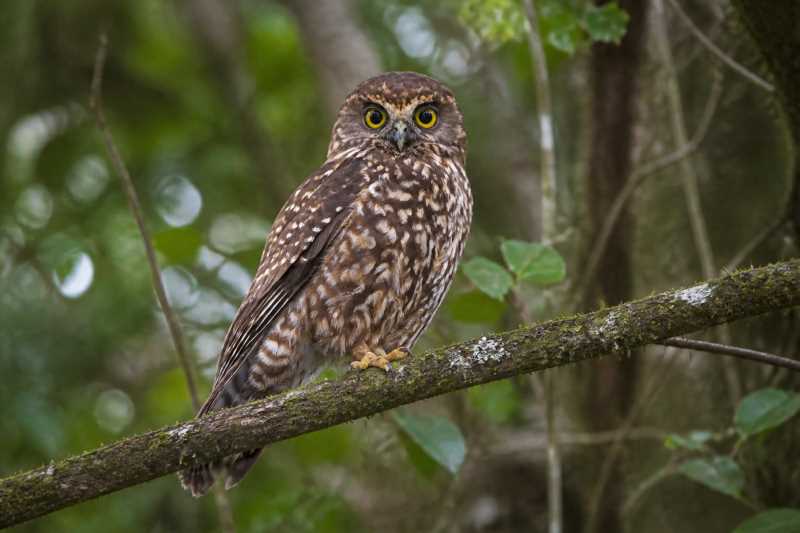
The Morepork is a medium-sized owl, measuring about 26 to 29 centimeters in length, with a wingspan of approximately 70 centimeters. Its plumage is a mottled combination of brown and cream, providing excellent camouflage against the bark and leaves of its forest home. The Morepork’s large, yellow eyes are adapted for excellent night vision, crucial for hunting in low-light conditions.
This adaptable owl is native to New Zealand and also found in Tasmania and other parts of Australia, where it is known as the Southern Boobook (Ninox boobook). In New Zealand, the Morepork inhabits a variety of environments, from native forests to urban parks, showcasing its adaptability to different habitats. However, they are most commonly associated with dense, mature forests that offer ample coverage and food resources.
Behavior and Diet
The Morepork is primarily nocturnal, emerging at dusk to begin its nightly activities. Its diet is diverse, consisting mainly of insects and small mammals, such as mice. Moreporks are also known to prey on small birds, showcasing their versatility as hunters. Their hunting technique is a combination of silent flight and acute hearing, allowing them to swoop down on unsuspecting prey with precision.
Vocal communication plays a significant role in the life of a Morepork. Their calls are not only a means of locating mates but also serve to establish territory and ward off potential intruders. The iconic ‘more-pork’ call is a familiar sound in New Zealand’s nightscape, often heard in the quiet of the evening.
Conservation Status and Threats
The Morepork is currently classified as ‘Least Concern’ by the International Union for Conservation of Nature (IUCN), indicating that the species is not at immediate risk of significant decline. However, like many native species in New Zealand, Moreporks face threats from habitat destruction and introduced predators such as rats, stoats, and possums. These invasive species not only compete with Moreporks for food but also pose a direct threat to their eggs and chicks.
Conservation efforts in New Zealand, including pest control and habitat restoration, are vital to ensuring the continued survival of the Morepork. Public awareness and education are also crucial components in fostering a supportive environment for these nocturnal birds.
Cultural Significance
In Maori culture, the Morepork, or "ruru," holds a special place as a guardian of the forest and a messenger from the spirit world. Its presence is often seen as an omen, and its calls are interpreted as messages from deceased ancestors. This cultural significance highlights the deep connection between the Morepork and the indigenous people of New Zealand.
Research and Observation
Bird enthusiasts and researchers alike are drawn to the Morepork, not only for its unique behavior but also for its role in the ecosystem. Studies on the Morepork contribute to a broader understanding of nocturnal avian species and their interactions within their habitats. Observational studies often focus on their hunting patterns, breeding behaviors, and territorial dynamics.
For those interested in observing Moreporks in their natural habitat, guided night walks and eco-tours are available in many parts of New Zealand. These tours offer a chance to witness the Morepork’s haunting calls and elusive behavior firsthand, providing an unforgettable experience for nature lovers.
Conclusion
The Morepork is more than just an owl; it is an integral part of New Zealand’s natural heritage. Its eerie calls and mysterious presence underscore the enchanting allure of the country’s nocturnal wilderness. As conservation efforts continue to protect and preserve New Zealand’s unique biodiversity, the Morepork stands as a symbol of resilience and adaptation.
Through ongoing research and public engagement, there is hope that future generations will continue to hear the haunting call of the Morepork echoing through New Zealand’s night skies, a testament to the enduring beauty and mystery of the natural world.
Related posts