Introduction
The Wonga Pigeon (Leucosarcia melanoleuca), also known as the Wonga Wonga, is a large, ground-dwelling pigeon endemic to eastern Australia. It inhabits rainforest, dense coastal forest, wet woodland and scrub, where its deep, repetitive call may be heard well before the bird is seen.
Physical Description
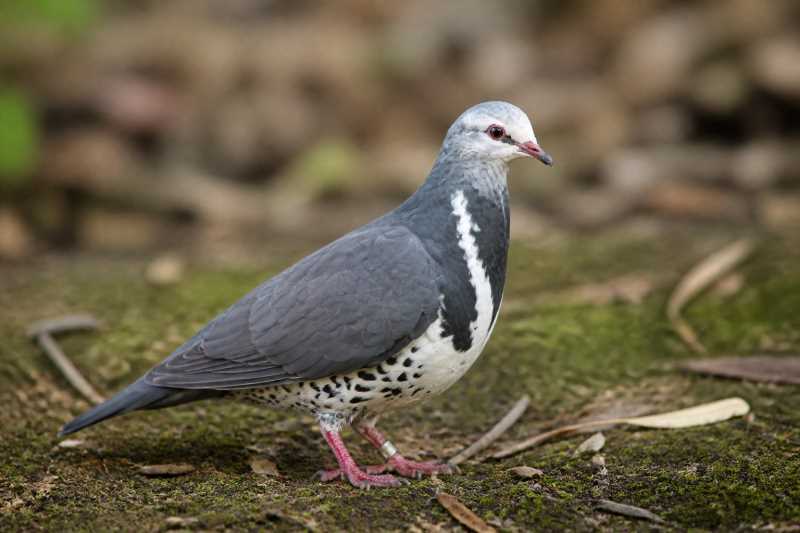
The Wonga Pigeon is a plump pigeon measuring up to about 38 cm in length. It has a small head, short broad wings and a relatively long tail. The upperparts are mainly slate-grey, while the face is pale and the underparts are white with bold black-brown crescent and wedge-shaped markings.
A prominent white V-shaped marking crosses the breast and is the most useful field character. The eyes are dark reddish-brown with a pink eye-ring, while the bill, legs and feet are pink to deep red. There is no strong difference in appearance between adult males and females. Young birds are browner overall and usually have a less distinct breast marking.
When flushed, the Wonga Pigeon can rise suddenly with rapid wingbeats and loud clapping or whirring sounds. It commonly flies only a short distance before landing in a tree or dense cover.
Range and Habitat
The Wonga Pigeon occurs along the eastern coast and adjacent ranges of Australia, from south-eastern Queensland through New South Wales to eastern Victoria, including the Gippsland region. It is an Australian endemic and is generally regarded as sedentary, although individuals may make local movements in response to food availability and local conditions.
Its preferred habitats include subtropical and temperate rainforest, dense coastal forest, wet sclerophyll forest, forested gullies and thick scrub. It may also visit clearings, walking tracks, picnic areas, roadsides and gardens close to suitable forest. The species is most often encountered on the ground beneath or beside forest cover, rather than in open country.
Where to See This Species
Wallingat National Park, New South Wales, Australia
Wallingat National Park supports extensive forest, flooded gums and cabbage palms, and the New South Wales National Parks and Wildlife Service specifically identifies the Wonga Pigeon’s distinctive call as part of the park’s birdlife. Listen for the repeated “woop, woop” call along forest roads, walking routes and around suitable clearings, then search quietly beneath the trees.
Nearby accommodation: Forster and Pacific Palms are the nearest practical gateway areas, with hotels, holiday rentals, cabins, guest houses and camping options.
Budderoo National Park, New South Wales, Australia
The Missingham Lookout Track in Budderoo National Park passes through forest and vegetation bordering remaining rainforest, and the park authority notes that Wonga Pigeons may be heard along the route. Early morning or late afternoon is a useful time to listen for calling birds and inspect the forest floor near tracks and sheltered edges.
Nearby accommodation: Robertson and the Southern Highlands provide hotels, guest houses, farm stays and self-catering accommodation, while Kangaroo Valley is another practical base for exploring the area.
Royal National Park, New South Wales, Australia
Wonga Pigeons have been recorded around the Audley precinct and in the wet forests of the upper Hacking Valley. The combination of dense forest, gullies, walking tracks and clearings provides suitable habitat. Move slowly and listen for calls, as the species often remains hidden until it is disturbed.
Nearby accommodation: Sutherland and the southern Sydney suburbs provide the nearest broad range of hotels, guest houses and self-catering accommodation. Camping and other visitor facilities are also available in and around the national park, subject to current park conditions.
Behaviour and Diet
Wonga Pigeons spend much of their time walking on the forest floor. They feed on seeds from native and introduced plants, fallen fruit, berries and occasional invertebrates, including insects. Individuals may repeatedly use the same routes between feeding areas, leaving clearly defined tracks through leaf litter or low vegetation.
Feeding is often concentrated in the early morning and late afternoon. Birds may call for long periods, producing a loud, monotonous “woop woop” that can carry through dense forest for considerable distances. They are usually shy, although birds in regularly visited areas can become less wary.
Pairs are monogamous and defend the area around the nest. Threat displays may include bowing and bill-clicking while walking towards an intruder. The nest is a saucer-shaped platform of sticks and twigs, usually placed high in a large tree, although abandoned nests of other large birds may sometimes be used. Both parents incubate the eggs and feed the young. Adults may adopt a cryptic posture, raising the patterned tail while facing a perceived threat and looking over the tail.
Identification Tips
- Look for a large, heavy-bodied pigeon walking on the ground beneath forest cover.
- The slate-grey upperparts contrast with a white breast marked by a bold white V and dark crescent-shaped patterning.
- Pink to red legs, feet and bill, together with the dark reddish eye and pink eye-ring, are useful supporting features.
- The species often freezes or remains motionless when detected, relying on its patterned plumage for camouflage.
- The loud, repeated “woop woop” call is often easier to detect than the bird itself.
- A sudden explosive take-off with loud wing claps is characteristic when a bird is startled.
The Wonga Pigeon is larger and more heavily patterned below than the Common Bronzewing. It also lacks the bronzewing’s metallic wing panels and is more closely associated with dense forest and shaded ground cover.
Conservation Status
The Wonga Pigeon is listed as Least Concern globally on the IUCN Red List. It remains relatively widespread across eastern Australia, but the loss, fragmentation and degradation of rainforest, wet forest and coastal woodland can reduce suitable habitat. Urban development, land clearing and changes in forest structure may also affect feeding and nesting areas.
Protecting remaining forest, maintaining connected habitat and retaining dense vegetation around gullies and forest edges are important conservation measures. The species also benefits from careful management of visitors, domestic animals and other disturbances in areas where it feeds or nests.
Frequently Asked Questions
Where does the Wonga Pigeon live?
The Wonga Pigeon lives in eastern Australia, from south-eastern Queensland through New South Wales to eastern Victoria. It is mainly associated with rainforest, wet forest, coastal forest and dense scrub.
What does a Wonga Pigeon look like?
It is a large grey pigeon with a pale face, pink to red legs and bill, and a distinctive white V-shaped marking on the breast. The white underparts are boldly patterned with dark crescents and wedges.
What does the Wonga Pigeon eat?
Its diet consists mainly of seeds, fallen fruit and berries collected from the ground, along with occasional insects and other small invertebrates.
What does a Wonga Pigeon’s call sound like?
The call is a loud, low and repetitive “woop woop”. It may continue for a long time and can often be heard through the forest before the bird is located.
Does the Wonga Pigeon migrate?
The Wonga Pigeon is generally sedentary rather than migratory. Local movements may occur, but it usually remains within or near suitable forest habitat.
References
- Australian Museum
- BirdLife Australia
- New South Wales National Parks and Wildlife Service
Related posts