Introduction
The White-winged Scoter, Melanitta deglandi, is a large North American sea duck in the family Anatidae. It breeds on remote freshwater lakes and wetlands across northern Canada and Alaska, then migrates to coastal waters of the Atlantic and Pacific, with some birds wintering on the Great Lakes and other large inland waters. Current taxonomic treatments recognise it as distinct from the Eurasian Velvet Scoter and Stejneger’s Scoter.
Physical Description
The White-winged Scoter is a stocky, heavy-bodied diving duck measuring approximately 48–58 centimetres in length, with a wingspan of about 80 centimetres. Adults generally weigh between 950 and 1,800 grams, although mass varies with sex, season and condition.
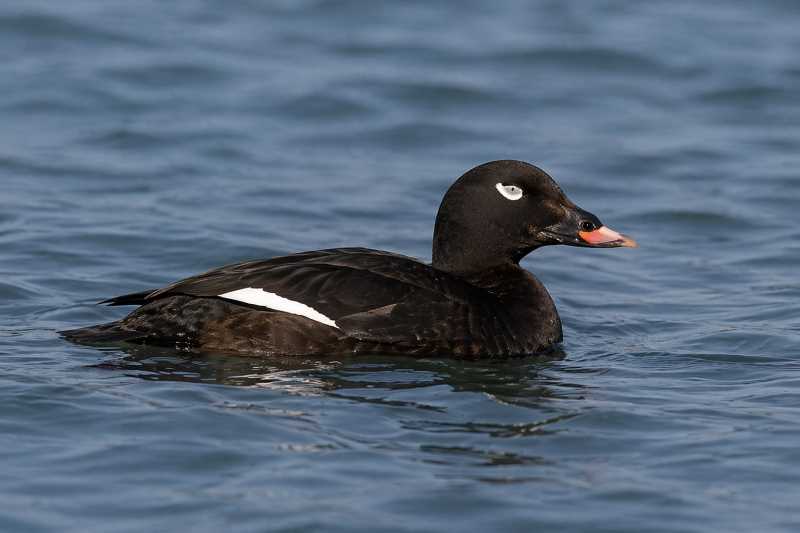
Adult males are predominantly velvety black. They have a conspicuous white, comma-shaped mark around and behind the eye, a broad white patch across the inner wing, and a heavy bill with a black basal knob and orange tip. The feet are bright orange-red. The white wing patch is especially obvious in flight but may be partly visible when the bird is resting on the water.
Females and immature birds are dark brown to brownish-grey, often with a paler belly. They have less sharply defined pale patches on the face and a darker bill. Juveniles are generally duller and less contrasting than adults, but the white wing patch remains an important identification feature.
Range and Habitat
White-winged Scoters breed mainly across the boreal forest and subarctic interior of Alaska and Canada. They usually nest near freshwater lakes and ponds surrounded by low, dense shrubs, although some breeding habitat extends into more open tundra and wetland landscapes. Nest sites may be well concealed in vegetation and can be some distance from the water.
After breeding, many birds move through rivers and large inland lakes towards the coast. Most winter in relatively shallow marine waters along the Atlantic and Pacific coasts of North America, particularly where molluscs and other benthic prey are abundant. Smaller numbers remain on the Great Lakes and other large freshwater bodies, especially during migration and winter.
The species is largely restricted to North America. Older sources may place it within a broader species concept that also included Velvet Scoter and Stejneger’s Scoter, but those forms are now generally treated as separate species.
Behaviour and Diet
White-winged Scoters forage by diving and swimming underwater, using their feet and partly spread wings for propulsion and manoeuvring. They commonly feed on molluscs, including mussels, as well as crustaceans, aquatic insects and small fish. Plant material forms only a minor part of the diet. Large shellfish may be brought to the surface before being swallowed.
Outside the breeding season, White-winged Scoters form loose flocks, often mixing with Surf Scoters, Black Scoters and other sea ducks. They are strong swimmers and divers, but their take-off is comparatively laborious, with the bird running along the water before becoming airborne. Vocal activity is generally limited, although males and females produce low or harsh calls during social interactions and courtship.
Courtship may begin on the wintering grounds. Displays include group flights, head and neck movements, wing-flapping, bathing motions and bill-dipping. Most pairs appear to be formed before or during spring migration. The female usually lays 6–16 eggs in a ground nest concealed beneath dense vegetation. She alone incubates the eggs for approximately 25–30 days, while the male may remain nearby for part of this period.
The ducklings are precocial. They leave the nest soon after hatching, are led to water by the female and feed themselves. The female provides protection and brooding, while young birds remain vulnerable to predators, severe weather and other hazards until they develop flight feathers.
Identification Tips
Look for the following combination of features:
- A large, heavy-bodied scoter that often appears bigger than nearby Surf or Black Scoters.
- A broad white wing patch, usually most visible in flight and often partly concealed when the bird is swimming.
- An adult male with glossy black plumage, a white comma-shaped mark behind the eye, and an orange-tipped bill with a black knob.
- A female or immature bird with dark brown plumage, pale facial patches and a dark bill.
- A heavy head and strongly sloping forehead, giving the bird a distinctive profile.
Surf Scoters have darker wings and a more colourful, patterned bill in adult males. Black Scoters lack the large white wing patch. Female and immature scoters can be difficult to separate at a distance, so wing pattern, head shape, bill structure and overall size should be assessed together.
Conservation Status
The White-winged Scoter is currently assessed as Least Concern on the IUCN Red List. A precise population estimate and reliable long-term trend are not presented here because monitoring is limited and some assessments combine information from related scoter species.
Important pressures include oil spills and other marine pollution, degradation of breeding wetlands, disturbance, exposure to contaminants such as heavy metals, and hunting in areas where the species is managed as a migratory game bird. Changes in coastal food resources and climate may also affect breeding and wintering conditions, although the effects can vary geographically.
Conservation priorities include protecting boreal lakes and wetland complexes, safeguarding important coastal feeding and wintering areas, preventing and responding rapidly to oil spills, maintaining sustainable harvest regulations, and improving population monitoring across the species’ range.
Frequently Asked Questions
Where does the White-winged Scoter live?
It breeds mainly near freshwater lakes and ponds in the boreal and subarctic regions of Alaska and Canada. In migration and winter, most birds use coastal waters along the Atlantic and Pacific coasts of North America, while some remain on the Great Lakes.
What does a White-winged Scoter eat?
Its diet consists mainly of aquatic invertebrates, especially molluscs and crustaceans. It also eats aquatic insects and small fish, while plant material makes up only a small proportion of the diet.
How can you identify a male White-winged Scoter?
An adult male is mostly black, with a white comma-shaped mark around and behind the eye, a large white wing patch, and an orange-tipped bill with a black knob at the base.
How can you identify a female White-winged Scoter?
Females are dark brown or brownish-grey with a paler belly, indistinct pale patches on the face and a dark bill. The white wing patch is often the most useful feature, particularly when the bird is flying.
How many eggs does a White-winged Scoter lay?
The usual clutch contains 6–16 eggs. The female incubates them for approximately 25–30 days and leads the precocial ducklings to water soon after they hatch.
Is the White-winged Scoter endangered?
No. The species is currently classified as Least Concern, although it remains vulnerable to oil pollution, wetland loss, contaminants, changes in marine food supplies and other pressures affecting migratory waterfowl.
References
- BirdLife International. n.d. “White-winged Scoter Melanitta deglandi Species Factsheet.” BirdLife DataZone. Available at: https://datazone.birdlife.org/species/factsheet/white-winged-scoter-melanitta-deglandi. Accessed 8 September 2026.
- Brown, P. W. and Fredrickson, L. H. 2019. “White-winged Scoter (Melanitta deglandi), version 1.1.” In Birds of North America. Cornell Lab of Ornithology, Ithaca, New York. https://doi.org/10.2173/bna.whwsco4.01.1.
- Brown, P. W. and Fredrickson, L. H. 1987. “Time Budget and Incubation Behavior of Breeding White-Winged Scoters.” The Wilson Bulletin 99(1): 50–55. Available through the Biodiversity Heritage Library: https://www.biodiversitylibrary.org/part/242322.
- Cornell Lab of Ornithology. n.d. “White-winged Scoter.” All About Birds. Available at: https://www.allaboutbirds.org/guide/White-winged_Scoter/overview. Accessed 8 September 2026.
- Cornell Lab of Ornithology. n.d. “White-winged Scoter Life History.” All About Birds. Available at: https://www.allaboutbirds.org/guide/White-winged_Scoter/lifehistory. Accessed 8 September 2026.
- IOC World Bird List. 2019. “Species Updates, IOC Version 9.2: Stejneger’s Scoter Melanitta stejnegeri split from White-winged Scoter Melanitta deglandi.” Available at: https://www.worldbirdnames.org/new/updates/species-updates/. Accessed 8 September 2026.
- U.S. Fish and Wildlife Service. n.d. “White-winged Scoter Species Account.” California Department of Fish and Wildlife archive. Available at: https://nrm.dfg.ca.gov/FileHandler.ashx?DocumentID=1637. Accessed 8 September 2026.
Related posts