Introduction
Steller’s Eider (Polysticta stelleri) is a small Arctic sea duck and the only member of the genus Polysticta. It is the smallest of the four eider species and is recognised for the male’s bold white, black and chestnut plumage. The species breeds mainly in Arctic Russia and Alaska, with smaller populations in northern Europe, and migrates to coastal marine areas for moulting and winter. (fws.gov)
Physical Description
Steller’s Eiders are compact ducks measuring approximately 43–46 cm in length. Adult males and females weigh roughly 850–890 g, although mass varies with sex, season and location. (fws.gov)
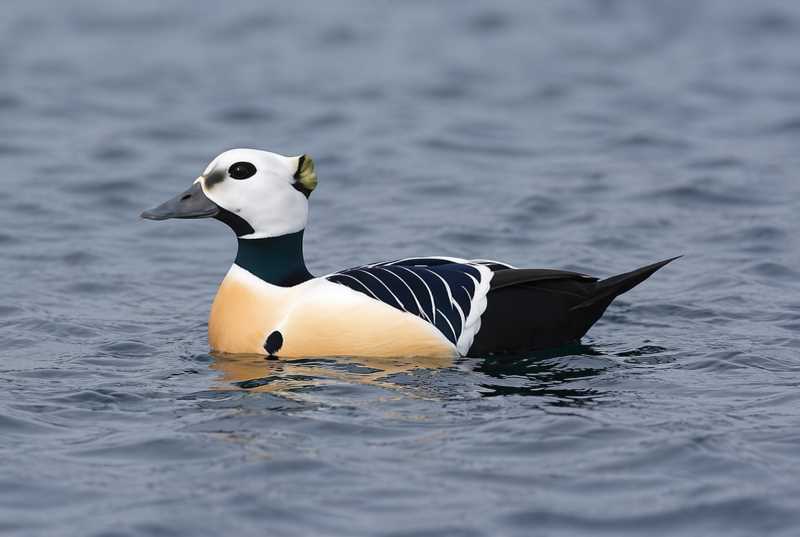
The breeding-plumaged male has a white head with a greenish tuft, small black eye patches, a black back, white shoulder markings and a rich chestnut breast and belly. The upper wing has a blue patch bordered with white. Outside the breeding season, males moult into largely mottled brown plumage.
Females and juveniles are mottled dark brown throughout the year, providing camouflage among tundra vegetation and coastal sediments. Both sexes have a relatively small head, short body, narrow wings and an elongated, pointed tail. Their webbed feet and streamlined shape are adaptations for swimming and diving. (fws.gov)
Range and Habitat
Steller’s Eider has a disjunct Arctic and sub-Arctic distribution. The largest population breeds along the Arctic coast of Russia and migrates to the Bering Sea and northern Gulf of Alaska. A much smaller North American breeding population occurs mainly on Alaska’s Arctic Coastal Plain, particularly near Utqiaġvik, with historically wider use of coastal wetlands on the Yukon–Kuskokwim Delta. A separate Atlantic population breeds in western Russia and winters in northern Europe, including the Baltic region and northern Norway. (alaska.usgs.gov)
Breeding birds use low-lying polygonal tundra, shallow freshwater ponds, sedge wetlands and small water bodies near the coast. During moulting and winter, the species occupies shallow coastal waters, estuaries, lagoons, bays and other ice-free marine habitats. Important Alaskan areas include Izembek Lagoon, Nelson Lagoon, Kuskokwim Shoals and the waters around the Aleutian Islands and Alaska Peninsula. Critical habitat designated for the Alaska-breeding population covers approximately 7,300 km². (adfg.alaska.gov)
Behaviour and Diet
Steller’s Eiders are social outside the breeding season and may gather in dense flocks numbering in the thousands at moulting and wintering sites. Birds often dive and surface together while feeding, then rest on sandbars, beaches or low coastal islands. They can forage during both daylight and darkness, particularly around changing tides. (fws.gov)
On the breeding grounds, the diet consists mainly of aquatic invertebrates associated with tundra wetlands, including midge and caddisfly larvae, together with some aquatic plant material. In coastal habitats, the principal foods include bivalve molluscs, amphipods, other crustaceans, worms, snails and echinoderms. Small fish may also be taken. Feeding methods include diving, head-dipping and dabbling in shallow water. (usgs.gov)
Pairs generally form before reaching the breeding grounds. Courtship includes head-dipping, vocalisations and close-following displays, sometimes involving several males around one female. The female builds a shallow nest on the tundra or among short willows, lining it with vegetation and down. She usually lays about 5–8 eggs and incubates them alone for approximately 24–28 days. The male normally leaves during incubation. Ducklings are precocial, leave the nest soon after hatching and are raised by the female. They can fly at approximately 5–7 weeks of age. (fws.gov)
Identification Tips
- Look for a small, compact eider with a relatively short neck, narrow wings and a pointed tail.
- In breeding plumage, the male is distinctive: white head, greenish head tuft, black eye patches, black back, white shoulder areas and chestnut underparts.
- The female and juvenile are dark brown and mottled, but their small size, compact shape and characteristic blue-and-white wing panel can help with identification.
- In flight, Steller’s Eiders often form tight groups and appear more compact and agile than larger eiders.
- Do not rely on plumage alone outside the breeding season, because males become extensively brown and may resemble females. Size, structure, flock behaviour and the blue upper-wing patch are useful supporting characters. (fws.gov)
Conservation Status
The global population is currently assessed as Vulnerable on the IUCN Red List. Available evidence indicates a long-term decline, although trends vary between regions and the species is difficult to monitor because it breeds in remote Arctic areas and winters in dispersed or inaccessible coastal habitats. (oap.ospar.org)
The Alaska-breeding population is listed as threatened under the United States Endangered Species Act. Important threats include the degradation or alteration of tundra wetlands, disturbance and development in coastal areas, oil spills and other marine pollution, changing food availability, climate-related changes to sea ice and wetland hydrology, disease, hunting or accidental shooting, and the concentration of large numbers of birds at a small number of moulting and wintering sites. The relative importance of these pressures differs between populations and is not fully resolved. (alaska.usgs.gov)
Conservation measures include protection of breeding, moulting and wintering habitat; monitoring of population size, survival and migration; reduction of disturbance and pollution risks; careful management of hunting and bycatch; and international cooperation across the species’ migratory range. In Alaska, designated critical habitat and recovery planning are important components of conservation action. (adfg.alaska.gov)
Frequently Asked Questions
Where does Steller’s Eider live?
Steller’s Eider breeds mainly in Arctic Russia and Alaska. It spends the non-breeding season in coastal waters of the Bering Sea, the northern Gulf of Alaska and northern Europe, depending on the population. (alaska.usgs.gov)
What does a male Steller’s Eider look like?
The breeding male has a white head, greenish tuft, black eye patches, black back, white shoulder markings and chestnut breast and belly. During late summer and autumn, the male becomes largely mottled brown. (fws.gov)
What does Steller’s Eider eat?
It feeds mainly on aquatic insects and other invertebrates in tundra wetlands, and on mussels, clams, amphipods, crustaceans, worms, snails and other marine invertebrates in coastal waters. Small fish and plant material may also be eaten. (usgs.gov)
Is Steller’s Eider endangered?
The species is classified globally as Vulnerable, rather than Endangered, on the IUCN Red List. The Alaska-breeding population has additional protection because it is listed as threatened under United States law. (oap.ospar.org)
How many eggs does Steller’s Eider lay?
A typical clutch contains about 5–8 eggs. Only the female incubates the eggs, usually for approximately 24–28 days, while the male departs during incubation. (fws.gov)
Where can Steller’s Eider be seen in winter?
Important wintering and moulting areas include shallow coastal waters around the Alaska Peninsula, the Aleutian Islands and the northern Gulf of Alaska. The Atlantic population winters in parts of northern Europe, including Norway and the Baltic region. (alaska.usgs.gov)
References
- Alaska Department of Fish and Game. 2024. Steller’s Eider Species Profile. Alaska Wildlife Conservation Center. https://www.awc.adfg.alaska.gov/index.cfm?adfg=stellerseider.main. Accessed 8 September 2026.
- Alaska Department of Fish and Game. n.d. Steller’s Eider (Polysticta stelleri): Federally Threatened Critical Habitat. https://www.adfg.alaska.gov/index.cfm?adfg=specialstatus.fedhabitat&species=stellerseider. Accessed 8 September 2026.
- BirdLife International. 2021. European Red List of Birds: Polysticta stelleri (Steller’s Eider), supplementary material. BirdLife International and Publications Office of the European Union. https://birdlifedata.blob.core.windows.net/sub-global/487_polysticta_stelleri.pdf. Accessed 8 September 2026.
- International Ornithologists’ Union. 2025. IOC World Bird List, version 15.2. https://www.worldbirdnames.org/. Accessed 8 September 2026.
- Petersen, M. R. 1980. Observations of wing-feather moult and summer feeding ecology of Steller’s Eiders at Nelson Lagoon, Alaska. Wildfowl.
- Petersen, M. R. 1981. Populations, feeding ecology and moult of Steller’s Eiders. The Condor 83: 256–262. https://doi.org/10.2307/1367319.
- Safine, D. E. 2004. Breeding biology of Steller’s Eiders (Polysticta stelleri) near Barrow, Alaska, 1991–99. Arctic 57(2): 166–175. https://journalhosting.ucalgary.ca/index.php/arctic/article/view/63553.
- U.S. Fish and Wildlife Service. n.d. Steller’s Eider (Polysticta stelleri). https://www.fws.gov/carp/species/stellers-eider-polysticta-stelleri. Accessed 8 September 2026.
- U.S. Geological Survey. n.d. Sea Duck Research: Steller’s Eider. https://www.usgs.gov/centers/alaska-science-center/science/sea-duck-research. Accessed 8 September 2026.
Related posts