Introduction
The Gorgeted Wood Quail, Odontophorus strophium, is a rare, ground-dwelling member of the New World quail family, Odontophoridae. It is endemic to Colombia, where it inhabits humid montane forests of the Eastern Andes. The species is elusive and remains poorly understood, although recent records have extended its known range and improved knowledge of its distribution. (birdlifedata.blob.core.windows.net)
Physical Description
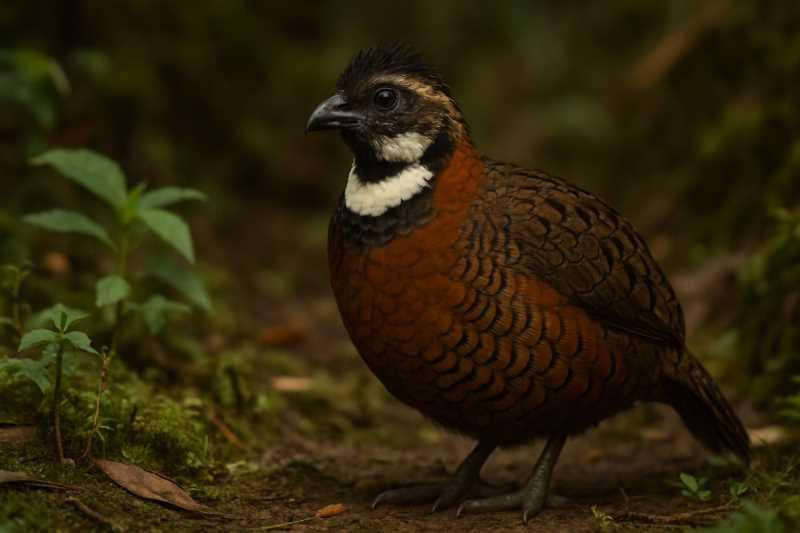
The Gorgeted Wood Quail is approximately 25.5–27 cm long. It has predominantly brown upperparts, a darker crown and ear-coverts, and a mottled back marked with fine pale streaks. The face is patterned with contrasting black, white and buff tones. A broad white band across the lower throat forms the characteristic gorget, while the breast is rich rufous-chestnut with prominent white spotting. The bill and legs are dark. (api.pageplace.de)
Males and females are broadly similar, although females may show differences in the throat pattern and reduced white spotting on the breast. Juveniles and immature birds are less well documented and may appear browner and less sharply marked than adults. A short crest or raised crown profile may be visible, but the throat pattern and spotted chest are more reliable identification features.
Range and Habitat
The species is endemic to Colombia. Its principal range is associated with the western slope of the Eastern Andes, historically including Santander and Cundinamarca. Documented records from Boyacá have extended the known distribution and show that the species also occurs on the eastern slope of the Eastern Cordillera. Records and historical specimens come from a relatively small and fragmented area. (birdlifedata.blob.core.windows.net)
The Gorgeted Wood Quail occupies humid subtropical and lower-temperate montane forest, particularly forest containing Colombian oak, Quercus humboldtii, and laurel-family trees. Confirmed records have generally been from about 1,750–2,050 metres above sea level, although suitable habitat may occur from approximately 1,500 to 2,500 metres. The species appears to prefer mature or primary forest, but it has also been recorded in some regenerating forest and other partially disturbed habitats. (birdlifedata.blob.core.windows.net)
It is considered sedentary rather than migratory. Its distribution is naturally restricted, and the loss and isolation of forest blocks are important concerns.
Behaviour and Diet
Gorgeted Wood Quails are secretive forest-floor birds. They forage among leaf litter and dense undergrowth, usually moving on foot and relying on camouflage. When disturbed, they can make a short, rapid flight, but they are not known for sustained long-distance movement.
The species may occur in small groups or family parties. Several birds have been recorded together before the breeding season, and groups are often detected by their calls rather than seen clearly. Vocal identification requires care because the calls of some Odontophorus species are similar. (birdlifedata.blob.core.windows.net)
Available evidence indicates a mixed diet of fruits, seeds and arthropods. Much of the food is probably obtained from the forest floor, although the precise importance of individual plant species remains uncertain. Breeding records suggest activity during periods of heavier rainfall, particularly March–May and September–November in Santander. Detailed information about nest construction, clutch size and parental care remains limited. (birdlifedata.blob.core.windows.net)
Identification Tips
- Look for a medium-sized, compact wood quail moving quietly through dense Andean forest undergrowth.
- The strongest field marks are the broad white throat band, dark banding around the front of the neck, rufous-chestnut lower parts and white spotting on the breast.
- The back is brown and finely mottled, with pale streaking that can be difficult to see in poor light.
- The face combines dark and pale markings, including a noticeable pale superciliary area and contrasting dark ear-coverts.
- Listen carefully for calls, but do not identify the species by sound alone where other wood quails occur. Recent records have used a combination of plumage characters, photographs, calls and location.
The Chestnut Wood Quail, Odontophorus hyperythrus, may occur in the same broad Andean region. It can be distinguished by differences in facial, throat and upperpart patterning, so photographs or repeated observations are preferable to a rushed identification. (pdfs.semanticscholar.org)
Conservation Status
The Gorgeted Wood Quail is currently assessed globally as Vulnerable on the IUCN Red List under the BirdLife International taxonomy. Earlier assessments classified it as Endangered or Critically Endangered, reflecting both changes in available evidence and improved knowledge of its distribution. The global category should not be confused with the United States listing of the species as Endangered under the U.S. Endangered Species Act. (datazone.birdlife.org)
The principal threats are the clearance and fragmentation of humid montane forest, agricultural expansion, grazing, logging and hunting. Fragmentation can isolate small groups, reduce access to suitable forest and increase exposure to hunting and other disturbances. Reliable current population estimates are not available, so population size should not be inferred from the number of reported sightings.
Important conservation measures include protecting remaining oak and laurel forests, maintaining connections between forest blocks, surveying poorly known sites, monitoring known populations and reducing hunting pressure. Sites associated with the species include the Serranía de los Yariguíes landscape, the Guanentá–Alto Río Fonce area and the Cachalú Biological Reserve. Local research, protected-area management and community involvement remain important because much of the species’ ecology and population trend is still uncertain. (natura.org.co)
Frequently Asked Questions
Where does the Gorgeted Wood Quail live?
It lives in humid montane forests of Colombia’s Eastern Andes, especially in forested areas of Santander, Cundinamarca and Boyacá. Most confirmed records come from mid-elevation forest, generally between about 1,750 and 2,050 metres.
Is the Gorgeted Wood Quail endangered?
The species is currently listed as Vulnerable globally by the IUCN Red List. It remains at significant risk because its forest habitat is restricted and fragmented, and because hunting and land-use change continue to affect some parts of its range.
What does the Gorgeted Wood Quail eat?
Its known diet includes fruits, seeds and arthropods. It probably finds much of this food while scratching or searching through leaf litter on the forest floor.
How can the species be identified?
Look for the combination of a white throat band, dark neck markings, a rufous-chestnut breast with white spots, a mottled brown back and contrasting facial pattern. It is usually detected in dense undergrowth or by its call before it is seen.
Does the Gorgeted Wood Quail migrate?
There is no evidence of regular long-distance migration. It is generally treated as a sedentary forest bird, although local movements within suitable habitat may occur.
What is being done to protect it?
Conservation work focuses on protecting remaining Andean forest, managing protected areas, restoring habitat, surveying new sites and monitoring populations. Reducing hunting and involving local communities are also important parts of long-term conservation.
References
- BirdLife International. 1992. Threatened Birds of the Americas: The ICBP/IUCN Red Data Book. Cambridge, UK: BirdLife International. Species account for Odontophorus strophium. https://birdlifedata.blob.core.windows.net/red-data-books/Odontophorus_strophium_eng.pdf
- BirdLife International. 2025. Gorgeted Wood-quail, Odontophorus strophium. BirdLife DataZone species factsheet. Accessed 8 September 2026. https://datazone.birdlife.org/species/factsheet/gorgeted-wood-quail-odontophorus-strophium
- BirdLife International. 2024. Taxonomic Checklist of the Birds of the World, Version 9.0. BirdLife International. Accessed 8 September 2026. https://datazone.birdlife.org/about-our-science/taxonomy
- Gill, F., Donsker, D. and Rasmussen, P., eds. 2026. IOC World Bird List, Version 15.2. International Ornithologists’ Union. Accessed 8 September 2026. https://www.worldbirdnames.org/
- Peñuela-Díaz, G., Calonge-Camargo, B. H., Aristizabal, H. and Carvajal-Cogollo, J. E. 2017. Range extensions of two species of Odontophorus (Galliformes, Odontophoridae) in the Eastern Colombian Andes. Check List 13(6): 783–788. https://doi.org/10.15560/13.6.783
- U.S. Fish and Wildlife Service. 2013. Endangered and Threatened Wildlife and Plants: Endangered Status for the Gorgeted Wood-Quail. Federal Register 78(228): 69684–69711. https://www.govinfo.gov/content/pkg/FR-2013-11-26/pdf/2013-25070.pdf
- U.S. Fish and Wildlife Service. n.d. Gorgeted Wood Quail, Odontophorus strophium. Species profile. Accessed 8 September 2026. https://www.fws.gov/species/gorgeted-wood-quail-odontophorus-strophium
- Key Biodiversity Areas Partnership. 2025. Yariguies Mountain Range: Key Biodiversity Area Factsheet. Accessed 8 September 2026. https://www.keybiodiversityareas.org/en/site/factsheet/14451/assessment
Related posts