Introduction
Stejneger’s Scoter (Melanitta stejnegeri) is a medium-sized sea duck in the family Anatidae. It breeds across northern and eastern Asia and generally moves south to coastal waters during winter. The species was formerly treated as part of the White-winged Scoter complex, but is now recognised as a separate species by major taxonomic authorities.
Physical Description
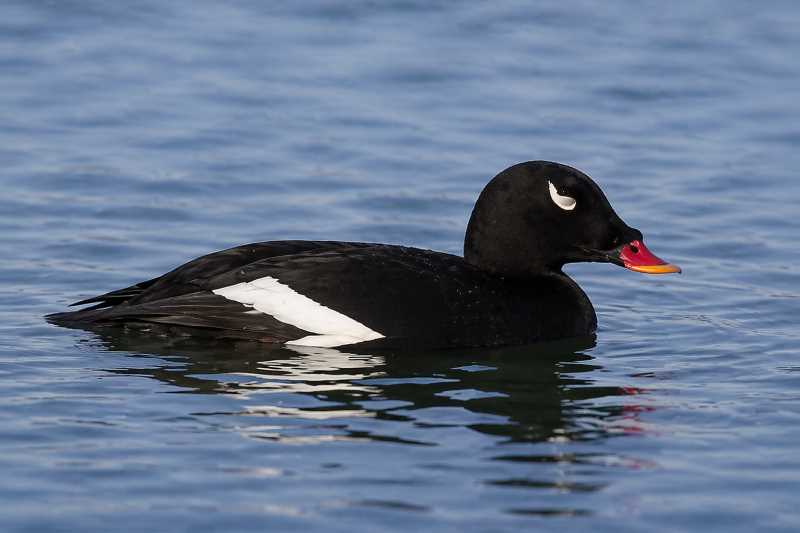
Stejneger’s Scoter is a robust diving duck with a rounded body, short tail and powerful legs. Adult males are predominantly black, with a small white post-ocular patch and a swollen orange-yellow bill. The bill profile is an important feature, with a prominent basal knob and a long, smoothly sloping forehead that can give the head a somewhat convex or “Roman-nosed” appearance.
Females are more subdued, with dark brown plumage, paler facial markings and a less conspicuous bill. Immature birds resemble females but are generally paler and less sharply marked. As in other scoters, males and females are strongly sexually dimorphic.
Range and Habitat
Stejneger’s Scoter breeds across northern and eastern Asia, from areas east of the Yenisei Basin through Siberia, the Russian Far East and Kamchatka. Its breeding range also includes parts of the Altai, Mongolia, the Lake Baikal region, the Amur area, Sakhalin and the Kuril Islands, although the western boundary and any zone of overlap with Velvet Scoter remain incompletely documented.
During winter, the species occurs mainly in shallow coastal waters, bays and estuaries. Its winter range extends south through the Kuril Islands and Japan, with smaller numbers along the eastern Russian coast, Korea and eastern China. It may also occur on large lakes and rivers. Breeding habitats include freshwater lakes, ponds and slow-moving streams in tundra and taiga landscapes.
Stejneger’s Scoter is migratory over much of its range. It forms large concentrations on suitable coastal waters during migration and winter, but records outside eastern Asia are generally uncommon or accidental.
Behaviour and Diet
Stejneger’s Scoter is a diving duck that forages by submerging in freshwater or marine habitats. Its diet includes molluscs, crustaceans, worms, echinoderms, amphipods, isopods, small fish and aquatic insects. Plant material, including leaves and shoots, may also be taken on the breeding grounds.
The species is often gregarious outside the breeding season, gathering in flocks on sheltered coastal waters. Flocks may be tightly packed and can take flight together when disturbed. It usually feeds in shallow water where benthic prey is accessible, although detailed information on its feeding rates and foraging behaviour remains limited.
Breeding takes place during the northern summer in freshwater habitats within the taiga and tundra zones. The species is less well studied than several related scoters, so published information on courtship, nesting sites, clutch size and parental care remains comparatively scarce.
Identification Tips
- Look for a dark sea duck with a heavy, mostly orange-yellow bill and a strongly swollen bill base.
- Adult males are black overall and show a small white patch behind the eye.
- The long, smoothly sloping forehead and prominent bill knob are useful clues when viewing a male in profile.
- White-winged Scoter (Melanitta deglandi) males usually have browner flanks, a less strongly swollen bill base and a more stepped transition between the bill and forehead.
- Velvet Scoter (Melanitta fusca) generally has a less prominent bill knob and less extensive white around the eye.
- Females and immature birds are difficult to identify confidently at a distance. Bill structure, head shape and the pattern of pale facial markings should be assessed together rather than relying on a single feature.
Conservation Status
Stejneger’s Scoter is currently assessed as Least Concern on the IUCN Red List. Available sources indicate that the global population is not considered to meet the thresholds for a threatened category, although population information is limited and some assessments report a decreasing trend.
Potential pressures include pollution and oil spills in coastal waters, degradation of estuaries and shallow marine feeding areas, disturbance at important sites, and climate-related changes affecting breeding, migration and wintering habitats. Conservation priorities include protecting wetlands and coastal waters, maintaining important migratory sites, reducing marine pollution and improving monitoring across the species’ range.
Frequently Asked Questions
Where does Stejneger’s Scoter live?
It breeds in northern and eastern Asia, including Siberia, Kamchatka, the Russian Far East, Sakhalin and the Kuril Islands. It winters mainly along the coasts of Japan, Korea, eastern Russia and eastern China.
Is Stejneger’s Scoter a migratory bird?
Yes. Most populations move between inland freshwater breeding areas in northern Asia and coastal wintering areas farther south, although the timing and distance of movements vary across the range.
What does Stejneger’s Scoter eat?
Its diet consists mainly of aquatic invertebrates, including molluscs and crustaceans. It also takes worms, echinoderms, insects, small fish and some plant material, particularly on the breeding grounds.
How can Stejneger’s Scoter be identified?
Adult males are black with a small white patch behind the eye and a large orange-yellow bill with a prominent basal knob. The smoothly sloping forehead and bill profile are especially useful when distinguishing it from White-winged and Velvet Scoters.
Is Stejneger’s Scoter endangered?
No. It is currently listed as Least Concern, although reliable information on population size and long-term trends is limited. Continued monitoring is important because the species depends on both northern freshwater breeding habitats and coastal wintering areas.
Was Stejneger’s Scoter once considered a different species?
Yes. It was formerly included within a broader White-winged Scoter complex. Taxonomic authorities now generally recognise Melanitta stejnegeri as a separate species from the North American White-winged Scoter, Melanitta deglandi.
References
- American Ornithologists’ Union Committee on Classification and Nomenclature. 2019. Sixtieth Supplement to the American Ornithological Society’s Check-list of North American Birds. The Auk 136(3): ukz042. https://doi.org/10.1093/auk/ukz042
- BirdLife International. n.d. Siberian Scoter (Melanitta stejnegeri) species factsheet. BirdLife DataZone. Accessed 8 September 2026. https://datazone.birdlife.org/species/factsheet/siberian-scoter-melanitta-stejnegeri
- British Trust for Ornithology. n.d. Stejneger’s Scoter (Melanitta stejnegeri). BirdFacts. Accessed 8 September 2026. https://www.bto.org/learn/about-birds/birdfacts/stejnegers-scoter
- Chen, H., Chen, Y., Wang, Z., Wu, D., Chen, P. and Chen, Y. 2024. The Complete Mitochondrial Genome of the Siberian Scoter Melanitta stejnegeri and Its Phylogenetic Relationship in Anseriformes. International Journal of Molecular Sciences 25(18): 10181. https://doi.org/10.3390/ijms251810181
- Cornell Lab of Ornithology. 2025. Stejneger’s Scoter (Melanitta stejnegeri), eBird Status and Trends, Data Version 2023. Accessed 8 September 2026. https://science.ebird.org/en/atlastw/status-and-trends/species/whwsco1/range-map
- Gill, F., Donsker, D. and Rasmussen, P. (eds.). 2025. IOC World Bird List, version 15.2. International Ornithologists’ Union. Accessed 8 September 2026. https://www.worldbirdnames.org/
- International Union for Conservation of Nature. 2026. Melanitta stejnegeri, IUCN Red List of Threatened Species. BirdLife International assessment, Least Concern. Accessed 8 September 2026. https://www.iucnredlist.org/
Related posts