Introduction
The White-tailed Emerald (Microchera chionura) is a very small hummingbird of the Talamancan highlands of Costa Rica and western Panama. It is associated with humid montane forests, forest edges, regenerating woodland, shaded plantations and gardens, particularly where flowering plants are available.
Physical Description
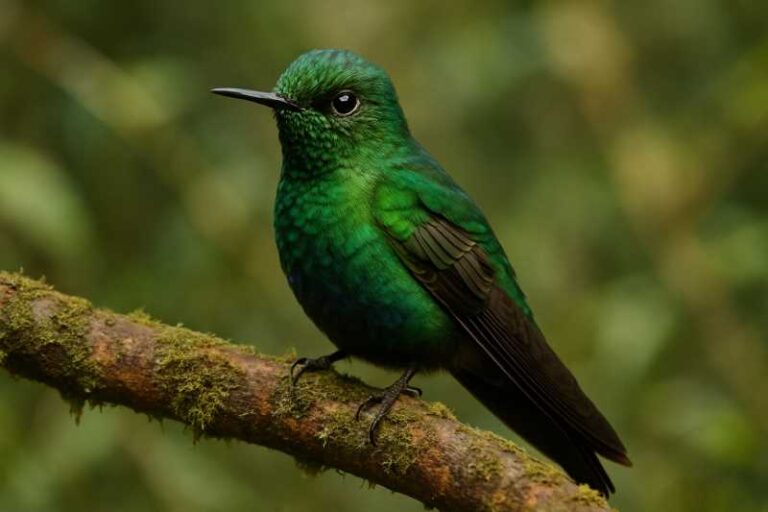
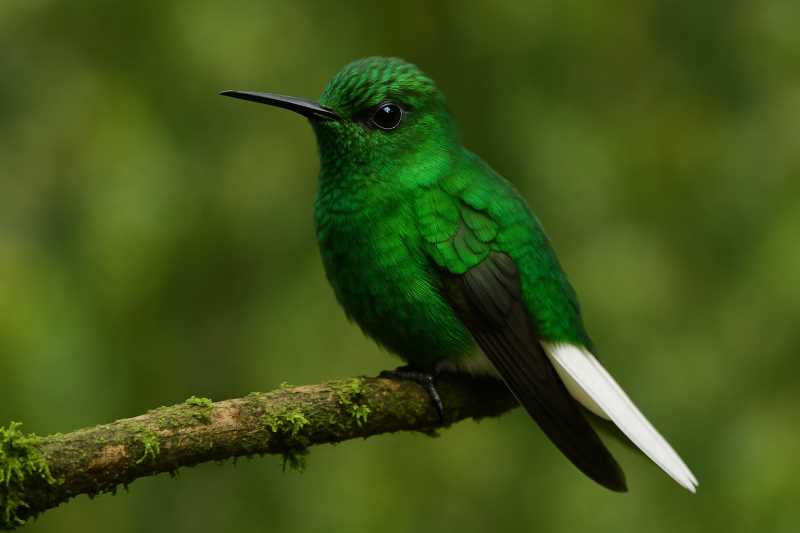
The White-tailed Emerald is a tiny, compact hummingbird with a short, straight bill and bright green plumage. The adult male has green upperparts and underparts, a bluish to violet crown, a prominent white postocular spot, a white stripe extending along the belly towards the vent, and conspicuous white outer tail feathers with black tips.
The female is less brightly coloured. She has a mostly white throat and underparts, while the outer tail feathers are white with a black subterminal band. The sexes can therefore be separated by the male’s more strongly coloured green underparts and distinctive belly stripe. Juvenile birds are generally duller than adults and may lack the full intensity of adult plumage.
Range and Habitat
The species occurs along the Pacific slope of the Talamanca mountain range from south-western Costa Rica through western Panama, reaching the Caribbean slope locally in Panama. It is generally found from about 750 to 2,000 metres above sea level, with breeding in Costa Rica reported mainly between approximately 1,000 and 1,700 metres.
White-tailed Emeralds use humid to wet montane forest, older second-growth woodland, forest edges, shaded coffee plantations and gardens. Although much of the range is mountainous, the species can occur in modified habitats when suitable vegetation and nectar sources remain available. It is considered resident rather than a long-distance migrant, although local movements may occur in response to food availability and conditions at different elevations.
Where to See This Species
Cloudbridge Nature Reserve, San Gerardo de Rivas, San José Province, Costa Rica
White-tailed Emeralds have been documented at Cloudbridge Nature Reserve through repeated observations and a published bird inventory. The reserve contains montane cloud forest, regenerating woodland and flowering gardens across the species’ known elevational range, making its public trails and garden areas realistic places to search. Early morning visits are generally most productive for hummingbirds, particularly around flowering plants and forest edges.
Nearby accommodation: San Gerardo de Rivas is the nearest practical village, with guest houses, cabins and small lodges. The larger town of San Isidro de El General provides additional hotels and other accommodation.
Behaviour and Diet
White-tailed Emeralds are active hummingbirds that usually forage alone. They hover while taking nectar from flowering plants and may also visit flowers in gardens and plantations. Like other hummingbirds, they supplement nectar with small insects and spiders, which provide protein and other nutrients.
Males may defend productive feeding areas from other hummingbirds. The species is capable of rapid, agile flight and may be difficult to follow as it moves between flowers, perches and patches of cover. Observations at Cloudbridge have also recorded White-tailed Emeralds feeding on ripe fruit, suggesting that fruit use may occasionally supplement their usual nectar-and-arthropod diet.
Identification Tips
- Look for a very small green hummingbird in humid highland forest, shaded coffee plantations, gardens or forest edges.
- The most useful field mark is the contrasting white outer tail, which has dark tips or a dark subterminal band depending on the sex.
- Adult males show green underparts, a white stripe along the belly towards the vent, a bluish to violet crown and a conspicuous white spot behind the eye.
- Females are paler below, with a mostly white throat and underparts.
- The species often hovers briefly at flowers before moving rapidly to another plant or perch.
- Do not rely on the common name alone. The tail pattern, white postocular spot and highland habitat should be assessed together because several small emerald hummingbirds occur in the same region.
Conservation Status
The White-tailed Emerald is currently classified as Least Concern on the IUCN Red List. Nevertheless, its relatively restricted range means that the loss and degradation of montane forest, agricultural expansion and development can reduce suitable habitat. Conservation depends on maintaining protected highland forests, forest connectivity, regenerating woodland and wildlife-friendly landscapes such as shaded plantations and gardens.
A reliable current population estimate and well-supported population trend should not be assumed without consulting the latest species assessment. Protecting flowering resources and reducing further fragmentation of the Talamancan montane forests remain important conservation measures.
Frequently Asked Questions
Where can the White-tailed Emerald be found?
It is found in the Talamanca highlands of south-western Costa Rica and western Panama, mainly on the Pacific slope, with local records on the Caribbean slope in Panama.
Is the White-tailed Emerald migratory?
It is generally regarded as a resident species rather than a long-distance migrant. Individuals may make local or elevational movements when food availability and weather conditions change.
What does the White-tailed Emerald eat?
Its diet consists mainly of nectar from flowering plants, supplemented by small insects and spiders. Occasional fruit-feeding has also been documented.
How can the sexes be distinguished?
Adult males have greener underparts, a white belly stripe, a bluish to violet crown and white outer tail feathers with black tips. Females are paler below and have a mostly white throat and underparts, with a dark subterminal band on the white outer tail feathers.
What is the conservation status of the White-tailed Emerald?
The species is classified as Least Concern. Its principal conservation concern is the continuing loss and degradation of humid montane forest and other suitable habitats within its restricted range.
What is the best way to look for this hummingbird?
Search flowering plants, forest edges, shaded plantations and cloud-forest gardens during the morning. Watch for a tiny green hummingbird with a strongly contrasting white outer tail, and listen for brief high-pitched calls when dense vegetation makes visual detection difficult.
References
- BirdLife International
- IUCN Red List of Threatened Species
- Cloudbridge Nature Reserve bird inventory
Related posts