Introduction
The Namaqua Dove (Oena capensis) is a small, long-tailed dove adapted to dry and semi-arid environments. It occurs widely across sub-Saharan Africa, Madagascar and parts of the Arabian Peninsula, and is often associated with open ground, sparse scrub and areas near water. The species is the only member of its genus, Oena. (doi.org)
Physical Description
The Namaqua Dove is about 22 cm long, with a slender body and an unusually long, pointed tail that makes it appear larger than its body size suggests. The plumage is mainly grey-brown above, with a pale to white belly and chestnut tones visible in the wings during flight.
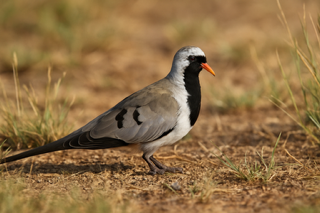
Adult males are distinctive. They have a black face, throat and upper breast, a grey crown and upperparts, and a boldly patterned bill with a reddish or orange base and darker tip. Females lack the black facial mask and are generally brownish-grey, with a softer, less contrasting pattern. Juveniles resemble females but are usually duller and more mottled, particularly on the wings and upperparts.
The long, tapered tail, small size and contrast between the dark male face and pale body are the most useful diagnostic features in the field.
Range and Habitat
The Namaqua Dove has a very broad distribution. It is found across much of sub-Saharan Africa, from the dry western regions through the Sahel and eastern Africa to southern Africa. Its range also includes Madagascar and parts of the Arabian Peninsula, with additional breeding or non-breeding records in the Middle East. The species has been recorded from sea level to approximately 1,800 metres. (doi.org)
It favours arid and semi-arid habitats, including dry savanna, open scrub, desert margins, lightly wooded country, grassland and cultivated areas. It often uses bare or sparsely vegetated ground for feeding and may occur around villages, farms, roadsides, river margins, waterholes and other places where seeds and drinking water are available.
The species is generally resident in suitable parts of its range, although local movements and seasonal wandering occur. In some regions, birds may move in response to rainfall, food availability or the presence of water.
Where to See This Species
Namaqua National Park, Northern Cape, South Africa
Namaqua National Park includes arid Succulent Karoo, coastal plain and escarpment habitats, and the park’s official bird checklist includes the Namaqua Dove. Open dry country, sparse vegetation and river valleys provide suitable places to search, particularly around roads, camps and other areas where bare ground is available. (sanparks.org)
Nearby accommodation: Kamieskroon and Springbok provide practical bases, with guest houses, hotels, self-catering accommodation and campsites available in the wider area.
Kruger National Park, Limpopo and Mpumalanga, South Africa
The Namaqua Dove is included on the official Kruger National Park bird checklist. It can be sought in open savanna, dry woodland and around water points, rest camps and picnic sites. Kruger offers extensive public birding access, although sightings can be local and seasonal. (sanparks.org)
Nearby accommodation: Visitors can stay inside the park at rest camps and bushveld camps, or use hotels, guest houses and lodges near gateways such as Phalaborwa, Hazyview, Malelane and Skukuza.
Mapungubwe National Park, Limpopo, South Africa
Mapungubwe National Park’s official bird checklist includes the Namaqua Dove. The park contains open grassland, dry shrubland, mopane and acacia woodland, as well as riverine habitats along the Limpopo. These varied habitats offer suitable places to look for a small dove feeding on open ground. (sanparks.org)
Nearby accommodation: Accommodation is available inside the park, including camps and self-catering facilities, while Musina is the main nearby town for additional guest houses, hotels and lodges.
Behaviour and Diet
Namaqua Doves usually forage on the ground, walking quickly through open areas while searching for small seeds. Their diet consists mainly of grass, sedge and weed seeds, although they may take small invertebrates opportunistically. They may also feed near cultivated land, livestock areas and water sources where food is concentrated.
They are commonly seen alone or in pairs. Outside the breeding season, several birds may gather where food or water is locally abundant, but the species is not normally highly gregarious. The flight is fast and direct, with rapid wingbeats and a tendency to fly low before settling again on the ground or in nearby vegetation.
Breeding may occur during different seasons in different parts of the range and is often associated with periods of rainfall and increased food availability. The nest is a small, flimsy platform of twigs placed in a shrub or low tree. The usual clutch is two white eggs. Both parents share incubation and care for the nestlings, which are fed crop milk during the early part of their development.
Identification Tips
- Look for a very small dove with a disproportionately long, pointed tail.
- An adult male has a conspicuous black face, throat and upper breast set against a pale grey-brown body.
- A female or juvenile is plainer and browner, without the male’s black mask.
- The bill is slender and shows reddish or orange tones near the base, with a darker tip.
- In flight, chestnut wing feathers and the long tapered tail may be more noticeable than the body pattern.
- The species is often found walking on bare ground, tracks, roadsides or sparsely vegetated areas rather than remaining high in trees.
- Its small size and long tail help distinguish it from larger doves such as the Laughing Dove, while the male’s black facial pattern separates it from most similarly sized African doves.
Conservation Status
The Namaqua Dove is currently listed as Least Concern on the IUCN Red List. Its very large geographic range and apparently increasing population trend mean that it does not currently meet the criteria for a threatened category, although the total population has not been quantified. (doi.org)
The species occurs in many protected areas and can use modified landscapes, including farms, villages and irrigated areas. Nevertheless, local populations may be affected by habitat loss, agricultural expansion, changes in water availability, drought, climate change and unsustainable capture or trade. Maintaining dryland habitats, natural vegetation around water sources and connected protected areas remains important for the species and other arid-zone birds.
Frequently Asked Questions
Where does the Namaqua Dove live?
The Namaqua Dove lives across much of sub-Saharan Africa, as well as Madagascar and parts of the Arabian Peninsula. It favours dry savanna, scrub, desert margins, lightly wooded areas and open cultivated landscapes.
How can you identify a male Namaqua Dove?
An adult male has a black face, throat and upper breast, a grey-brown body, a reddish-based bill and a long, pointed tail. Chestnut wing feathers may be visible when the bird flies.
What does the Namaqua Dove eat?
It feeds mainly on small seeds from grasses, sedges and weeds. It usually searches for food while walking across bare or sparsely vegetated ground.
Is the Namaqua Dove migratory?
The species is generally resident, but local movements and seasonal wandering occur. Birds may move in response to rainfall, food supplies and the availability of water.
Where can I see a Namaqua Dove in South Africa?
Reliable public viewing locations include Namaqua National Park, Kruger National Park and Mapungubwe National Park. In each area, search open dry habitats, roadsides, camps, water points and other places with sparse ground cover.
Is the Namaqua Dove endangered?
No. The Namaqua Dove is currently classified as Least Concern, although local threats such as habitat degradation, drought, water scarcity and capture may still affect regional populations.
References
- BirdLife International and IUCN Red List of Threatened Species
- IOC World Bird List
- South African National Parks
Related posts