Introduction
The Barred Owlet-nightjar (Aegotheles bennettii) is a small, secretive nocturnal bird of New Guinea. It belongs to the owlet-nightjar family, Aegothelidae, and is most often encountered in humid forest, where its cryptic plumage and habit of roosting in tree cavities make it difficult to detect. Current taxonomic treatments place the species in New Guinea and nearby islands, rather than in northern Australia. The Australian owlet-nightjar, Aegotheles cristatus, is a separate species.
Physical Description
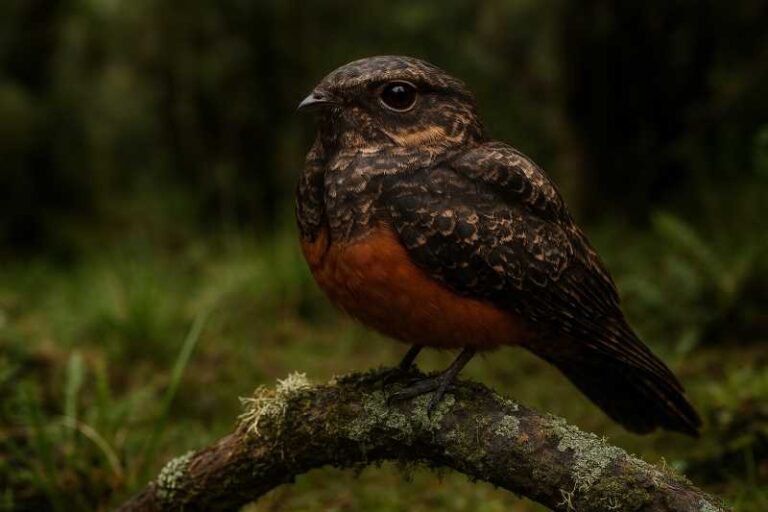
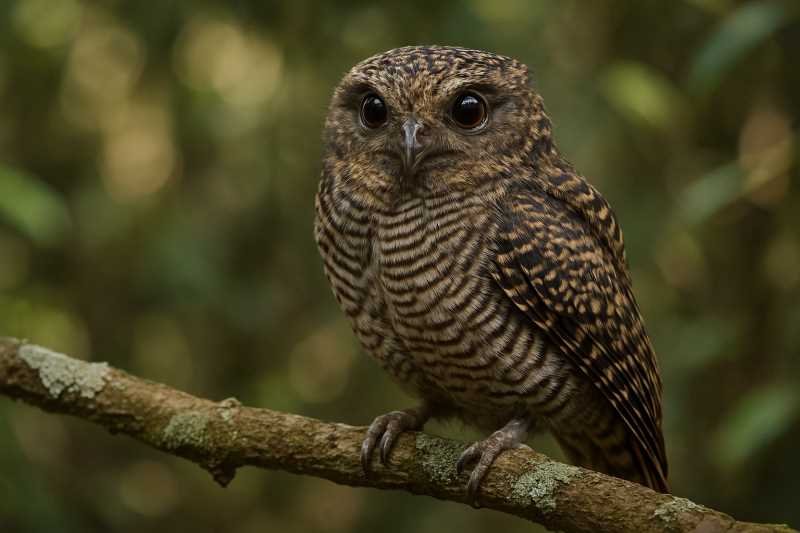
The Barred Owlet-nightjar is approximately 20–23 centimetres long and weighs about 45–47 grams. It has a compact body, a large head, short tail and broad, rounded wings. The tiny bill is surrounded by bristle-like feathers that are characteristic of owlet-nightjars.
The upperparts are dark greyish-brown to brown, with fine pale vermiculation and mottling. The underparts are paler, generally whitish-buff or greyish-buff, with darker barring and spots. Broad pale markings above the eyes contribute to its distinctive facial pattern. The sexes are similar in size and plumage. Reliable information on juvenile plumage and age-related variation remains limited.
Range and Habitat
The Barred Owlet-nightjar occurs across parts of New Guinea, including northern and south-eastern areas, and on islands in the D’Entrecasteaux Archipelago. It is associated mainly with tropical moist lowland and hill forests, including rainforest, monsoon forest and forest edges.
The species has been recorded from sea level to approximately 1,100 metres, although the nominate form is generally recorded below about 800 metres. Its distribution follows suitable forest habitat, and it is regarded as a resident rather than a regular long-distance migrant. Several geographically distinct forms have been described, and the taxonomy of some New Guinea owlet-nightjar populations has changed as genetic and field evidence has improved.
Where to See This Species
Varirata National Park, Central Province, Papua New Guinea
Varirata National Park, in the forested hills south-east of Port Moresby, is one of the most reliable publicly accessible locations for the Barred Owlet-nightjar. The species has been documented there repeatedly, including individuals roosting in natural tree holes. Look in mature forest and along forest tracks near suitable hollow trees, particularly during quiet evening or early-morning birding sessions. The bird is usually difficult to find unless a roosting cavity is already known.
Nearby accommodation: Port Moresby is the practical gateway, with hotels, guest houses and other visitor accommodation. Local guides are advisable because access, security and park conditions can vary.
Behaviour and Diet
The Barred Owlet-nightjar is primarily nocturnal, with activity beginning around dusk and continuing through the night. During the day it commonly roosts in a tree cavity, although a bird may occasionally rest on an exposed branch. When disturbed, it can leave the cavity abruptly and fly into dense vegetation.
It is believed to feed mainly on insects and other small arthropods. Detailed, species-specific observations of its foraging behaviour are scarce, but owlet-nightjars generally capture prey during short flights from a perch or while flying through the forest understorey and lower canopy.
Its vocal behaviour is poorly documented compared with that of many more conspicuous nocturnal birds. Calls may be heard at night, but locating a calling bird can be difficult because the species is quiet and highly secretive.
Breeding information is limited. A nest has been recorded in a dead tree trunk, and the known clutch consisted of two white eggs. Records of nesting females and recently fledged young indicate breeding activity in different parts of New Guinea during the September-to-December period, but the full breeding season, incubation period and length of parental care are not well established.
Identification Tips
- Look for a small, compact nocturnal bird with a large head, tiny bill and broad, rounded wings.
- The combination of dark, finely mottled upperparts and pale underparts marked with darker bars is characteristic.
- Pale eyebrow markings and the bird’s tendency to sit upright at the entrance of a tree hole can be useful clues.
- A roosting bird may be visible only as a face or pair of dark eyes inside a cavity.
- Do not confuse it with the Australian Owlet-nightjar, Aegotheles cristatus. That species occurs in Australia and has a different distribution and generally more open-woodland associations.
- Other New Guinea owlet-nightjars may overlap locally, so geographic range, habitat, plumage pattern and the exact appearance of the facial markings should all be considered together.
Conservation Status
The Barred Owlet-nightjar is currently classified as Least Concern on the IUCN Red List. Its broad distribution and the persistence of substantial areas of suitable forest mean that it is not presently considered globally threatened. However, the species is difficult to survey, and its population size and long-term trend are not well quantified.
Forest clearance, logging and agricultural expansion can reduce the mature forest and tree cavities on which the species depends. Protecting lowland and hill forests, retaining old trees and improving knowledge of the species’ distribution and breeding biology are important conservation measures.
Frequently Asked Questions
Where does the Barred Owlet-nightjar live?
It lives in New Guinea and nearby islands, mainly in humid lowland, hill and foothill forests, including rainforest, monsoon forest and forest edges.
Is the Barred Owlet-nightjar found in Australia?
No. The Barred Owlet-nightjar is a New Guinea species. Reports of an owlet-nightjar in northern Australia usually refer to the separate Australian Owlet-nightjar, Aegotheles cristatus.
What does the Barred Owlet-nightjar eat?
It is considered primarily insectivorous and probably feeds on insects and other small arthropods. Detailed observations of its diet and hunting technique are limited.
Where does the Barred Owlet-nightjar roost?
It commonly roosts during the day in natural tree cavities, including holes in dead trunks. It may occasionally rest on an exposed branch.
How can the Barred Owlet-nightjar be identified?
Look for a small, darkly mottled bird with pale, barred underparts, a large head, a tiny bill and noticeable pale eyebrow markings. A bird peering from a tree hole is especially characteristic.
Is the Barred Owlet-nightjar endangered?
It is currently assessed as Least Concern. Nevertheless, local populations may be affected by the loss and degradation of mature forest, and more research is needed because the species is poorly known.
References
- BirdLife International
- IOC World Bird List
- Macaulay Library
Related posts