The White-spotted Flufftail: A Hidden Jewel of the African Understory
The avian world is replete with a plethora of fascinating species that captivate both ornithologists and birdwatchers alike. Among these, the White-spotted Flufftail (Sarothrura pulchra) stands out as a particularly intriguing bird due to its elusive nature and striking appearance. This article delves into the various aspects of the White-spotted Flufftail, exploring its habitat, behavior, conservation status, and the efforts being made to study and protect this remarkable species.
Taxonomy and Description
The White-spotted Flufftail is a member of the Sarothruridae family, a group of birds commonly referred to as the flufftails. The scientific name, Sarothrura pulchra, aptly describes its appearance, with ‘Sarothrura’ derived from Greek words meaning ‘tail’ and ‘broom’, and ‘pulchra’ signifying ‘beautiful’ in Latin. This nomenclature reflects the bird’s exquisite plumage and distinctive tail feathers.
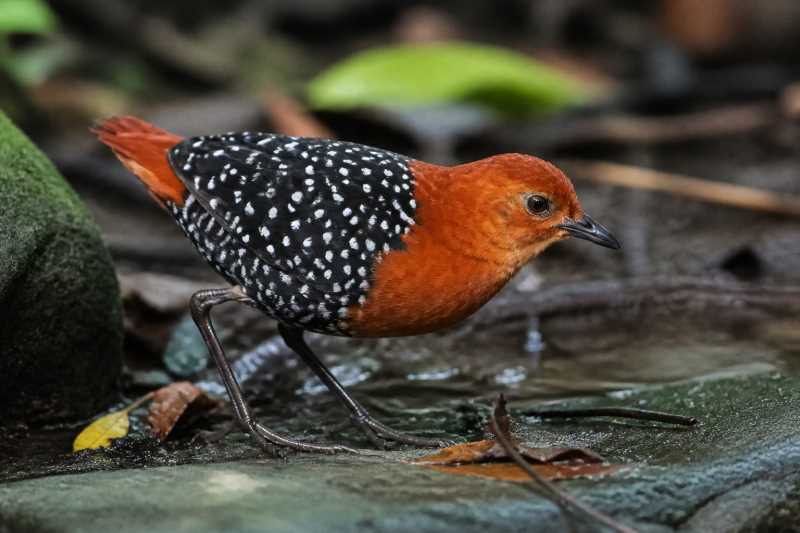
Adult White-spotted Flufftails are small, measuring about 17-19 cm in length, with a wingspan that is proportionally short, characteristic of birds that dwell in dense undergrowth. The male is particularly striking, with a rich, rufous-chestnut body, adorned with numerous white spots, particularly on its wings and back. The female, while less vividly colored, is equally beautiful, featuring a more subdued rufous coloration with similar spotting.
Habitat and Distribution
The White-spotted Flufftail is primarily found in the tropical rainforests of sub-Saharan Africa. Its range extends across several countries, including Gabon, Cameroon, the Democratic Republic of Congo, and Uganda, among others. These birds prefer dense, humid forest environments where they can conceal themselves among the thick undergrowth and leaf litter.
Their preference for such habitats makes them challenging to study, as they are adept at remaining unseen. The flufftail’s elusive nature is exacerbated by its preference for remaining low to the ground, rarely taking to the air except when absolutely necessary. This behavior is an adaptation to their environment, where staying hidden from predators is a crucial survival strategy.
Behavior and Ecology
White-spotted Flufftails are known for their secretive and solitary behavior. They are primarily terrestrial, foraging for insects, small invertebrates, and seeds within the forest floor. Their diet is supplemented by occasional snails and small amphibians, which they capture using their sharp beaks.
These birds are also known for their distinctive vocalizations, which are more often heard than the birds are seen. The male flufftail’s call is a series of low, resonant hoots, which can be heard echoing through the forest. This call plays a crucial role in territory establishment and mate attraction.
Breeding in White-spotted Flufftails occurs during the rainy season when resources are abundant. They build their nests close to the ground, often hidden among dense vegetation to protect the eggs and chicks from predators. The female typically lays a clutch of 3-5 eggs, with both parents sharing the incubation duties.
Conservation Status
The White-spotted Flufftail is currently listed as Least Concern on the IUCN Red List. However, like many forest-dwelling species, it faces threats from habitat destruction due to logging, agriculture, and human encroachment. These activities lead to fragmentation of their habitat, which can have deleterious effects on their populations.
Conservation efforts are crucial to ensure the survival of this species. Protecting large swathes of forest habitat and promoting sustainable land-use practices are essential strategies. Additionally, raising awareness about the importance of the White-spotted Flufftail and its ecosystem can garner support for conservation initiatives.
Research and Study
Studying the White-spotted Flufftail poses significant challenges due to its secretive nature and the dense environments it inhabits. Researchers often rely on auditory surveys to detect the presence of these birds, using their distinctive calls as indicators of their presence. Advances in technology, such as remote sensing and camera traps, have also facilitated more in-depth studies of their behavior and ecology.
Continued research is important for understanding the ecological role of the White-spotted Flufftail within its environment. By studying its interactions with other species and its response to environmental changes, scientists can better predict how these birds might adapt to future challenges.
Conclusion
The White-spotted Flufftail is a testament to the biodiversity and complexity of African rainforests. Its elusive nature and captivating appearance make it a species of great interest to ornithologists and bird enthusiasts. While currently not endangered, the bird faces ongoing threats from habitat destruction and fragmentation. Through concerted conservation efforts and continued research, we can ensure that the White-spotted Flufftail remains a vibrant part of Africa’s natural heritage.
References
- BirdLife International. (2021). Species factsheet: Sarothrura pulchra. Retrieved from BirdLife International
- IUCN Red List of Threatened Species. (2021). Sarothrura pulchra. Retrieved from IUCN Red List
- Sinclair, I., & Ryan, P. (2010). Birds of Africa South of the Sahara. Princeton University Press.
- Urban, E.K., Fry, C.H., & Keith, S. (1986). The Birds of Africa. Academic Press.
Related posts