The Enigmatic White-crowned Cuckoo: A Comprehensive Overview
The White-crowned Cuckoo (Caliechthrus leucolophus) is a remarkable bird that has captivated ornithologists and birdwatchers alike with its distinctive appearance and fascinating behaviors. Belonging to the family Cuculidae, the White-crowned Cuckoo is a lesser-known species that offers a wealth of interest due to its unique ecological interactions and elusive nature. This article delves into the various aspects of this intriguing bird, including its physical characteristics, habitat, behavior, and conservation status.
Physical Characteristics
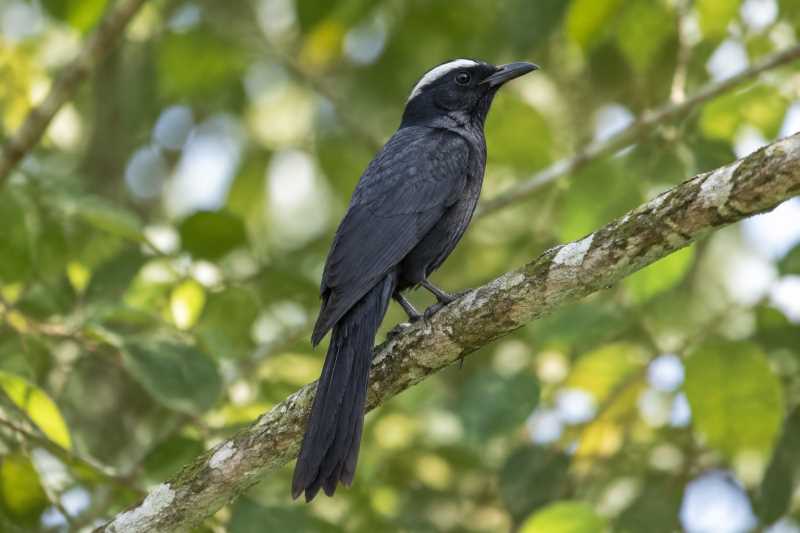
The White-crowned Cuckoo is easily recognizable due to its striking plumage and distinctive features. Adult individuals exhibit a sleek body with a length ranging from 35 to 40 centimeters. One of the most prominent features of this species is its white crown, which starkly contrasts with its otherwise dark plumage. The bird’s upperparts are predominantly dark brown or black, while the underparts are lighter, often displaying a pale or rufous hue.
The cuckoo’s long tail and wings are adapted for agile flight, aiding in its ability to navigate through dense forest canopies. Its beak is slightly curved, an adaptation that assists in foraging for insects and small invertebrates. The species also exhibits sexual dimorphism, with males typically larger and more vibrantly colored than females.
Habitat and Distribution
The White-crowned Cuckoo inhabits the lush, tropical rainforests of Southeast Asia. Its range extends from the Malay Peninsula, through the Indonesian archipelago, to parts of New Guinea. These birds are highly adapted to life in the dense forest canopy, where they spend the majority of their time.
The species favors lowland and montane forests, often found at elevations ranging from sea level to 1,500 meters. The availability of suitable habitat is crucial for the cuckoo’s survival, as it relies heavily on the forest’s insect population for sustenance.
Behavior and Ecology
The White-crowned Cuckoo is known for its elusive behavior, often remaining hidden among the dense foliage of the forest canopy. This bird is primarily solitary, though it may be seen in small family groups during the breeding season.
One of the most fascinating aspects of the White-crowned Cuckoo’s behavior is its reproductive strategy. Like many cuckoos, it is a brood parasite, laying its eggs in the nests of other bird species. This strategy allows the cuckoo to avoid the costs of raising its own young, leaving the host species to care for the cuckoo chick. The host species are often smaller passerine birds, which are tricked into raising the larger and more demanding cuckoo chick.
Despite its brood parasitism, the White-crowned Cuckoo plays a vital role in its ecosystem. As an insectivore, it helps control insect populations, contributing to the ecological balance within its habitat.
Vocalizations
The vocalizations of the White-crowned Cuckoo are another point of interest. The species is known for its distinctive calls, which range from a series of melodious whistles to harsh, repetitive notes. These calls are primarily used during the breeding season, serving as a means of communication between potential mates and as a territorial display.
Conservation Status
Currently, the White-crowned Cuckoo is classified as Least Concern by the International Union for Conservation of Nature (IUCN). However, like many bird species that inhabit tropical rainforests, it faces threats from habitat destruction and fragmentation. Deforestation for agriculture, logging, and infrastructure development poses significant challenges to the preservation of its natural habitat.
Conservation efforts are essential to ensure the survival of the White-crowned Cuckoo. Protecting large areas of intact forest is crucial, as is promoting sustainable land-use practices that minimize habitat loss. Furthermore, raising awareness of the cuckoo’s ecological role can foster a greater appreciation and drive conservation initiatives.
Conclusion
The White-crowned Cuckoo (Caliechthrus leucolophus) is a fascinating example of avian adaptation and ecological interaction. Its unique characteristics, behavior, and the challenges it faces highlight the importance of conservation efforts in preserving the biodiversity of tropical rainforests. As we continue to study and understand this enigmatic bird, we gain valuable insights into the complex web of life that sustains our planet.
By appreciating and protecting species like the White-crowned Cuckoo, we contribute to the broader goal of conserving the natural world for future generations.
Related posts