Introduction
The Blue-eyed Spotted Cuscus (Spilocuscus wilsoni) is a captivating marsupial that has captured the attention of wildlife enthusiasts and researchers alike. Native to the lush rainforests of Indonesia, this unique species is renowned for its striking blue eyes and distinctively patterned fur. As a member of the Phalangeridae family, the Blue-eyed Spotted Cuscus is closely related to other cuscuses and possums, yet it stands out due to its remarkable appearance and elusive nature.
The discovery of the Blue-eyed Spotted Cuscus is relatively recent, with its classification as a distinct species occurring only in the early 21st century. Consequently, there remains much to learn about this intriguing mammal, from its ecological role in the rainforest ecosystem to its behavior and reproductive habits. In this comprehensive article, we will explore various aspects of the Blue-eyed Spotted Cuscus, providing valuable insights into its physical characteristics, habitat, diet, and conservation status.
Physical Description
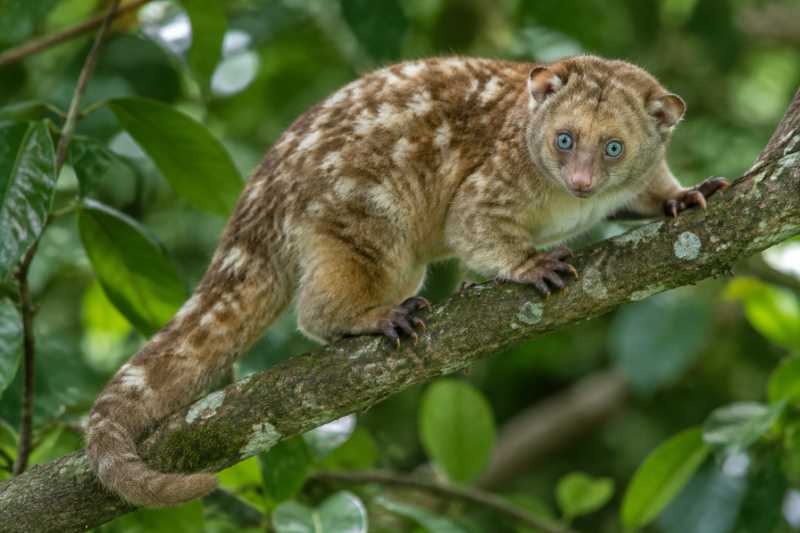
The Blue-eyed Spotted Cuscus is a medium-sized marsupial, with an average length of 50 to 60 centimeters and a weight ranging from 3 to 5 kilograms. One of the most distinguishing features of this species is its vibrant blue eyes, which are a rarity among mammals and contribute to its distinctive appearance. The fur of the Blue-eyed Spotted Cuscus is another prominent feature, characterized by a creamy white base color adorned with irregular brown or reddish spots. This unique coloration serves as effective camouflage in the dappled light of the rainforest canopy.
The cuscus possesses a prehensile tail, which is essential for grasping branches and navigating the arboreal environment. The tail is covered with short fur at the base, transitioning to a bare, tactile surface towards the tip, enhancing its grip. The limbs of the Blue-eyed Spotted Cuscus are muscular and equipped with sharp claws, enabling it to climb effortlessly and forage for food.
Range and Habitat
The Blue-eyed Spotted Cuscus is endemic to the tropical rainforests of the Biak-Supiori archipelago in Papua, Indonesia. This region is characterized by a humid climate, with dense, multi-layered forest canopies that provide an ideal habitat for arboreal mammals. The cuscus is primarily found in lowland and hill forests, where it occupies the upper canopy layers. These forests offer a rich diversity of plant and animal life, supporting the cuscus’s dietary and ecological requirements.
Due to its limited geographic range, the Blue-eyed Spotted Cuscus is susceptible to habitat loss and fragmentation, driven by human activities such as logging and agricultural expansion. Efforts to conserve and protect these vital habitats are crucial for the survival of this species.
Behavior and Diet
The Blue-eyed Spotted Cuscus is predominantly nocturnal, spending the daylight hours resting in the safety of tree hollows or dense foliage. At night, it becomes active, foraging for food in the upper canopy. Its diet is primarily herbivorous, consisting of leaves, fruits, flowers, and occasionally small insects. The cuscus plays a vital role in seed dispersal, as it consumes a variety of fruits and excretes the seeds, facilitating the regeneration of the rainforest.
Social behavior in the Blue-eyed Spotted Cuscus is not well-documented, but it is generally considered to be solitary, with individuals maintaining defined home ranges. Breeding is thought to occur year-round, with females giving birth to a single joey that remains in the pouch for several months before transitioning to riding on the mother’s back.
Identification Tips (Field Recognition Cues)
Identifying the Blue-eyed Spotted Cuscus in the wild can be challenging due to its elusive nature and the dense rainforest habitat it occupies. However, there are several key features that can aid in its recognition:
- Eye Color: Look for the striking blue eyes, which are a unique characteristic of this species.
- Fur Pattern: Note the creamy white fur with irregular brown or reddish spots that provide effective camouflage among the leaves.
- Tail: Observe the prehensile tail, which is often seen curled around branches for support.
- Behavior: Since they are nocturnal, the best time to spot them is at night when they are active and foraging.
Conservation Status (With Threats and Protections)
The Blue-eyed Spotted Cuscus is currently classified as Vulnerable on the IUCN Red List of Threatened Species. The primary threats to its survival are habitat loss and fragmentation, resulting from deforestation for timber extraction, agricultural development, and human settlement expansion. Climate change also poses a long-term threat, potentially altering the delicate balance of the rainforest ecosystem.
Conservation efforts are underway to protect the natural habitat of the Blue-eyed Spotted Cuscus, including the establishment of protected areas and initiatives to promote sustainable land-use practices. Raising awareness about the species and its ecological importance is essential to garner support for these conservation measures.
Frequently Asked Questions
What is the Blue-eyed Spotted Cuscus’s natural habitat? The Blue-eyed Spotted Cuscus is native to the rainforests of the Biak-Supiori archipelago in Papua, Indonesia. It thrives in the dense, humid canopy of these tropical forests.
Why are the Blue-eyed Spotted Cuscus’s eyes blue? The blue eyes of the Blue-eyed Spotted Cuscus are a rare trait among mammals and contribute to its unique appearance. While the exact reason for this eye color is not fully understood, it may be an adaptation to its environmental conditions.
How does the Blue-eyed Spotted Cuscus contribute to its ecosystem? The Blue-eyed Spotted Cuscus plays a vital role in seed dispersal within the rainforest ecosystem. By consuming a variety of fruits and excreting the seeds, it aids in the regeneration and biodiversity of its habitat.
What are the main threats to the Blue-eyed Spotted Cuscus? The primary threats to the Blue-eyed Spotted Cuscus include habitat loss due to deforestation, agricultural expansion, and climate change, which together threaten its survival and the integrity of its ecosystem.
Can the Blue-eyed Spotted Cuscus be found outside Indonesia? Currently, the Blue-eyed Spotted Cuscus is endemic to the Biak-Supiori archipelago in Papua, Indonesia, and is not naturally found outside this region.
Related posts