Introduction
The White-crested Coquette (Lophornis adorabilis) is a very small hummingbird of the family Trochilidae. It is endemic to the Pacific slope of Costa Rica and adjacent western Panama, where it inhabits forest edges, clearings, gardens and other flowering habitats. Its restricted range and striking sexual dimorphism make it a sought-after species for birdwatchers.
Physical Description
The White-crested Coquette measures about 7 cm in length and weighs approximately 2.7 g. It has a short bill, a compact body, rounded wings and a noticeably rufous lower body and tail. A narrow white band across the rump is an important field mark in both sexes.
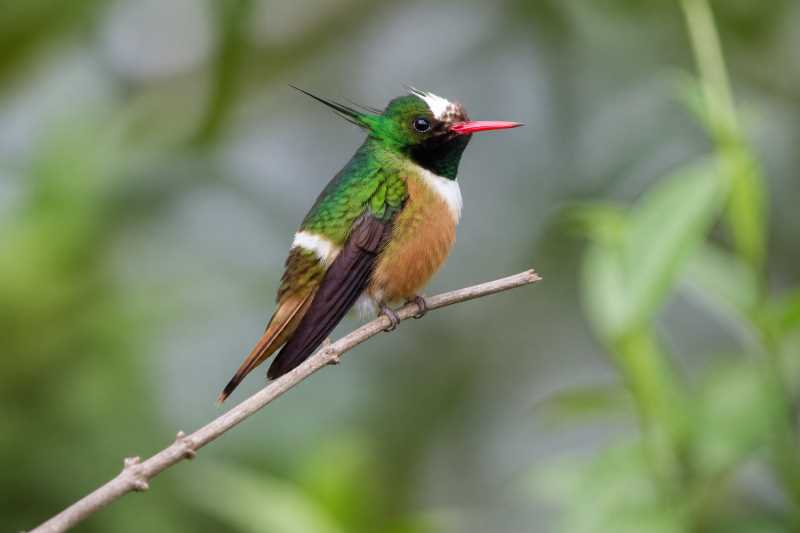
The adult male is distinctive. Its upperparts are bronze-green, the forehead is coppery, and the crown bears a conspicuous white crest. Elongated feathers on the cheeks and sides of the head add to its ornate appearance. The throat is iridescent green, the upper breast is white, and the lower breast, belly and undertail are largely rufous. The tail is also predominantly rufous, with darker markings on the central feathers.
The female lacks the white crest and elongated cheek feathers. She is generally duller, with bronze-green upperparts, a white throat that may be lightly spotted with green, and rufous lowerparts and tail. Immature birds resemble females and may be difficult to sex until the male’s adult head ornaments develop.
Range and Habitat
The White-crested Coquette occurs in Costa Rica and western Panama, particularly in the Pacific lowlands and foothills. It is a regional endemic rather than a widespread Central American hummingbird.
It uses humid forest, secondary woodland, forest margins, clearings, gardens and flowering vegetation in settled landscapes. The species is often associated with foothill and mid-elevation habitats, although it may also occur at lower elevations where suitable flowering plants are available. It commonly forages in the canopy but can descend to forest edges and gardens.
The species is not regarded as a regular long-distance migrant. Local movements may occur as birds follow flowering plants and changing food availability.
Where to See This Species
Wilson Botanical Garden and Las Cruces Biological Station, San Vito, Puntarenas, Costa Rica
The Wilson Botanical Garden and adjoining Las Cruces Biological Station are recognised sites for the White-crested Coquette. The gardens contain extensive tropical plantings and flowering shrubs at approximately 1,200 metres, while the surrounding protected forest provides additional habitat. The species is included in regional visitor information for the area and is most likely to be found around flowering vegetation and forest edges.
Nearby accommodation: San Vito is the practical gateway, with guest houses, small hotels, lodges and self-catering accommodation in and around town.
Carara National Park, Puntarenas, Costa Rica
Carara National Park supports humid forest, secondary growth and forest-edge habitat on Costa Rica’s central Pacific slope. The White-crested Coquette is included in documented bird lists for the park, and sightings have been reported around open areas and flowering vegetation, including near visitor facilities. Early morning is the best time to search for active hummingbirds.
Nearby accommodation: Tárcoles and Jacó provide the main accommodation bases, including hotels, guest houses, lodges and self-catering options.
Esquinas Rainforest Lodge and Piedras Blancas National Park, Puntarenas, Costa Rica
The Esquinas Rainforest Lodge bird list documents the White-crested Coquette in the Piedras Blancas area. The site combines lowland rainforest, forest margins, gardens and flowering plants, offering suitable habitat for a species that often moves between forest and open feeding areas.
Nearby accommodation: Golfito is the nearest recognised gateway, with hotels, guest houses, rainforest lodges and other accommodation serving visitors to Piedras Blancas National Park.
Behaviour and Diet
The White-crested Coquette feeds mainly on nectar, especially in flowering trees and shrubs. It usually forages in the canopy but may visit flowers at lower levels along forest edges, in clearings and in gardens. Like other hummingbirds, it can hover while feeding and also takes small insects and spiders, which provide protein and other nutrients.
Males defend small display areas and perform aerial courtship displays near females. Displays may include hovering, rapid movements and short flights that reveal the white crest, iridescent throat and cheek feathers. The species is generally seen alone rather than in large groups, although several individuals may gather temporarily where flowering plants are abundant.
The female builds the nest and provides the parental care. The nest is a small cup made from plant down and other fine fibres, bound with spider silk and camouflaged with lichen. Two eggs are normally laid. The female incubates the eggs and feeds the nestlings after hatching.
Identification Tips
- Look for a tiny hummingbird with a conspicuous white band across the rump and a largely rufous tail and lower body.
- Adult males are unmistakable when seen well: the white crown crest, green throat, coppery forehead and elongated cheek feathers are diagnostic.
- Females and immature birds are more subdued. Focus on the white rump band, rufous lowerparts, pale throat and small size.
- The species may be confused with other coquettes, particularly where ranges overlap. The combination of a white crest in adult males, a white rump band and extensive rufous on the belly and tail helps separate it from the Black-crested Coquette and Rufous-crested Coquette.
- Search flowering shrubs and forest edges, but also scan the canopy, where the species may spend much of its feeding time.
Conservation Status
The White-crested Coquette is assessed as Least Concern on the IUCN Red List. It has a restricted distribution, but it remains present across a substantial area of suitable habitat in Costa Rica and western Panama.
Habitat loss and fragmentation caused by agricultural expansion, logging and development remain potential local threats, particularly where forest edges and flowering resources are removed. Protected areas, biological stations, private reserves and wildlife-friendly gardens help retain habitat. Maintaining native vegetation and connected forest in the species’ range is an important conservation measure.
Frequently Asked Questions
Where is the White-crested Coquette found?
It is found in Costa Rica and adjacent western Panama, mainly on the Pacific slope and in foothill habitats with forest, clearings and flowering vegetation.
How can you identify a male White-crested Coquette?
The adult male has a bright white crown crest, elongated cheek feathers, a green iridescent throat, bronze-green upperparts, a white rump band and rufous lowerparts and tail.
How is the female different from the male?
The female lacks the white crest and cheek feathers. She is duller overall, with a lightly spotted pale throat, bronze-green upperparts and rufous lowerparts and tail.
What does the White-crested Coquette eat?
It feeds mainly on nectar from flowering plants and supplements its diet with small insects and spiders.
Is the White-crested Coquette migratory?
It is not known as a regular long-distance migrant. Local movements may follow flowering plants and changes in food availability.
Is the White-crested Coquette endangered?
No. The species is currently assessed as Least Concern, although habitat loss and fragmentation can affect local populations.
References
- BirdLife International
- IUCN Red List of Threatened Species
- Costa Rican Tourism Institute
Related posts