Understanding the Rhinoceros Auklet: A Unique Seabird of the Northern Pacific
The Rhinoceros Auklet (Cerorhinca monocerata) is a fascinating and distinctive seabird that belongs to the Alcidae family, which also includes puffins and murres. Despite its name, the Rhinoceros Auklet is more closely related to puffins than to true auklets. This bird is notable for its unique appearance and intriguing behaviors, making it an interesting subject for ornithologists and bird enthusiasts alike.
Appearance and Identification
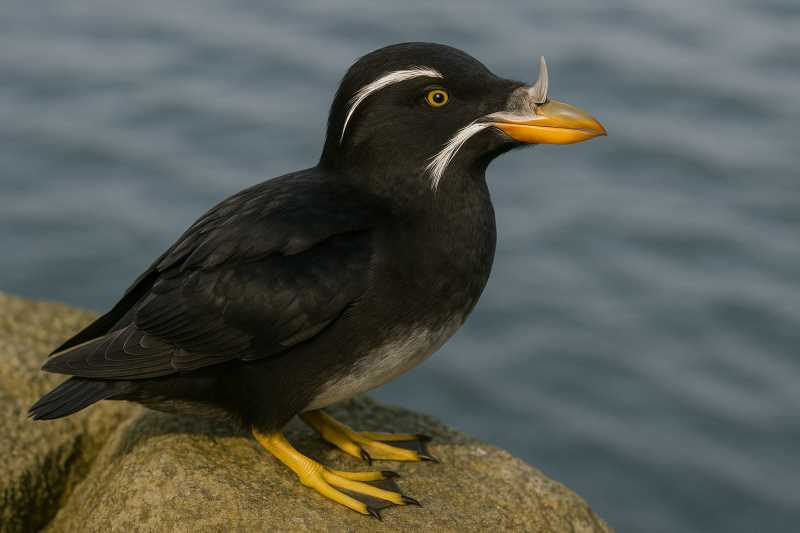
The Rhinoceros Auklet is medium-sized, measuring approximately 30 to 35 centimeters in length with a wingspan of 50 to 60 centimeters. One of its most distinctive features is the "horn" that develops on its bill during the breeding season, which resembles a rhinoceros horn and gives the bird its name. This horn is a keratinous structure that is shed after the breeding season, and its exact purpose is still not entirely understood, although it may play a role in mate attraction or identification.
The bird’s plumage is primarily dark gray or brown with a paler belly, and it has bright orange feet that stand out against its muted body colors. During the breeding season, Rhinoceros Auklets also develop white facial plumes, adding to their distinctive look.
Habitat and Distribution
Rhinoceros Auklets are found along the North Pacific Ocean, with breeding colonies located from California in the United States to the Aleutian Islands in Alaska, and across to Japan and Korea in Asia. They are pelagic birds, spending most of their non-breeding time at sea, often far from land.
These birds prefer nesting in burrows on coastal islands, where they can avoid predators and access abundant marine food resources. The burrows are often dug into soft soil or sand, and they provide a safe environment for raising chicks.
Feeding and Diet
Rhinoceros Auklets are primarily piscivorous, meaning their diet consists largely of fish. They are adept divers, using their wings to swim underwater in pursuit of prey such as sand lance, herring, and anchovies. They can dive to depths of over 50 meters, staying submerged for up to a minute as they hunt.
In addition to fish, they also consume small invertebrates like krill and squid, especially during the breeding season when they need to provide a rich diet for their chicks.
Breeding and Behavior
Breeding season for Rhinoceros Auklets typically begins in early spring. They are monogamous birds, often returning to the same burrow with the same mate year after year. The female usually lays a single egg, which both parents incubate for about 45 days. Once hatched, the chick is fed by both parents and remains in the burrow until it fledges at about 50 days old.
Rhinoceros Auklets are known for their nocturnal habits during the breeding season, likely as a strategy to avoid predation. They return to their burrows under the cover of darkness and are most active at night, which is a behavior not commonly seen in many other seabird species.
Conservation Status
Currently, the Rhinoceros Auklet is classified as Least Concern by the International Union for Conservation of Nature (IUCN). However, like many seabirds, it faces threats from habitat disturbance, oil spills, and climate change, which can affect food availability. Conservation efforts are focused on protecting breeding habitats and monitoring population trends to ensure this unique bird remains a vibrant part of the marine ecosystem.
Conclusion
The Rhinoceros Auklet is a remarkable seabird with unique adaptations that allow it to thrive in the challenging environments of the North Pacific. Its distinctive appearance, fascinating behaviors, and ecological role make it a subject of ongoing interest for scientists and conservationists. By understanding and protecting the habitats on which these birds depend, we can help ensure that the Rhinoceros Auklet continues to be a part of our natural heritage for generations to come.
Related posts