Introduction
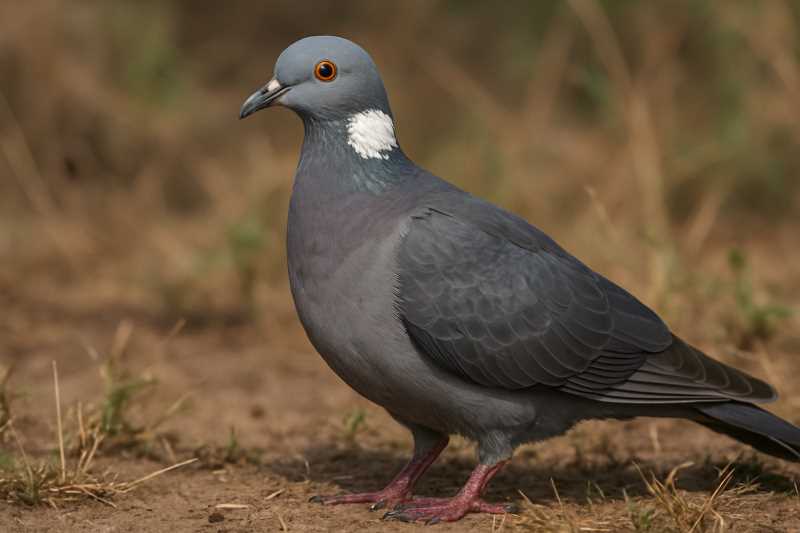
The White-collared Pigeon (Columba albitorques) is a resident pigeon of the Ethiopian Highlands in Ethiopia and Eritrea. It is recognised by its dark slate-grey plumage, conspicuous white hindcollar and white wing patch. The species is particularly associated with rocky highlands, cultivated landscapes, villages and towns.
Physical Description
The White-collared Pigeon is a medium-sized, robust pigeon measuring approximately 28–31 cm in length. Adults are mainly slate-grey to grey-brown, with a darker head and a sharply contrasting white band across the hindneck. In flight, the white primary coverts form a noticeable white patch on the upper wing, while the secondary wing-coverts may show some dark chequering.
The sexes are alike in overall appearance. Young birds are duller and may show pale edging on the crown and other feathers, making the white collar less sharply defined than in adults. The bill and feet are relatively small compared with the bird’s stocky body.
Range and Habitat
The species has a restricted range in the highlands of Ethiopia and Eritrea. It is a resident rather than a long-distance migrant, although birds may move locally between high roosting sites and lower feeding areas during the day.
White-collared Pigeons generally occur above about 1,800 metres, with records extending to more than 4,000 metres in Ethiopia. They use a wide range of highland habitats, including:
- Rocky cliffs, escarpments, gorges and outcrops
- Highland grassland, shrubland and cultivated fields
- Open woodland, juniper and heath vegetation
- Villages, bridges, churches and other large buildings
- Urban areas, including Addis Ababa
The species is often most noticeable where rocky nesting or roosting sites occur close to farmland, markets or other open feeding areas. It is endemic to the Ethiopian Highlands region, with its range shared between Ethiopia and Eritrea.
Where to See This Species
Simien Mountains National Park, Amhara Region, Ethiopia
The White-collared Pigeon is documented on bird checklists for Simien Mountains National Park. The park’s high cliffs, gorges, cultivated margins and open highland habitats provide suitable roosting and feeding conditions. Look for pigeons around rocky escarpments, settlements and farmland, especially during morning movements from roosts to feeding areas.
Nearby accommodation: Debark is the main gateway settlement, with guest houses, small hotels and trekking lodges. Campsites and basic lodges are also available within or near the park.
Bale Mountains National Park, Oromia Region, Ethiopia
The species is recorded from the Bale Mountains, where it uses high-elevation cliffs, open moorland, cultivated areas and nearby settlements. Birds may descend from higher roosting areas to feed in lower fields, so early morning is a useful time to watch for movements between cliffs and farmland.
Nearby accommodation: Dinsho and Goba are practical bases, with guest houses, lodges and camping options serving visitors to the park.
Entoto Natural Park, Addis Ababa, Ethiopia
White-collared Pigeons have been recorded in the Entoto mountain area and its associated natural park and escarpment habitats. The park’s elevation, rocky slopes, planted and natural woodland and proximity to open urban areas make it a realistic site for observing this highland species. Check exposed ridges, cliffs, clearings and larger trees, particularly in the cooler morning hours.
Nearby accommodation: Addis Ababa provides the widest choice of hotels, guest houses and self-catering accommodation, with the city serving as the practical base for visiting Entoto.
Behaviour and Diet
White-collared Pigeons are mainly active during the day. They may occur singly or in pairs, but they also gather in small parties and can form much larger feeding or roosting groups. Their flight is fast and direct, with strong wing beats. Birds may leave cliff or building roosts in the morning and return later in the day, or roost in trees and other sheltered sites near feeding areas.
The species feeds mainly on seeds and grains gathered from cultivated fields, open ground and other disturbed areas. It also uses market places, village surroundings and urban spaces where food is available. Foraging is often concentrated during the cooler parts of the day, especially in the morning and late afternoon.
The White-collared Pigeon is a solitary nester and forms monogamous pair bonds. Its simple nest is made from grass stems, twigs and similar plant material. Nest sites include sheltered ledges on buildings, bridges and cliffs, as well as dark rock crevices, caves and other protected structures. Breeding records have been reported in several months of the year, suggesting that nesting is not restricted to a single short season. Two creamy-white eggs are normally laid, and both adults are involved in incubation and care of the young.
Identification Tips
- Look for a medium-sized, dark grey pigeon with a bold white band across the back of the neck.
- In flight, check for the contrasting white patch formed by the white primary coverts.
- The bird’s overall plumage is darker and more uniform than that of the Speckled Pigeon, which has much more obvious spotting on the neck and upperparts.
- It is usually encountered in rugged highland country, around cliffs, villages, farmland and large buildings rather than in lowland habitats.
- White-collared Pigeons may gather in sizeable groups, particularly near feeding grounds or communal roosts.
- Juveniles are duller and may have pale feather edges, so their collar can appear less distinct.
Conservation Status
The White-collared Pigeon is currently assessed as Least Concern on the IUCN Red List. It has a restricted geographic range, but it is reported to be common in many parts of its Ethiopian and Eritrean highland distribution.
The species uses a mixture of natural and human-modified habitats, which may provide some resilience to local habitat change. Nevertheless, the continued loss or alteration of cliffs, highland woodland, cultivated landscapes and traditional village structures could reduce suitable roosting, nesting or feeding sites in some areas. Protecting highland ecosystems and maintaining suitable habitat around important cliffs, gorges and agricultural areas remain useful conservation measures.
Frequently Asked Questions
Where does the White-collared Pigeon live?
It lives in the Ethiopian Highlands of Ethiopia and Eritrea, usually at elevations above about 1,800 metres. It uses cliffs, gorges, farmland, woodland, villages and urban areas.
Is the White-collared Pigeon endemic to Ethiopia?
It is restricted to the Ethiopian Highlands region and occurs in both Ethiopia and Eritrea. It is therefore best described as a highland species endemic to that region rather than to Ethiopia alone.
What does the White-collared Pigeon eat?
Its diet consists mainly of seeds and grains collected from open ground, cultivated fields, villages, markets and other disturbed habitats.
How can the White-collared Pigeon be identified?
The most useful field marks are its dark slate-grey body, bright white hindcollar and white wing patch visible in flight. It is also commonly found around rocky highland habitats and settlements.
Is the White-collared Pigeon migratory?
No. It is considered a resident species, although individuals may make local daily movements between high roosting sites and lower feeding areas.
What is the conservation status of the White-collared Pigeon?
The species is classified as Least Concern. Although its range is restricted, it remains common in many areas, and no major global population decline has been established.
References
- BirdLife International
- IUCN Red List of Threatened Species
- IOC World Bird List
Related posts