Introduction
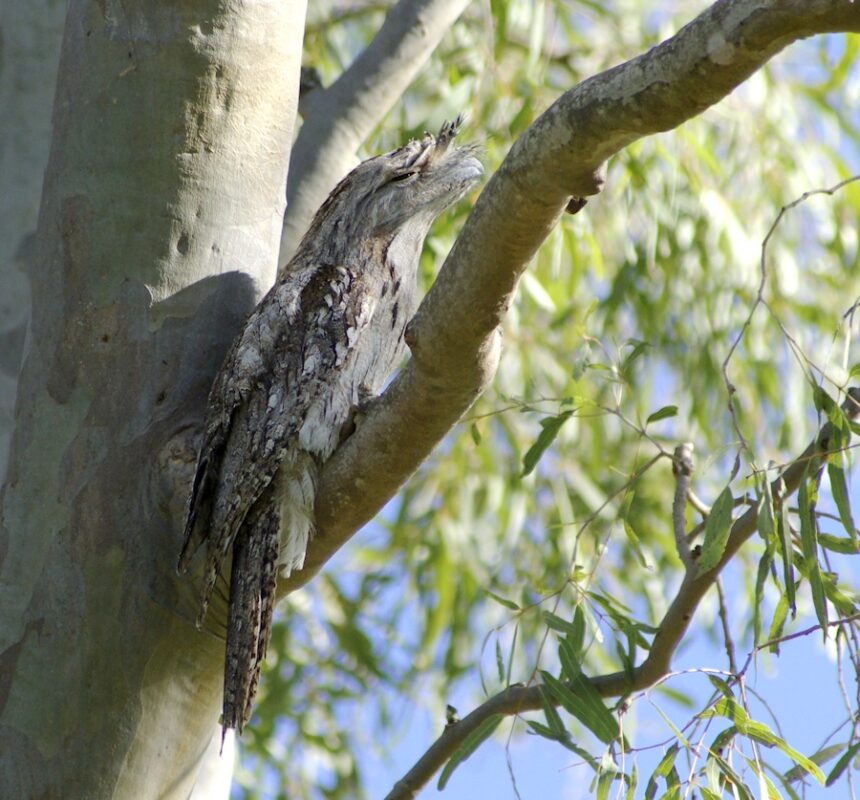
The Tawny Frogmouth (Podargus strigoides) is a nocturnal Australian bird in the frogmouth family, Podargidae. Although its large head, yellow eyes and night-time habits often lead to confusion with owls, it is more closely related to nightjars and other birds in the order Caprimulgiformes. Its mottled plumage and habit of remaining motionless against a tree trunk or branch make it one of Australia’s most effective camouflage specialists. (birdlife.org.au)
Physical Description
Tawny Frogmouths are robust birds measuring approximately 34–53 centimetres in length. Their plumage is usually silver-grey, brown and rufous, with dark streaking and mottling that resemble bark. A russet-red colour phase also occurs. The underparts are generally paler, while the broad, heavy bill ranges from olive-grey to blackish. The eyes are yellow in both colour phases. (australian.museum)
There is geographic and individual variation in size and colour. Birds from south-eastern Australia are generally larger than those from northern regions. Some differences between the sexes can be subtle, although males commonly have a broader bill and a squatter posture when roosting, while females may show a paler brown line along the cheek. (birdlife.org.au)
The wide gape gives the species its common name, but Tawny Frogmouths do not have the strong, curved talons of owls. Their feet are relatively weak because prey is usually seized with the bill rather than the feet. Fringed edges on the primary wing feathers also help reduce the sound of flight. (birdlife.org.au)
Range and Habitat
The Tawny Frogmouth is native to Australia and occurs across most of the mainland, as well as Tasmania. It is generally resident rather than migratory. The species uses a wide range of habitats, including open forest, woodland, heathland, rainforest margins, alpine woodland, timbered watercourses, rural areas, parks and suburban gardens. It is less typical of dense rainforest, treeless desert and exposed alpine moorland. (australian.museum)
Tawny Frogmouths commonly select daytime roosts where their plumage matches the colour and texture of the surrounding bark. Roost sites may be low in a tree or within the leafy canopy, depending on camouflage, temperature and local conditions. In a four-year study in central coastal Queensland, a pair showed strong fidelity to a small group of roost trees but used different trees for nesting. (afo.birdlife.org.au)
Geographic variation is reflected in recognised subspecies and in differences in size and plumage across the species’ broad Australian range. The species remains taxonomically treated as Podargus strigoides by the IOC World Bird List. (ww.worldbirdnames.org)
Behaviour and Diet
Tawny Frogmouths are mainly active from dusk through the night. During the day they perch upright and remain still, often narrowing the eyes and stretching the body to resemble a broken branch. This posture provides concealment from predators and helps reduce detection by people.
They are territorial and commonly live in long-term pairs. Their low, repeated call is often described as a soft, deep series of ‘oom’ notes. When threatened, they may hiss, gape and adopt a defensive posture. (australian.museum)
Most prey is taken from the ground. A frogmouth usually waits on a branch or other elevated perch before gliding or pouncing down onto insects, spiders, worms, slugs and snails. It may also take frogs, reptiles, small mammals and small birds. Moths and other flying insects can sometimes be caught in the air. Because they may pursue insects attracted to vehicle headlights, road collisions are a recognised hazard. (australian.museum)
Breeding usually occurs from late winter through summer, commonly between August and December, although birds in arid regions may respond to heavy rainfall. The nest is a loose platform of sticks, usually placed in a horizontal fork or on a horizontal branch. Clutches generally contain two or three eggs. Both parents incubate the eggs, with the male commonly sitting during the day and the pair sharing incubation at night. Published observations report incubation of about 28–30 days and fledging at approximately 27–31 days, followed by an extended period of parental care. (australian.museum)
Identification Tips
Look for the following combination of features:
- A large, broad-headed bird with a very wide bill.
- Silver-grey, brown or russet plumage marked with dark streaks and fine mottling.
- Large yellow eyes and a heavy, olive-grey to blackish bill.
- An upright posture on a branch, often with the body stretched to imitate a broken limb.
- Nocturnal activity and a deep, repeated ‘oom-oom-oom’ call.
- A habit of dropping or gliding from a perch to the ground when hunting.
Tawny Frogmouths are most often confused with owls. The frogmouth’s bill is broad rather than sharply hooked, its feet lack the powerful curved talons typical of owls, and its camouflage posture is especially characteristic. Unlike many owls, it is frequently found perched lengthwise against a branch or trunk during daylight. (birdlife.org.au)
Conservation Status
The Tawny Frogmouth is currently assessed as Least Concern globally under the IUCN system. This classification does not mean that individual birds or local populations are free from risk. Documented or recognised hazards include habitat loss and degradation, collisions with vehicles and other infrastructure, predation or disturbance by domestic animals, invasive predators and exposure to poisons such as rodenticides. (birdlife.org.au)
Important conservation measures include retaining mature trees and woodland structure, protecting nesting and roosting habitat, reducing unnecessary tree removal, keeping cats indoors or securely contained, and avoiding the use of poisons that may enter the food chain. Care is also needed around roads, particularly where frogmouths feed on insects drawn towards headlights. Reliable population estimates and a single national trend figure are not provided in the sources used here.
Frequently Asked Questions
Is the Tawny Frogmouth an owl?
No. The Tawny Frogmouth is not an owl. It belongs to the frogmouth family, Podargidae, and is more closely related to nightjars than to true owls. Its owl-like appearance and nocturnal habits are the main reasons for the confusion. (birdlife.org.au)
Where does the Tawny Frogmouth live?
It occurs across most of mainland Australia and Tasmania. Suitable habitats include open forests, woodlands, heathlands, rural areas, parks, gardens and suburban bushland, although it generally avoids dense rainforest and treeless desert. (australian.museum)
What does the Tawny Frogmouth eat?
Its diet consists mainly of nocturnal insects, spiders, worms, slugs and snails. It also eats frogs, reptiles, small mammals and small birds when available. Most prey is taken from the ground after the bird drops or glides from a perch. (australian.museum)
Why is the Tawny Frogmouth difficult to see during the day?
Its streaked and mottled plumage closely resembles tree bark. During daylight it remains motionless, stretches its body and narrows its eyes, creating the appearance of a broken branch. (australian.museum)
When do Tawny Frogmouths breed?
Breeding commonly occurs from August to December, although rainfall can influence breeding in arid regions. A loose stick nest is usually built on a horizontal branch or in a branch fork, and both parents incubate the eggs and care for the young. (australian.museum)
Are Tawny Frogmouths endangered?
The species is currently classified as Least Concern globally. Local birds can still be affected by habitat loss, vehicle collisions, domestic animals, invasive predators and poisoning, so protecting mature trees and reducing these hazards remain important. (birdlife.org.au)
References
- Australian Museum. 2025. Tawny Frogmouth. Australian Museum, Sydney. https://australian.museum/learn/animals/birds/tawny-frogmouth/ (accessed 8 September 2026).
- BirdLife Australia. n.d. Tawny Frogmouth, Podargus strigoides. BirdLife Australia. https://birdlife.org.au/bird-profiles/tawny-frogmouth/ (accessed 8 September 2026).
- Briggs, A. 2023. Roosting and breeding behaviour of Tawny Frogmouths Podargus strigoides in central-coastal Queensland. Australian Field Ornithology 40: 70–76. https://doi.org/10.20938/afo40070076.
- Gill, F., Donsker, D. and Rasmussen, P. (eds). 2026. IOC World Bird List, version 15.2. International Ornithologists’ Union. https://www.worldbirdnames.org/ (accessed 8 September 2026).
- Higgins, P. J. (ed.). 1999. Handbook of Australian, New Zealand and Antarctic Birds, Volume 4: Parrots to Dollarbird. Oxford University Press, Melbourne.
- Körtner, G. and Geiser, F. 1999. Roosting behaviour of the Tawny Frogmouth (Podargus strigoides). Journal of Zoology 248: 501–507.
- Körtner, G. and Geiser, F. 1999. Nesting behaviour and juvenile development of the Tawny Frogmouth Podargus strigoides. Emu 99: 212–217.
- NSW National Parks and Wildlife Service. n.d. Tawny frogmouth. NSW National Parks and Wildlife Service. https://www.nationalparks.nsw.gov.au/plants-and-animals/tawny-frogmouth (accessed 8 September 2026).
- Victorian Government Department of Energy, Environment and Climate Action. 2023. Species: Tawny frogmouth (Podargus strigoides). In Biodiversity Response Planning, Part B: General birds. Victorian Government. https://www.wildlife.vic.gov.au/__data/assets/pdf_file/0024/671262/Part-B-Birds-Chapter1.pdf (accessed 8 September 2026).
Related posts