Introduction
Hartlaub’s Duck (Pteronetta hartlaubii) is a medium-sized forest duck and the only living species in the genus Pteronetta. It is named after the German ornithologist Gustav Hartlaub and occurs mainly in freshwater habitats across equatorial West and Central Africa. Although often difficult to observe, it is a distinctive member of the African waterfowl fauna. (ww.worldbirdnames.org)
Physical Description
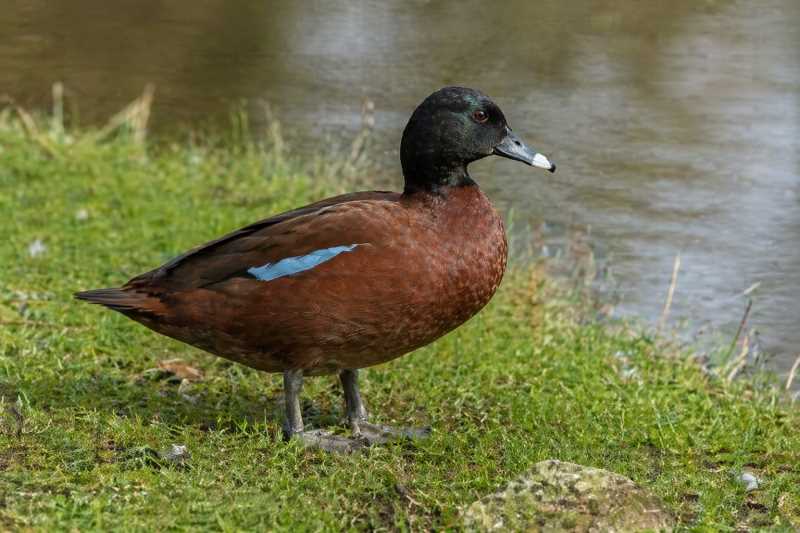
Hartlaub’s Duck measures approximately 56–58 cm in length. Adults have a predominantly dark, chestnut-brown plumage, with a blackish head and upper neck, a paler patch above the bill and blue wing coverts. The bill is dark, often with a pale or whitish tip, and the legs and feet are dark yellowish to grey-brown. (dokumen.pub)
The sexes are similar but show modest differences. Males are generally larger and usually have a more conspicuous pale mark on the forehead or at the base of the bill. In some males, the base of the bill becomes swollen during the breeding season. Females are usually duller and have less white on the head. Juveniles resemble females but are generally less richly coloured, with paler feather edges that can give the underparts a subtly mottled appearance. (sierwatervogels.nl)
The species should not be described as having a bright green speculum as its principal field mark. The blue wing coverts, dark head, chestnut body and pale facial or bill-base marking are more reliable identification features.
Range and Habitat
Hartlaub’s Duck is resident in the tropical forests and associated wetlands of equatorial West and Central Africa. Its range extends from the Upper Guinea forests, including Sierra Leone, Guinea and Liberia, eastwards through Nigeria and Cameroon to the Congo Basin, including Gabon, the Republic of the Congo and the Democratic Republic of the Congo. It also occurs in parts of South Sudan and other neighbouring areas within the Congo and western equatorial forest region. Distribution details vary slightly between taxonomic and regional sources. (birdsoftheworld.org)
It favours freshwater habitats within or near forest, including quiet rivers, streams, pools, swamps, marshes and seasonally flooded areas. It may also occur in well-wooded savanna and forest-edge wetlands, and has been recorded in mangrove habitats in parts of its range. The species is generally associated with lowland environments, although locally suitable habitat may occur at higher elevations. (oiseaux.net)
Hartlaub’s Duck is not regarded as a long-distance migrant. Local or seasonal movements may occur in response to water levels, food availability and breeding conditions, but the species is principally resident. (birdsoftheworld.org)
Behaviour and Diet
Hartlaub’s Duck is usually shy and wary, often remaining concealed among dense vegetation along forest streams and swamps. It may occur singly, in pairs or in small family groups rather than in large flocks. The species is reported to feed mainly during the evening or at night, although it can also be active by day. (waterfowl.org.uk)
Its diet consists chiefly of aquatic invertebrates, including insects and other small freshwater animals. Seeds and other plant material may also be taken, but available evidence suggests that animal prey is an important part of the diet. Feeding takes place on the water, at the water’s edge and occasionally on adjacent ground. (en.wikipedia.org)
Breeding information from the wild remains limited. Reported clutches contain about seven to ten eggs, and incubation lasts approximately 30–32 days. Nests are generally concealed close to water in dense vegetation or other sheltered sites. Both adults may participate in caring for the young, and the male can be strongly defensive near the nest. (waterfowl.org.uk)
Identification Tips
When searching forest wetlands, look for a medium-sized duck with the following combination of features:
- A dark, blackish head and upper neck.
- Rich chestnut-brown body plumage.
- Blue wing coverts, visible most clearly when the bird is perched, swimming or flying.
- A pale mark above or at the base of the bill, usually more obvious in males.
- Dark legs and a relatively broad, dark bill.
- A secretive manner and preference for shaded streams, pools and swamp margins.
The combination of a dark head, chestnut body and blue wing coverts helps separate Hartlaub’s Duck from more uniformly brown African ducks. The pale facial marking is variable, particularly in females, so identification should be based on the overall pattern rather than on that feature alone. Its forest habitat and retiring behaviour are also useful clues.
Conservation Status
Hartlaub’s Duck is currently assessed as Least Concern on the IUCN Red List. This category reflects its broad geographical range and does not mean that local populations are secure or well monitored. The species is poorly known in several parts of its range, and reliable information on population size and long-term trends remains limited. (handwiki.org)
The main concerns are the loss and degradation of forest wetlands through deforestation, agricultural expansion, drainage, infrastructure development and other forms of habitat conversion. Hunting, disturbance, pollution and destructive fishing practices may also affect local populations. Conservation priorities include protecting intact forest streams, swamps and floodplain habitats, maintaining water quality, regulating unsustainable hunting and improving field surveys across the species’ range. (pdf.usaid.gov)
Frequently Asked Questions
Where does Hartlaub’s Duck live?
It lives in freshwater habitats across equatorial West and Central Africa, especially forest streams, pools, swamps, marshes and seasonally flooded wetlands.
Is Hartlaub’s Duck migratory?
It is mainly a resident species. Local seasonal movements may occur, but it is not generally considered a long-distance migrant.
What does Hartlaub’s Duck eat?
Its diet consists mainly of aquatic invertebrates such as insects and other small freshwater animals. Seeds and plant material may also be eaten.
How can Hartlaub’s Duck be identified?
Look for a dark head and upper neck, a chestnut-brown body, blue wing coverts, a dark bill and, especially in males, a pale mark above or at the base of the bill.
How large is Hartlaub’s Duck?
Adults are approximately 56–58 cm long. Males are generally somewhat larger than females.
Is Hartlaub’s Duck endangered?
The species is currently assessed as Least Concern, but habitat loss, wetland degradation, hunting and limited knowledge of population trends remain conservation concerns.
References
- BirdLife International. 2016. Pteronetta hartlaubii. The IUCN Red List of Threatened Species 2016: e.T22680070A92841893. https://doi.org/10.2305/IUCN.UK.2016-3.RLTS.T22680070A92841893. Accessed 8 September 2026.
- Carboneras, C. and G. M. Kirwan. 2020. Hartlaub’s Duck (Pteronetta hartlaubii), version 1.0. In Birds of the World, edited by J. del Hoyo, A. Elliott, J. Sargatal, D. A. Christie and E. de Juana. Cornell Lab of Ornithology. https://doi.org/10.2173/bow.harduc1.01. Accessed 8 September 2026.
- Gill, F., D. Donsker and P. Rasmussen, eds. 2026. IOC World Bird List, version 15.2. International Ornithologists’ Union. https://www.worldbirdnames.org/. Accessed 8 September 2026.
- Madge, S. and H. Burn. 1988. Wildfowl: An Identification Guide to the Ducks, Geese and Swans of the World. Christopher Helm, London.
- Myhrvold, N. P., E. Balzer, J. M. Chaney, A. Sivam, D. L. L. S. Freeman and S. N. Morgan. 2015. An amniote life-history database to perform comparative analyses with birds and reptiles. Ecology 96(11): 3109. https://doi.org/10.1890/15-0845R.1.
- International Union for Conservation of Nature. 2026. The IUCN Red List of Threatened Species, version 2026-1. IUCN. https://www.iucnredlist.org/. Accessed 8 September 2026.
- British Waterfowl Association. n.d. Hartlaub’s Duck, Pteronetta hartlaubii. British Waterfowl Association. https://www.waterfowl.org.uk/wildfowl/true-ducks/hartlaubs-duck/. Accessed 8 September 2026.
Related posts