Introduction
The Moluccan Megapode (Eulipoa wallacei), also known as Wallace’s Scrubfowl or Moluccan Scrubfowl, is an Indonesian endemic megapode in the family Megapodiidae. It is best known for laying its eggs in communal, sun-warmed nesting grounds rather than incubating them with body heat. The species uses forest habitat for much of its life but travels to suitable sandy or volcanic nesting sites to reproduce.
Physical Description
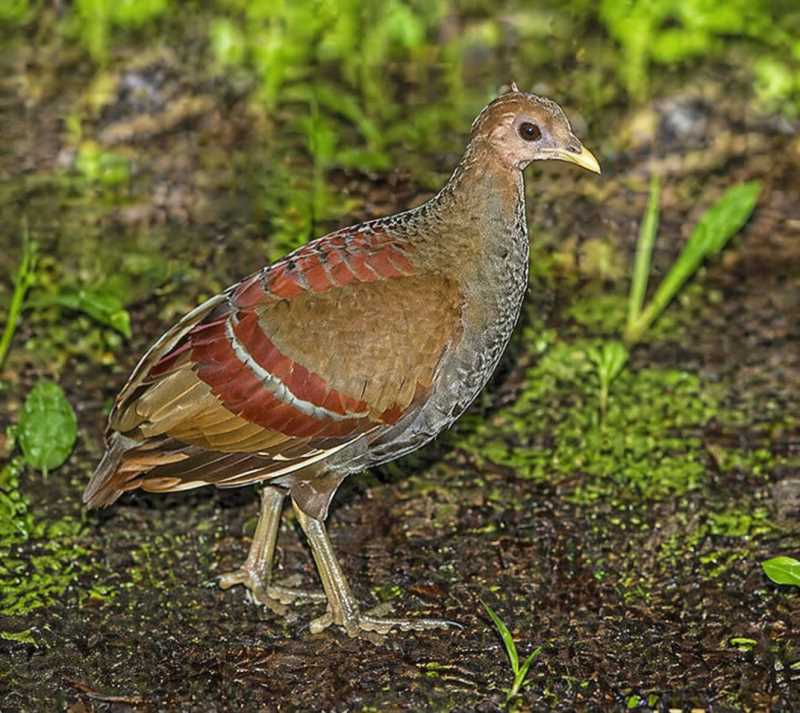
The Moluccan Megapode is a relatively small megapode, measuring about 30–31 cm in length. Adults have mainly olive-brown upperparts, greyish or bluish-grey underparts, pale or white undertail coverts, and contrasting reddish-maroon areas on the back and wings marked with lighter streaks. The face has areas of bare pinkish skin, while the bill is pale bluish-yellow and the legs are dark olive or greyish.
The sexes are broadly similar in appearance, with no prominent sexual dimorphism reported. Juveniles are duller than adults and have darker bills and legs. As with other megapodes, newly hatched chicks are well developed, fully feathered and capable of moving independently soon after emerging from the nest.
Range and Habitat
The Moluccan Megapode is endemic to Indonesia. Its recorded range includes islands in the northern and central Moluccas, particularly Halmahera, Buru, Seram, Ambon and Haruku. Historical and more recent records also include islands such as Bacan and Ternate, although the species has disappeared from, or become uncertain on, some formerly occupied islands. Records from Misool are also included in older distribution accounts, but the persistence of the species there requires caution.
Adults are associated with forest, including inland and lower montane habitats, where they feed and shelter. Breeding sites are usually separate from the main forest habitat and may occur on sun-exposed beaches, coastal sand, volcanic soils or other open ground with suitable conditions for digging. Loose, deep soil and reliable solar warming are important because the eggs depend on environmental heat for incubation.
The species is endemic rather than migratory. However, individuals make regular movements between forest habitat and communal nesting grounds, and the precise movements of juveniles after hatching remain poorly documented.
Behaviour and Diet
The Moluccan Megapode lays its eggs at night, a distinctive behaviour among megapodes. Several birds may use the same communal nesting ground, where females dig into sand or soil and bury their large eggs. Reported nest depths are approximately 60–90 cm. The eggs are left to incubate through heat from the surrounding soil, which is warmed mainly by the sun.
Incubation varies with local conditions. Studies on Haruku have recorded an average incubation period of about 74 days, while other accounts report a broader period of roughly 65–80 days. The female does not remain to incubate the eggs or provide parental care. Chicks hatch fully feathered, dig their way to the surface and begin living independently.
The species is omnivorous, although detailed observations of its natural diet are limited. Available evidence indicates that it eats a mixture of seeds and invertebrates, including beetles and ants. Termites and other small soil invertebrates have also been suggested as food items, but direct observations remain scarce. Foraging is mainly associated with the forest floor, where the bird searches through leaf litter and soil.
Identification Tips
- Look for a small, stocky, ground-dwelling bird about 30–31 cm long in Moluccan forest or near a known nesting beach.
- Adults are mainly olive-brown above and greyish below, with reddish-maroon, pale-streaked feathers on the back and wings.
- The pale bluish-yellow bill, pinkish bare facial skin and dark olive legs are useful field marks at close range.
- The species is more likely to be detected by its footprints, scratching and activity around nesting grounds than by prolonged views in dense forest.
- Communal, sun-exposed nesting beaches are a particularly important clue. The birds may visit these sites at night to dig and lay eggs.
- It should not be confused with other local megapodes solely on the basis of nesting behaviour. Identification is most reliable when plumage, island range and the characteristic communal nesting habitat are considered together.
Conservation Status
The Moluccan Megapode is currently listed as Vulnerable on the IUCN Red List. The principal threats are the loss and degradation of forest and coastal nesting habitat, disturbance or destruction of communal nesting grounds, hunting and the collection of eggs for consumption or trade. Because many birds may depend on a relatively small number of major nesting sites, damage to those sites can have effects beyond the immediate nesting area.
Conservation priorities include protecting forest habitat and communal nesting beaches, preventing the conversion or disturbance of important nesting grounds, reducing unsustainable egg collection and involving local communities in monitoring and site protection. Continued surveys are also needed because the species’ distribution, population size and status on several islands remain incompletely known.
Frequently Asked Questions
Where does the Moluccan Megapode live?
It is endemic to Indonesia and occurs in parts of the northern and central Moluccas, including Halmahera, Buru, Seram, Ambon and Haruku. Records from other islands are historical, localised or require further confirmation.
How does the Moluccan Megapode incubate its eggs?
The eggs are buried in communal nesting grounds and incubated by heat from the surrounding sand or soil, warmed mainly by sunlight. The adults do not sit on the eggs.
Does the Moluccan Megapode build a nest?
Rather than constructing a conventional nest, the female digs a deep burrow in suitable sand or soil, lays an egg and covers it. Several birds may use the same communal nesting ground.
How long do the eggs take to hatch?
Incubation depends on soil temperature and local conditions. Research on Haruku recorded an average of about 74 days, while published accounts give an approximate range of 65–80 days.
What does the Moluccan Megapode eat?
It is an omnivore. Available evidence indicates a diet that includes seeds and small invertebrates such as beetles and ants, although the species’ natural feeding ecology has not been studied in detail.
Why is the Moluccan Megapode threatened?
Its main threats include habitat loss, degradation of forest and coastal nesting areas, egg collection, hunting and disturbance at communal nesting grounds. The species is classified as Vulnerable.
References
- BirdLife International. n.d. Moluccan Scrubfowl Eulipoa wallacei species factsheet. BirdLife DataZone. Accessed 8 September 2026. http://datazone.birdlife.org/species/factsheet/moluccan-scrubfowl-eulipoa-wallacei
- International Union for Conservation of Nature. n.d. The IUCN Red List of Threatened Species: Eulipoa wallacei, Moluccan Megapode. IUCN Red List. Accessed 8 September 2026. https://www.iucnredlist.org/
- Gill, F., Donsker, D. and Rasmussen, P., eds. 2026. IOC World Bird List, version 15.2. International Ornithologists’ Union. Accessed 8 September 2026. https://www.worldbirdnames.org/
- Dekker, R. W. R. J., Argeloo, M. and Jepson, P. 1995. Notes on the Moluccan Megapode Eulipoa wallacei (G. R. Gray, 1860) following the rediscovery of two major nesting grounds. Zoologische Mededelingen, 69(19), 251–260. Naturalis Biodiversity Center. https://repository.naturalis.nl/pub/318499
- Baker, G. C. 1999. Temporal and spatial patterns of laying in the Moluccan megapode Eulipoa wallacei (G. R. Gray). Zoologische Verhandelingen, 327, 53–59. Naturalis Biodiversity Center. https://repository.naturalis.nl/pub/219420
- Heij, C. J. 2025. The behaviour of the Moluccan megapode, Eulipoa wallacei (Aves: Megapodidae), in nesting grounds. Treubia, 31(2), 169–176. https://doi.org/10.14203/trb.v31i2.619
- Heij, C. J., Rompas, C. F. E. and Moeliker, C. W. 1997. The biology of the Moluccan megapode Eulipoa wallacei (Aves, Galliformes, Megapodiidae) on Haruku and other Moluccan Islands, part 2: final report. Deinsea, 3, 1–124. https://natuurtijdschriften.nl/pub/538580/
- Leimena, H. E. P., Sjarmidi, A. and Syamsudin, T. S. 2023. Identification of the Moluccan Megapode (Eulipoa wallacei) natural habitat in Haruku Island, Indonesia and its vegetation composition. Biotropia, 30(2), 158–170. https://doi.org/10.11598/btb.2023.30.2.1778
Related posts