The Melodic Minstrel of the Savanna: The Singing Cisticola (Cisticola cantans)
Nature often gifts us with avian wonders that captivate our senses, both visually and aurally. Among these enchanting creatures is the Singing Cisticola (Cisticola cantans), a small passerine bird renowned for its melodious calls and distinctive behavior. Widely distributed across sub-Saharan Africa, this species is a fascinating subject for ornithologists and bird enthusiasts alike.
Habitat and Distribution
The Singing Cisticola is a versatile bird, thriving in a variety of habitats including savannas, grasslands, marshes, and cultivated fields. Its adaptability to different environments is a testament to its resilience and evolutionary success. From Senegal in the west to Ethiopia in the east, and extending southwards to northern South Africa, the Singing Cisticola’s range is vast, allowing it to inhabit diverse climatic regions.
These birds are often found in areas with tall grasses or reed beds, which provide ample cover and nesting materials. Their preference for such habitats is not only due to the availability of resources but also because these environments amplify their vocalizations, a crucial aspect of their breeding and territorial behavior.
Physical Characteristics
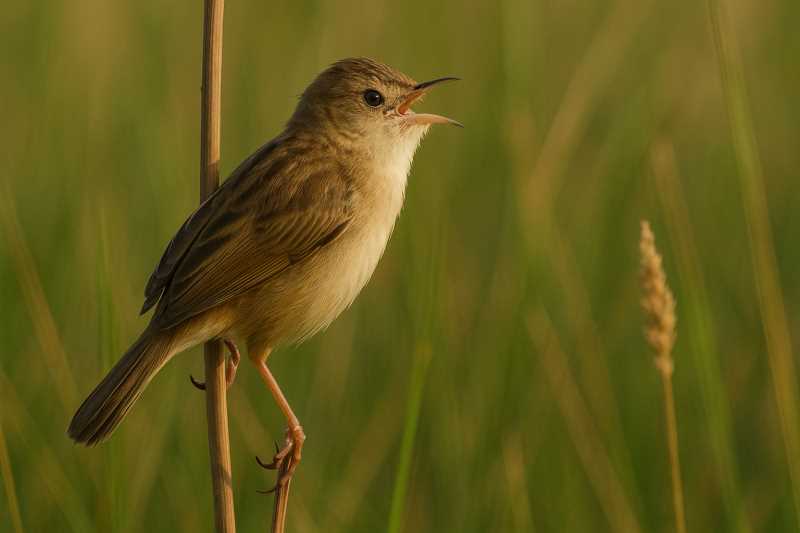
The Singing Cisticola measures about 12 to 13 centimeters in length, making it a relatively small bird. Its plumage is predominantly brown, with lighter underparts and a slightly streaked appearance on the back and wings. This coloration provides excellent camouflage against the grasslands and scrub, where it spends much of its time.
One of the most distinguishing features of the Singing Cisticola is its tail, which is often cocked upwards. This characteristic is common among cisticolas and aids in their identification. During flight, the tail displays a unique pattern that is particularly noticeable when the bird performs its acrobatic aerial displays.
Vocalizations
True to its name, the Singing Cisticola is celebrated for its vocal prowess. The male’s song is a complex series of melodious whistles and trills, often delivered from a prominent perch or during a display flight. This song serves multiple purposes: attracting mates, defending territory, and communicating with other cisticolas. Each male has a unique song pattern, which helps females identify potential mates and assess their fitness.
During the breeding season, the song of the Singing Cisticola becomes more frequent and elaborate, as males compete for the attention of females. The ability to maintain a consistent and intricate song is a sign of a healthy and vigorous bird, making vocal performance a key factor in sexual selection.
Breeding and Nesting
The breeding season of the Singing Cisticola varies depending on the geographical location and the availability of resources. In general, breeding coincides with the rainy season, when food is abundant, and the environment is lush. Males establish territories and engage in courtship displays to attract females.
The nest, an intricately woven structure, is built by the female using grasses and other plant materials. It is typically hidden within tall grasses or reeds to provide protection from predators. The female lays a clutch of 2 to 4 eggs, which she incubates alone. After hatching, both parents participate in feeding the chicks, ensuring they receive enough nourishment to thrive.
Conservation Status
Currently, the Singing Cisticola is classified as a species of Least Concern by the International Union for Conservation of Nature (IUCN). Its wide distribution and adaptability to various habitats have contributed to its stable population. However, ongoing threats such as habitat degradation, agricultural expansion, and climate change could potentially impact its numbers in the future.
Conservation efforts aimed at preserving natural grasslands and wetlands are crucial for maintaining the Singing Cisticola’s habitat. Initiatives that promote sustainable land-use practices and protect biodiversity corridors will be vital in ensuring the long-term survival of this and other grassland species.
Conclusion
The Singing Cisticola is a remarkable example of nature’s complexity and beauty. Its melodious song and adaptive nature make it a fascinating subject for study and appreciation. As we continue to explore and understand the intricate balance of ecosystems, the Singing Cisticola reminds us of the importance of preserving our natural world. By protecting these melodious minstrels and their habitats, we safeguard not only their future but also the rich tapestry of life that enriches our planet.
Related posts