
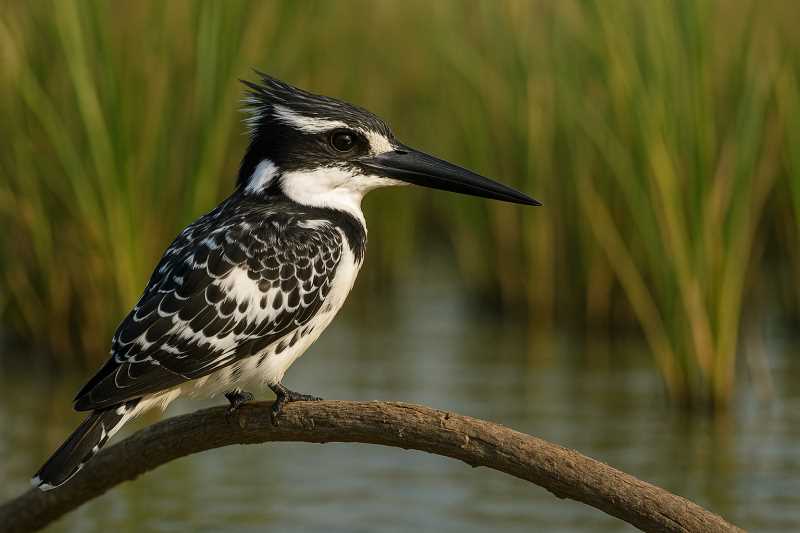
The Pied Kingfisher: A Fascinating Beacon of Aerial Mastery
The Pied Kingfisher (Ceryle rudis) is a captivating bird species renowned for its exceptional fishing skills and striking appearance. As one of the most widespread kingfishers, this bird is found across Africa and Asia, thriving in a variety of aquatic habitats. This article delves into the fascinating world of the Pied Kingfisher, exploring its unique characteristics, habitat preferences, and ecological significance.
Distinctive Appearance and Behavior
The Pied Kingfisher is immediately recognizable due to its striking black and white plumage. This highly contrasting coloration serves as both a form of camouflage against the dappled sunlight on water surfaces and a means of communication among its peers. Males and females can be distinguished by the presence of a double breast band in males, whereas females possess a single incomplete band.
Measuring around 25-30 cm in length, the Pied Kingfisher is medium-sized compared to other kingfisher species. Its long, pointed bill is perfectly adapted for catching fish, its primary food source. Unlike other kingfishers that rely on perches to hunt, the Pied Kingfisher is renowned for its ability to hover mid-air before diving to capture its prey. This unique hunting strategy allows it to exploit open water areas where perches are scarce.
Habitat and Distribution
The Pied Kingfisher enjoys a broad geographic range, inhabiting lakes, rivers, estuaries, and even coastal regions. Its adaptability to various aquatic environments has enabled it to flourish across sub-Saharan Africa, the Middle East, and South Asia, making it one of the most widespread kingfisher species.
In terms of habitat preference, Pied Kingfishers are often found near freshwater bodies with clear water, which is essential for spotting prey. They are also highly adaptable and can be found in both large water bodies and small streams, provided there is an abundance of fish.
Feeding and Hunting Techniques
The Pied Kingfisher’s diet primarily consists of fish, but it is also known to consume crustaceans and aquatic insects. Its exceptional hunting technique involves hovering above the water to spot potential prey, allowing it to dive accurately, piercing through the water with its sharp bill.
This bird’s ability to hover is facilitated by its rapid wingbeats, which enable it to maintain a stable position above the water. Once it spots its prey, the Pied Kingfisher plunges into the water with remarkable precision, often catching fish near the surface. Its success rate is impressive, highlighting its status as one of the most efficient avian fishers.
Breeding and Social Behavior
Pied Kingfishers are monogamous and typically breed in loose colonies. Their breeding season varies depending on geographical location but generally coincides with periods of high fish availability. During courtship, males perform elaborate aerial displays and bring fish to the females as a form of nuptial gift.
Nesting occurs in burrows excavated in sandy banks or cliffs near water bodies. Both parents partake in the excavation process, creating a tunnel that can be up to 1.5 meters long, ending in a nesting chamber. The female typically lays 3-6 eggs, and both parents share the responsibility of incubation and feeding the chicks.
Pied Kingfishers are known for their cooperative social behavior. In some instances, non-breeding individuals assist breeding pairs by helping to feed the chicks, a behavior known as cooperative breeding. This assistance increases the survival rate of the young, demonstrating the species’ complex social structure.
Ecological Significance and Conservation
As a top predator in its aquatic ecosystem, the Pied Kingfisher plays a crucial role in maintaining the balance of fish populations. Its presence indicates healthy water systems, making it an important bioindicator for environmental health.
Despite its widespread distribution and adaptability, the Pied Kingfisher faces threats from habitat degradation, pollution, and climate change. Conservation efforts aimed at preserving aquatic habitats are essential for ensuring the continued survival of this remarkable bird species.
In conclusion, the Pied Kingfisher is not just a symbol of aerial prowess and adaptability but also an integral component of its ecosystem. Through its unique hunting strategy and cooperative breeding behavior, it exemplifies the intricate connections between avian species and their environments. Protecting the habitats of the Pied Kingfisher is vital for preserving the biodiversity and health of aquatic ecosystems.
Related posts


