Shelley’s Eagle-Owl: A Majestic Sentinel of the African Forests
The mysterious and elusive Shelley’s Eagle-Owl (Ketupa shelleyi) is one of Africa’s most enigmatic avian residents. Known for its striking appearance and elusive nature, this species has captured the imagination of ornithologists and bird enthusiasts alike. Found primarily in the dense forests of Central and West Africa, Shelley’s Eagle-Owl plays a critical role in the ecosystem, serving as both predator and indicator of environmental health.
Taxonomy and Naming
Shelley’s Eagle-Owl belongs to the family Strigidae, which encompasses true owls. The species was named after the English ornithologist George Ernest Shelley, a prominent figure in African ornithology during the 19th century. The genus name “Ketupa” indicates its close relation to fish owls, although Shelley’s Eagle-Owl is primarily a terrestrial hunter.
Physical Characteristics
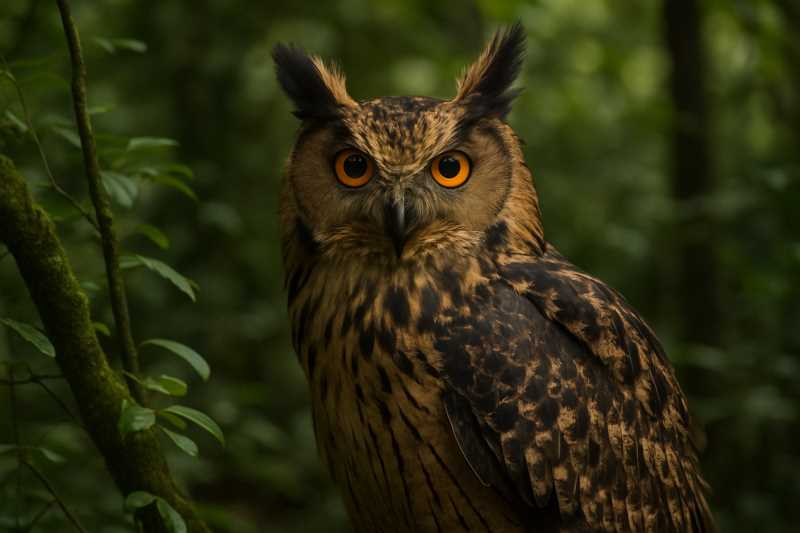
This species is renowned for its robust size and striking plumage. Adult Shelley’s Eagle-Owls typically measure between 48 to 58 centimeters in length, with a wingspan that can extend up to 140 centimeters. They exhibit a distinctive combination of rich brown and buff coloring, with intricate barred patterns across their feathers. The bright yellow eyes are a hallmark of the species, providing acute night vision essential for their nocturnal lifestyle.
Habitat and Distribution
Shelley’s Eagle-Owl is endemic to the lowland rainforests of Central and West Africa. Its range spans countries such as Ghana, Nigeria, Cameroon, and the Democratic Republic of the Congo. They prefer dense, mature forests with ample canopy cover which provides camouflage and hunting opportunities. These habitats are increasingly threatened by deforestation and human encroachment, raising concerns about the species’ long-term survival.
Behavior and Diet
As a nocturnal predator, Shelley’s Eagle-Owl is most active during the night. Its diet is diverse, consisting primarily of small mammals, birds, reptiles, and insects. The owl employs a sit-and-wait hunting strategy, using its excellent hearing and vision to locate prey from a perch before swooping down with precision.
During the breeding season, which varies across its range, Shelley’s Eagle-Owl becomes more vocal, using a series of hoots and calls to communicate with potential mates and establish territory. Nests are typically situated in tree cavities or on cliff ledges, providing protection from predators.
Conservation Status
The International Union for Conservation of Nature (IUCN) currently classifies Shelley’s Eagle-Owl as “Data Deficient.” This designation highlights the lack of comprehensive data on the species’ population trends and ecological requirements. However, habitat destruction remains a significant threat, as logging and agricultural expansion continue to reduce the availability of suitable environments.
Conservation efforts are critical to ensuring the survival of Shelley’s Eagle-Owl. Protecting forest habitats through the establishment of reserves and promoting sustainable land-use practices are essential strategies. Additionally, further research into the species’ ecology and behavior will help inform conservation policies and actions.
The Role of Shelley’s Eagle-Owl in Ecosystems
As an apex predator, Shelley’s Eagle-Owl plays a crucial role in maintaining the balance of its ecosystem. By controlling populations of small mammals and other prey species, it helps prevent overpopulation and the subsequent depletion of vegetation. This balance supports a greater diversity of plant and animal life, contributing to the overall health of the forest.
Moreover, as an indicator species, the presence of Shelley’s Eagle-Owl signifies a healthy, biodiverse environment. Its decline or absence can be an early warning sign of ecological degradation, prompting further investigation and conservation interventions.
Conclusion
Shelley’s Eagle-Owl is a remarkable testament to the biodiversity of Africa’s rainforests. Its striking appearance, coupled with its role as both predator and environmental indicator, underscores the importance of preserving its habitats. As human activities continue to encroach upon these forests, it is imperative that conservation efforts are intensified to protect this majestic species and the ecological balance it helps maintain.
Through a combination of research, habitat protection, and sustainable practices, we can ensure that future generations will be able to appreciate the beauty and significance of Shelley’s Eagle-Owl in the wild. In doing so, we safeguard not only a unique species but also the rich tapestry of life that thrives in Africa’s tropical forests.
Related posts