Introduction
The Santa Marta Sabrewing (Campylopterus phainopeplus) is a critically endangered hummingbird endemic to Colombia’s Sierra Nevada de Santa Marta. Once regarded as possibly lost to science, it was documented again in the 2010s and a resident population was located in the Guatapurí River basin in 2022. Its confirmed range is extremely small, making it one of Colombia’s most vulnerable endemic birds.
Physical Description
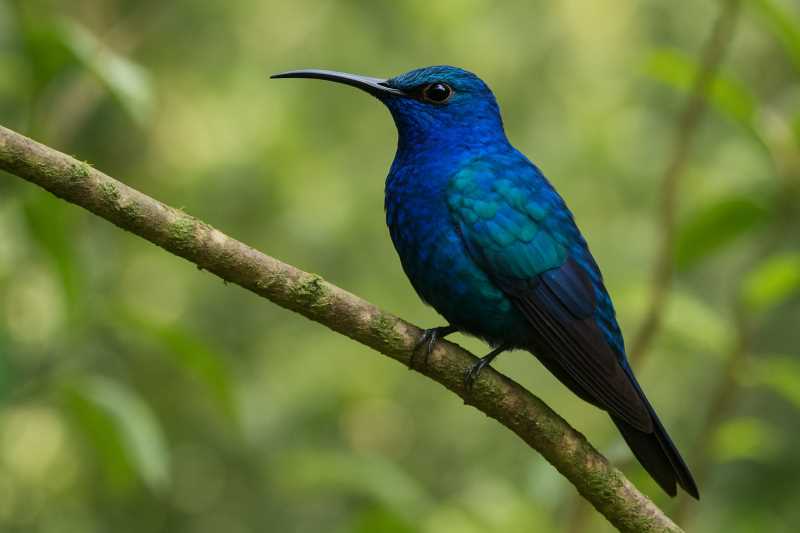
The Santa Marta Sabrewing is a relatively large hummingbird, measuring about 13 centimetres in length. It has a stout, slightly decurved black bill and a small white spot behind the eye.
Adult males have glittering green upperparts, a blue-green to violet-blue throat and chest, and a dark steely blue-black, square-ended tail. The wings are darker and less iridescent than the body. Females are also green above, but have a duller crown and cheeks, greyish-white underparts, green flanks and undertail-coverts, and a mostly green tail with narrow grey tips.
Reliable information on juvenile plumage is limited. The sexes can be separated in the field by the male’s more strongly iridescent blue throat and darker tail, while females appear paler and greyer below.
Range and Habitat
The Santa Marta Sabrewing is endemic to the Sierra Nevada de Santa Marta in northern Colombia. Recent documented records are concentrated on the south-eastern slopes, especially along the mid-elevation Guatapurí River basin in Cesar Department. The species is considered a microendemic because its confirmed distribution is exceptionally restricted.
Recent fieldwork recorded birds mainly between approximately 1,150 and 1,850 metres above sea level. They were associated particularly with riparian forest strips, dense secondary vegetation, forest edges and mixed agricultural landscapes containing shade-grown coffee, banana and sugarcane. The presence of native vegetation near streams appears to be important.
Earlier accounts suggested that the species might move seasonally to much higher elevations, possibly approaching the páramo or snowline. However, birds were recorded in the Guatapurí basin throughout a 16-month monitoring period, and the available evidence provides no support for regular elevational migration.
Where to See This Species
Guatapurí River corridor, Cesar Department, Colombia
The Guatapurí River and nearby streams around Chemesquemena and Guatapurí are currently the most important known area for the species. A resident population was documented there from 2022 onwards, with birds using riparian forest, secondary vegetation and nearby agroforestry systems. Access may involve local community arrangements and should be undertaken with respect for Indigenous lands and guidance from experienced local conservation practitioners. Records should be carefully documented because the species is easily confused with other hummingbirds.
Nearby accommodation: Basic community lodging or guest-house accommodation may be available around Guatapurí and Chemesquemena. Valledupar is the nearest larger town, with a broader range of hotels and guest houses.
ProAves El Dorado Reserve, Magdalena Department, Colombia
El Dorado Reserve is a documented historical locality for the Santa Marta Sabrewing, including a photographed male recorded there in 2010. The reserve protects montane forest in the Sierra Nevada and remains an important birdwatching site, although recent surveys did not relocate the species there. It is therefore better regarded as a site of historical occurrence than as a dependable current location.
Nearby accommodation: The reserve itself provides nature-reserve accommodation, while Minca and Santa Marta offer additional lodges, guest houses and hotels.
Behaviour and Diet
The Santa Marta Sabrewing feeds on nectar and has been observed visiting banana flowers, as well as flowers of trees and shrubs including Calliandra, Erythrina and Malvaviscus. It may also take small insects, although details of its insect-eating behaviour remain limited.
Males are strongly territorial. They commonly sing or call from exposed perches during the morning, usually from several metres above the ground, and chase both other Santa Marta Sabrewings and competing hummingbird species. In some areas, males hold nearby territories in loose groups that may function as lek-like display sites.
Observed displays include aggressive chases, forward hovering with the wings and tail spread, and vertical ascents followed by steep display dives. Territorial behaviour has been recorded throughout the year. No confirmed nest, eggs or young have been documented, although a female was observed collecting spider web, possibly for nest construction.
Identification Tips
Look for a medium-sized, powerful hummingbird with a stout black bill, glittering green plumage and a distinctly dark blue or steely tail.
- Male: Iridescent green above, with a conspicuous blue-green or violet-blue throat and chest, plus a dark square-ended tail.
- Female: Green above but greyer below, with green flanks and a mainly green tail with narrow grey tips.
- White-vented Plumeleteer: Females can be confused with this species, but the plumeleteer is generally a lowland bird with a shorter tail and contrasting white undertail-coverts.
- Lazuline Sabrewing: Males may look similar, but the Lazuline Sabrewing has rust-coloured tail feathers rather than the Santa Marta Sabrewing’s dark steely tail.
- Black-throated Mango: Some males may also be confused with this species, particularly when the tail pattern is not clearly visible.
Because misidentifications have contributed to erroneous historical records, photographs, field notes and, where possible, sound recordings are valuable for confirming sightings.
Conservation Status
The Santa Marta Sabrewing is listed as Critically Endangered on the IUCN Red List. It has an extremely small and restricted known range, and the population is considered likely to be very small and declining.
The principal concerns are habitat loss and degradation caused by deforestation, agricultural expansion, logging and settlement. The species appears to depend on narrow strips of riparian vegetation and remaining native forest within a heavily modified landscape. Climate change may add pressure by altering vegetation, water availability and the timing of flowering, but the effects are not yet well quantified.
Conservation priorities include protecting the Guatapurí basin, maintaining forest along streams, restoring native vegetation, supporting research and monitoring, and working closely with the Indigenous communities whose lands overlap the species’ habitat. Accurate identification and verification of new records are also essential because the bird has often been confused with similar hummingbirds.
Frequently Asked Questions
Where is the Santa Marta Sabrewing found?
It is endemic to the Sierra Nevada de Santa Marta in northern Colombia. Recent confirmed records are concentrated around the Guatapurí River basin on the range’s south-eastern slopes.
Is the Santa Marta Sabrewing migratory?
Regular migration has not been demonstrated. Recent monitoring recorded birds in the same mid-elevation area throughout 16 consecutive months, providing no evidence of regular elevational movement.
What does the Santa Marta Sabrewing eat?
It feeds mainly on nectar. Observed food plants include banana, Calliandra, Erythrina and Malvaviscus. It may also take small insects, but its diet remains poorly documented.
How can the Santa Marta Sabrewing be identified?
The key features are its approximately 13-centimetre length, stout black bill, glittering green plumage and dark steely-blue tail. Males have a strongly iridescent blue-green throat, while females are greyer below and have a greener tail.
Why is the Santa Marta Sabrewing critically endangered?
Its known range is exceptionally small, and its remaining habitat is threatened by deforestation, agricultural conversion, logging and settlement. The population is believed to be very small and declining.
Where is the best place to look for this species?
The Guatapurí River corridor near Chemesquemena and Guatapurí is currently the most important documented area. The ProAves El Dorado Reserve is also a historical locality, but the species has not been reliably relocated there in recent surveys.
References
- IUCN Red List of Threatened Species
- Bird Conservation International
- ProAves El Dorado Reserve
Related posts