Introduction
The Talamanca Hummingbird (Eugenes spectabilis) is a large, high-elevation hummingbird endemic to the mountains of Costa Rica and western Panama. Once treated as part of the Magnificent Hummingbird complex, it is now recognised as a separate species. It is especially associated with cool, moist montane forests, forest edges and highland clearings.
Physical Description
The Talamanca Hummingbird is one of the largest hummingbirds in its range, with a long, straight to slightly decurved bill and powerful, agile flight.
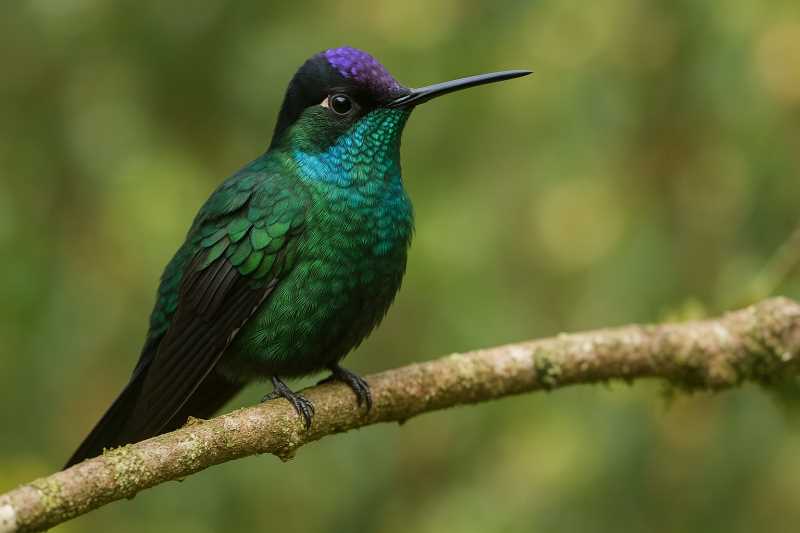
Adult males are predominantly dark green. In subdued light the head can appear almost black, but bright illumination reveals an iridescent purple crown and turquoise to blue-green throat. The upperparts are generally duller green, while the tail shows contrasting darker and bronzy-green tones.
Females are less brightly coloured. They have greenish upperparts, greyish and mottled underparts, a prominent pale spot behind the eye and a longer, slightly more decurved bill than males. Immature birds resemble females but may show darker, brownish underparts with a buff, scaly appearance. As with many hummingbirds, the sexes are strongly dimorphic, with males displaying the more conspicuous ornamental plumage.
Range and Habitat
The species occurs in the Central Cordillera and Talamanca mountain ranges of Costa Rica, extending south into western Panama, particularly the highlands of Chiriquí and the Volcán Barú region. It is a resident species rather than a long-distance migrant, although local movements may follow flowering patterns and seasonal conditions.
Talamanca Hummingbirds occupy humid montane and cloud forests, mossy woodland, forest margins, secondary growth and high-elevation clearings. In Costa Rica they are most often associated with elevations above about 2,000 metres, with many records from higher areas above 2,500 metres. In western Panama, they also occur in highland forest at roughly 1,600 to 2,400 metres. The species is particularly characteristic of the Talamancan highlands, where suitable habitat includes flowering shrubs, epiphyte-rich forest and open edges near mature woodland.
Where to See This Species
Tapantí-Macizo de la Muerte National Park, Cartago, Costa Rica
Talamanca Hummingbird is documented from Tapantí-Macizo de la Muerte National Park, a protected area containing extensive high-elevation forest in the Talamanca region. Look along forest roads, trails, flowering vegetation and open edges, particularly in the higher parts of the park. The species may also visit hummingbird feeders near established birding facilities in the surrounding highlands.
Nearby accommodation: Orosi and Paraíso are the nearest practical towns, with hotels, guest houses, cabins and self-catering accommodation available in the wider valley.
Los Quetzales National Park, San José Province, Costa Rica
The park protects cool cloud forest in the Cordillera de Talamanca and is a realistic place to search for this species in high-elevation woodland and forest margins. Birders should concentrate on flowering plants, mossy trails and open areas around the park entrance and nearby mountain birding sites. The species is also recorded in the surrounding Savegre highlands.
Nearby accommodation: San Gerardo de Dota is the principal gateway settlement, offering lodges, guest houses, cabins and small eco-tourism properties.
Volcán Barú National Park, Chiriquí, Panama
Volcán Barú protects montane and cloud-forest habitats within the species’ known Panamanian range. The Sendero Los Quetzales and other highland access routes around the park provide suitable habitat for searching, especially where forest borders flowering clearings. Access can be affected by weather and trail conditions, so visitors should check current arrangements with park authorities before travelling.
Nearby accommodation: Boquete and the communities around Volcán are the main accommodation areas, with hotels, lodges, guest houses, cabins and campsites.
Behaviour and Diet
The Talamanca Hummingbird feeds mainly on nectar from a variety of flowering plants. Its long bill allows it to exploit tubular flowers, while its hovering flight enables precise feeding in dense vegetation and along forest edges. It also takes small insects and spiders, which provide protein and other nutrients, particularly when feeding young.
Individuals may defend productive flowers or feeding areas from other hummingbirds. Males can be assertive and use rapid chases, perching displays and sharp calls to deter rivals. The species is usually seen alone while feeding, although several birds may gather where flowers or feeders are abundant.
Courtship and nesting are not as well documented as in some more widespread hummingbirds. The female is expected to undertake nest construction and most parental care, as is typical of hummingbirds. Precise information on breeding dates, nest placement, clutch size and survival remains limited.
Identification Tips
- Look for a very large hummingbird with a long bill and powerful flight.
- Adult males are dark green overall, with a purple crown and turquoise or blue-green throat that become more obvious in direct light.
- Females are duller and more mottled below, with a conspicuous pale spot behind the eye and greenish sides.
- The bird is distinctive within its Central American range because of its size and combination of dark head, pale eye mark and iridescent crown and throat.
- Do not confuse it with Rivoli’s Hummingbird, which occupies a more northerly range. The two were formerly treated together in the Magnificent Hummingbird complex, but the Talamanca form is now recognised as a separate species.
- The Fiery-throated Hummingbird and other highland hummingbirds may occur in the same forests, but they are smaller or differently patterned and lack the Talamanca Hummingbird’s combination of great size and dark, broad-headed appearance.
Conservation Status
The Talamanca Hummingbird is currently assessed as Least Concern on the IUCN Red List. It is locally common in suitable highland habitat, but its restricted distribution makes it dependent on the continued protection of montane forests and associated flowering vegetation.
Potential concerns include deforestation, habitat fragmentation, infrastructure development and climate-driven changes to high-elevation ecosystems. Warming conditions could alter the distribution of suitable forest and flowering plants, particularly for species confined to narrow elevational zones. Protected areas in Costa Rica and Panama, together with continued field surveys and population monitoring, are important for maintaining the species and its habitat.
Frequently Asked Questions
Where does the Talamanca Hummingbird live?
It lives in the highlands of Costa Rica and western Panama, especially in the Central Cordillera, the Talamanca Range and the Volcán Barú region of Chiriquí.
Is the Talamanca Hummingbird endemic to Costa Rica?
No. It is endemic to the highlands of Costa Rica and western Panama, with most of its range centred on the Talamanca mountain system.
What does the Talamanca Hummingbird eat?
Its diet consists mainly of flower nectar, supplemented by small insects and spiders. It may visit both natural flowers and hummingbird feeders.
How can the Talamanca Hummingbird be identified?
It is a very large hummingbird. Males are dark green with an iridescent purple crown and turquoise throat, while females are duller, mottled below and marked by a pale spot behind the eye.
Is the Talamanca Hummingbird migratory?
It is generally considered resident within its mountain range. Local movements may occur in response to flowering conditions, weather and the availability of food.
What is the conservation status of the Talamanca Hummingbird?
The species is assessed as Least Concern, although its restricted highland range means that habitat loss, fragmentation and climate change remain important conservation concerns.
References
- Cornell Lab of Ornithology, Birds of the World
- Cornell Lab of Ornithology, eBird
- IUCN Red List of Threatened Species
Related posts