Introduction
The Caucasian Snowcock (Tetraogallus caucasicus) is a large, ground-dwelling galliform of the Phasianidae family. Endemic to the Caucasus Mountains, it occupies steep, rocky high-altitude terrain where alpine vegetation persists between scree, cliffs and snowfields. The species is generally resident, although it makes seasonal movements up and down mountain slopes in response to snow cover and food availability.
Physical Description
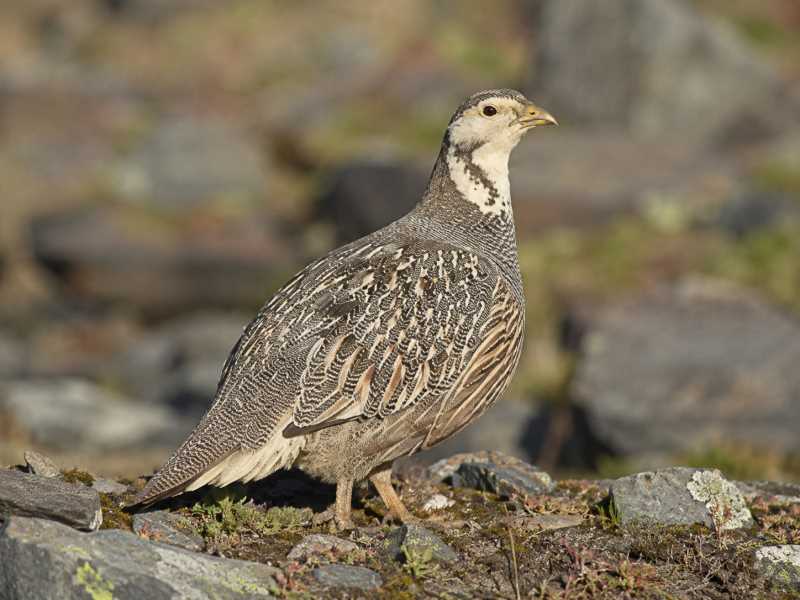
The Caucasian Snowcock is a robust, long-bodied bird measuring approximately 52–56 centimetres in length, with a wingspan of about 80–95 centimetres. Its plumage is predominantly grey, brown, white and black, giving it a subdued, stone-like appearance at a distance.
Key features include:
- A whitish throat and conspicuous white markings on the sides of the neck.
- A darker breast with fine black patterning.
- Rusty-brown or reddish-brown tones on the flanks and nape.
- Pale, patterned upperparts that blend with rock and scree.
- White flight feathers and white undertail coverts, which are especially noticeable in flight.
- Strong legs and feet suited to walking across steep, uneven ground.
The sexes are broadly similar in plumage, although males are generally larger and may show more pronounced colour and patterning. Males possess short spurs, while females usually lack them. Juveniles are smaller and duller than adults, with less clearly defined markings.
Range and Habitat
The Caucasian Snowcock is endemic to the Greater Caucasus, occurring principally in southern Russia, northern Georgia and northern Azerbaijan. It is associated with the high mountain systems of the Caucasus rather than lowland or wooded habitats.
It commonly occupies rocky slopes, cliffs, scree fields and alpine meadows near the upper forest limit and the snowline. It is usually found from roughly 1,800–2,000 metres to nearly 4,000 metres above sea level, with breeding commonly reported in the middle and upper alpine zones. Habitat use varies seasonally. Birds may descend to lower, sunnier slopes in winter or after heavy snowfall, then move upwards as snow retreats and alpine plants become available.
The species is generally considered monotypic, with no consistently recognised subspecies in current major bird taxonomies.
Behaviour and Diet
Caucasian Snowcocks are primarily terrestrial and usually walk or run across mountain slopes while feeding. They can fly strongly when disturbed, but often use short, rapid flights or glide down slopes before returning to higher ground. They are wary birds and may remain difficult to detect among rocks even when vocalising.
Outside the breeding season, they may occur in pairs, family groups or small flocks. Their calls include a loud, rising whistle described as desolate or loon-like, as well as shorter alarm notes. Calling is particularly important during the breeding season and can carry considerable distances across mountain valleys.
The diet is principally herbivorous. Depending on season and altitude, it includes leaves, shoots, stems, flowers, seeds, fruits, tubers and other parts of alpine plants. Grasses, legumes and other low-growing mountain vegetation are important food sources. Invertebrates do not appear to form a significant part of the adult diet.
Breeding takes place on the ground. The nest is a shallow scrape, usually placed among rocks, beneath sheltering stones or in other concealed locations on steep mountain terrain. Clutches commonly contain about five to eight eggs, although reported clutch sizes vary between sources and localities. The female undertakes incubation, and the chicks are precocial, leaving the nest soon after hatching and following the female while feeding.
Identification Tips
When seen at a distance, the Caucasian Snowcock usually appears as a large, pale-grey, heavily built bird on a rocky slope. Look for the combination of a whitish throat, white neck patches, darker breast, rusty-brown flanks and a generally mottled grey appearance.
In flight, the white flight feathers and undertail can provide useful clues. The species is more heavily built and longer-bodied than a typical partridge, but it may be confused with other snowcocks where their ranges approach one another.
The Caspian Snowcock (Tetraogallus caspius) is the most relevant comparison. The Caucasian Snowcock is associated with the Caucasus, has rusty tones around the nape and flanks, and is distinguished by its characteristic call, which includes a noticeable fall in pitch at the end of the song. Identification should still be based on several features because plumage can vary with wear, age, lighting and distance.
Conservation Status
The Caucasian Snowcock is currently assessed as Least Concern on the IUCN Red List. European assessments report breeding populations in Azerbaijan, Georgia and Russia, but also note that some estimates are based on partial surveys or expert judgement. The available data do not provide a reliable single global population figure or a consistently quantified worldwide trend.
Its high-altitude habitat and occurrence in protected mountain areas provide some protection. Nevertheless, local populations may be affected by disturbance, infrastructure development, changes in alpine land use, severe winter conditions and hunting or poaching where these occur. Continued monitoring is important because the species has a geographically restricted range and depends on specialised alpine habitats. Conservation priorities include protecting high-elevation slopes and meadows, maintaining habitat connectivity, managing disturbance in breeding areas and improving population surveys.
Frequently Asked Questions
Where does the Caucasian Snowcock live?
It lives in the Greater Caucasus, mainly in southern Russia, northern Georgia and northern Azerbaijan. It occupies rocky alpine and subalpine slopes, scree, cliffs and mountain meadows.
How high in the mountains does the Caucasian Snowcock occur?
It is generally found from about 1,800–2,000 metres to nearly 4,000 metres above sea level. Breeding birds commonly use alpine terrain between approximately 2,500 and 3,500 metres, although the precise range varies geographically.
What does the Caucasian Snowcock eat?
Its diet consists mainly of alpine plant material, including leaves, shoots, stems, flowers, seeds, fruits and tubers. Invertebrates are not considered an important part of its normal adult diet.
Does the Caucasian Snowcock migrate?
It is generally a resident species rather than a long-distance migrant. However, it makes seasonal movements along mountain slopes, descending during heavy snow or winter conditions and moving higher as snow retreats in spring and summer.
How does the Caucasian Snowcock nest?
It nests on the ground in a shallow scrape, often among rocks or beneath sheltering stones. The female incubates the eggs, and the chicks are precocial, leaving the nest soon after hatching.
Is the Caucasian Snowcock endangered?
No. It is currently classified as Least Concern. This does not mean that every local population is secure, so habitat protection, monitoring and careful management of disturbance remain important.
References
- BirdLife International. 2021. European Red List of Birds: Tetraogallus caucasicus (Caucasian Snowcock), supplementary material. BirdLife International and Publications Office of the European Union. Available at: https://birdlifedata.blob.core.windows.net/sub-global/132_tetraogallus_caucasicus.pdf. Accessed 8 September 2026.
- Salvador, A. and Sokolov, A. Y. 2023. Caucasian Snowcock (Tetraogallus caucasicus), version 2.0. In: Kirwan, G. M. and Keeney, B. K. (eds), Birds of the World. Cornell Lab of Ornithology, Ithaca, New York. https://doi.org/10.2173/bow.causno1.02. Accessed 8 September 2026.
- Gill, F., Donsker, D. and Rasmussen, P. (eds). 2026. IOC World Bird List, version 15.2. International Ornithologists’ Union. https://www.worldbirdnames.org/. Accessed 8 September 2026.
- Cornell Lab of Ornithology. n.d. Caucasian Snowcock (Tetraogallus caucasicus). eBird Species Account. https://ebird.org/species/causno1. Accessed 8 September 2026.
- European Environment Agency. n.d. Caucasian Snowcock, Tetraogallus caucasicus (Pallas, 1811). European Nature Information System. https://eunis.eea.europa.eu/species/15636. Accessed 8 September 2026.
- del Hoyo, J., Elliott, A. and Sargatal, J. (eds). 1994. Handbook of the Birds of the World, Volume 2: New World Vultures to Guineafowl. Lynx Edicions, Barcelona.
- Liu, Y., et al. 2020. The uplift of the Qinghai–Tibet Plateau and glacial oscillations triggered the diversification of Tetraogallus (Galliformes, Phasianidae). Frontiers in Zoology 17. https://pmc.ncbi.nlm.nih.gov/articles/PMC7029067/.
Related posts