Introduction
The Rufous-cheeked Nightjar (Caprimulgus rufigena) is a medium-sized member of the nightjar family, Caprimulgidae. It is a mainly nocturnal and crepuscular insect-eater associated with dry savannas, open woodland, scrub and semi-desert habitats. The species breeds in southern Africa and migrates within Africa after the breeding season, although some individuals may remain in parts of the region during winter.
Physical Description
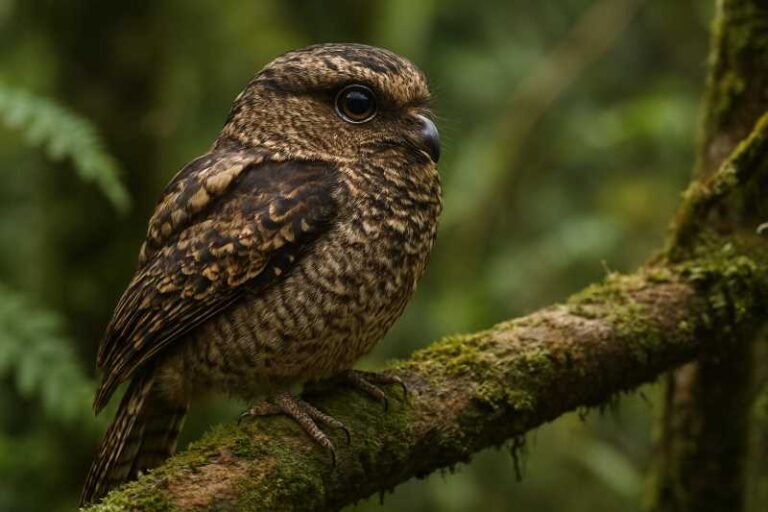
The Rufous-cheeked Nightjar is approximately 23–24 cm long and has the compact, broad-headed shape typical of nightjars. Its plumage is a cryptic mixture of greyish brown, dark brown, buff and rufous markings, providing effective camouflage among dry leaves, sand, stones and sparse vegetation.
The cheeks and sides of the neck have noticeable rufous tones, while the upperparts are finely mottled and streaked. The underparts are barred and mottled in brown, buff and grey. Like other nightjars, it has long pointed wings, a short bill surrounded by rictal bristles, short legs and large eyes adapted to low-light conditions.
Males and females are similar in general appearance. Adult males usually show white markings on the outer primary feathers and tail corners, whereas these markings are generally buff or less conspicuous in females. Young birds are more softly marked and may be difficult to distinguish from adults in the field.
Range and Habitat
The Rufous-cheeked Nightjar has a broad but discontinuous distribution across Africa. It breeds mainly in southern Africa, including parts of Angola, Namibia, Botswana, Zambia, Zimbabwe and South Africa, with records also extending into adjacent regions. After the breeding season, many birds move northwards to non-breeding areas in central and west-central Africa, including parts of Cameroon, the Democratic Republic of the Congo and neighbouring countries.
In southern Africa, the species is most strongly associated with dry inland regions, including Kalahari sands, open Acacia and Mopane savanna, open woodland, scrub, Karoo and semi-desert vegetation. It generally avoids dense forest, very thick bush, high mountains, wet valleys and permanently damp ground. It may occur in open country where scattered trees or bushes provide cover, and it often nests on sparsely vegetated or recently burnt ground.
The species is primarily a breeding summer migrant to much of southern Africa. Numbers commonly increase from late August or early September and decline from March to April, although small numbers may be recorded during the southern African winter, particularly in Zimbabwe. Two geographical forms are commonly recognised in traditional treatments, but the limits and treatment of subspecies can vary between taxonomic authorities.
Behaviour and Diet
Rufous-cheeked Nightjars are most active around dusk, during the early night and sometimes before dawn. During the day they usually roost on the ground in the shade of a bush or tree, in long grass or among leaf litter. When approached, a bird may crouch low with its head forward, making it surprisingly difficult to detect. If flushed, it may fly erratically for a short distance before landing near vegetation or on a low branch.
The species feeds on flying insects. It commonly waits on the ground or another low perch, then makes short aerial sallies to seize passing prey before returning to the same or a nearby perch. Beetles and other flying insects have been recorded in its diet. Foraging activity may be concentrated near waterholes or other locations where insect prey gathers, especially at dusk.
Breeding takes place during the warmer and wetter part of the year in southern Africa. The species does not build a nest. Usually two eggs are laid directly on bare ground or in a shallow natural depression among coarse soil, stones or sparse leaf litter. The female incubates mainly by day and the male mainly at night. Both adults participate in caring for the young, and replacement clutches may be produced if an earlier clutch is lost.
The territorial call is an important part of the species’ behaviour. It includes several gulping or introductory notes followed by a prolonged, relatively even trill. Males may sing from or near potential nest sites and defend territories through vocal responses and aerial or ground-based interactions with intruders.
Identification Tips
- Look for a medium-sized nightjar with heavily mottled brown, grey, buff and rufous plumage.
- The rufous cheeks and narrow rufous collar are useful clues, although they may be difficult to see in poor light.
- In flight, note the fairly prominent pale wing spots and the relatively small pale markings near the tail corners.
- The bird is often found on bare or sparsely vegetated ground in dry inland habitats rather than in dense woodland or wet country.
- The call is frequently more useful than sight. Listen for a few gulping notes followed by a long, steady trill with little change in pitch.
- In southern Africa, comparison with Fiery-necked Nightjar and Square-tailed Nightjar may be necessary. Rufous-cheeked Nightjar is generally associated with drier, more open habitats than Fiery-necked Nightjar, while Square-tailed Nightjar has a different call and usually shows more extensive pale markings in the wings and tail.
Conservation Status
The Rufous-cheeked Nightjar is currently assessed as Least Concern on the IUCN Red List. Its broad distribution, wide habitat tolerance and locally common populations support this assessment, although a precise global population estimate is not available in the sources consulted.
Potential pressures include habitat conversion, disturbance of breeding areas, road mortality where birds forage or rest on roads, and the wider effects of agricultural expansion, settlement and changes in land management. The species occurs in a number of protected areas, but continued monitoring is useful because nightjars are easily overlooked and population changes may be difficult to detect through casual observation alone. Maintaining dry savanna, open woodland, scrub and semi-desert habitats, together with limiting unnecessary disturbance during the breeding season, will benefit the species.
Frequently Asked Questions
Where does the Rufous-cheeked Nightjar live?
It occurs mainly in dry and semi-arid parts of Africa. Its breeding range includes southern African countries such as Namibia, Botswana, Zimbabwe, Zambia and South Africa, with additional records in Angola and neighbouring regions.
Is the Rufous-cheeked Nightjar migratory?
Yes. It is generally an intra-African migrant. Many birds arrive in southern Africa for the breeding season and move northwards after breeding, although small numbers may remain in some southern African areas during winter.
What does the Rufous-cheeked Nightjar eat?
It feeds on flying insects, including beetles and other aerial invertebrates. It often catches prey during short flights launched from a ground perch or another low position.
Where does it build its nest?
It does not build a conventional nest. One or two eggs are laid directly on bare ground or in a shallow natural depression among stones, soil or sparse leaf litter.
What does the Rufous-cheeked Nightjar sound like?
Its territorial call consists of several gulping or introductory notes followed by a prolonged, even trill. The call is often easier to identify than the bird itself.
Is the Rufous-cheeked Nightjar endangered?
No. The species is currently classified as Least Concern by the IUCN. Nevertheless, habitat loss, disturbance and road mortality may affect local populations and should be monitored.
References
- BirdLife South Africa. 2020. Nightjars: Identification. BirdLife South Africa. https://www.birdlife.org.za/wp-content/uploads/2020/07/44-50_Nightjar.pdf (accessed 8 September 2026).
- Gill, F., Donsker, D. and Rasmussen, P. (eds). 2026. IOC World Bird List, version 15.2. International Ornithologists’ Union. https://www.worldbirdnames.org/ (accessed 8 September 2026).
- International Union for Conservation of Nature. 2025. The IUCN Red List of Threatened Species: Caprimulgus rufigena, Rufous-cheeked Nightjar. IUCN. https://portals.iucn.org/library/sites/library/files/documents/RL-68-004-En.pdf (accessed 8 September 2026).
- Jackson, H. D. 2015. Rufous-cheeked Nightjar Caprimulgus rufigena behaviour during the breeding season in Zimbabwe. Bulletin of the British Ornithologists’ Club 135(3): 247–266. https://boc-online.org/bulletins/downloads/BBOC1353-Jackson.pdf.
- Maclean, G. L. 1997. Rufouscheeked Nightjar Caprimulgus rufigena. In J. A. Harrison, D. G. Allan, L. G. Underhill, M. Herremans, A. J. Tree, V. Parker and C. J. Brown (eds), The Atlas of Southern African Birds, Volume 1: Non-passerines. BirdLife South Africa, Johannesburg. Species account available at https://sabap2.birdmap.africa/docs/sabap1/406.pdf (accessed 8 September 2026).
- University of Cape Town Animal Demography Unit. n.d. Caprimulgus rufigena: Rufous-cheeked Nightjar. Biodiversity Explorer. https://www.biodiversityexplorer.info/birds/caprimulgidae/caprimulgus_rufigena.htm (accessed 8 September 2026).
Related posts