Introduction
The Mountain Owlet-nightjar (Aegotheles albertisi) is a small, elusive nocturnal bird of New Guinea’s mountain forests. It belongs to the owlet-nightjar family, Aegothelidae, and is currently treated as a single, geographically variable species. The name honours the Italian explorer Luigi Maria D’Albertis.
Physical Description
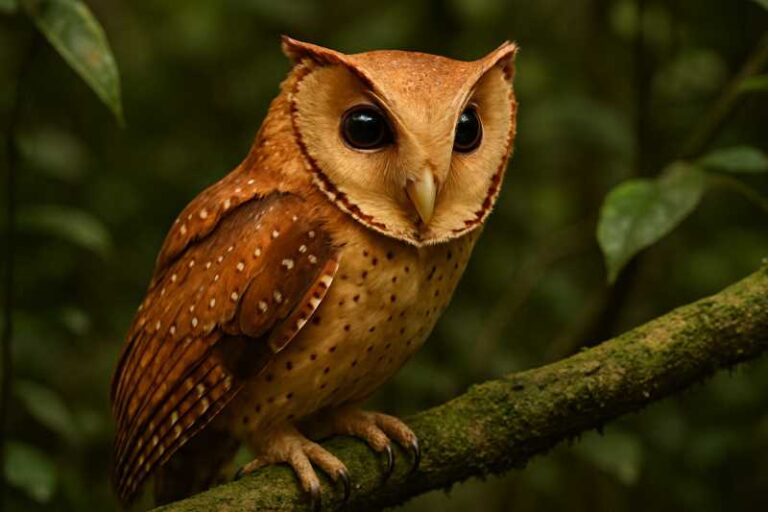
The Mountain Owlet-nightjar is approximately 20 to 25 centimetres long. It has cryptic brown, grey and buff plumage, usually with pale spotting and mottling that helps it blend into bark, foliage and shaded forest edges. A pale collar or hind-neck band, buff facial markings and a broadly spotted or streaked underside can be visible at close range.
Its rounded wings, long rounded tail and wide gape are typical of owlet-nightjars. The eyes are large and adapted to low-light conditions, while fine bristles around the bill may help detect or handle flying insects. Reliable evidence for strong sexual dimorphism is lacking, and males and females are generally difficult to distinguish in the field. Juvenile plumage is poorly documented.
Plumage varies geographically across New Guinea. Forms formerly treated by some authorities as Archbold’s Owlet-nightjar and other subspecies are now generally included within Aegotheles albertisi by current taxonomic treatments.
Range and Habitat
The Mountain Owlet-nightjar is endemic to New Guinea, occurring in mountain ranges from the Bird’s Head and Wandammen Peninsulas through the central highlands to the Huon and south-eastern peninsulas. It occurs in both Indonesian New Guinea and Papua New Guinea.
It is associated mainly with humid subtropical or tropical montane forest, including forest edges, clearings and some disturbed or semi-open upland habitats. Published records place it broadly from about 800 to 2,900 metres above sea level, with occasional records at higher elevations in the Huon Peninsula. Local abundance and elevation limits vary between mountain ranges.
The species is considered a resident rather than a regular long-distance migrant, although local movements may occur in response to conditions and food availability. Its dependence on upland forest makes the protection of connected montane habitats important.
Where to See This Species
The Mountain Owlet-nightjar is difficult to locate and is more often heard than seen. Night surveys should be conducted with experienced local guides, with minimal use of playback and no disturbance of suspected roosting sites.
Kumul Lodge, Western Highlands Province, Papua New Guinea
The forest trails and surrounding montane habitats at Kumul Lodge are among the most consistently documented places to look for this species. Birding reports have recorded Mountain Owlet-nightjars calling near the cabins and have also documented birds seen along the lodge trails. Dusk and night walks are the most appropriate approach, particularly in forested areas around the lodge.
Nearby accommodation: Kumul Lodge itself provides lodge-style accommodation. Mount Hagen is the nearest major town, with additional hotels, guest houses and self-catering options.
Ambua Lodge and the Tari Valley, Hela Province, Papua New Guinea
The montane forest around Ambua Lodge and the upper Tari Valley supports a well-documented highland bird community that includes the Mountain Owlet-nightjar. Records are mainly based on birds heard during night surveys, so visitors should expect a listening opportunity rather than a guaranteed sighting. Forest edges and quiet trails above the lodge are the most suitable habitats to investigate with local guidance.
Nearby accommodation: Ambua Lodge is the principal wildlife accommodation in the area. Tari provides a limited range of additional guest houses and small lodge-style accommodation.
Behaviour and Diet
The Mountain Owlet-nightjar is primarily nocturnal and most active around dusk, during the night and before dawn. It usually remains motionless during daylight, roosting on a branch, against a trunk or in dense vegetation where its plumage provides effective camouflage.
Its call has been described as a short, high-pitched, squeaky note that may be repeated at intervals and can resemble the bark or yap of a small dog. Individuals are often detected by sound before they are seen. The species is generally encountered singly or in pairs, and its social behaviour remains poorly known.
The diet consists mainly of insects and other small invertebrates, including beetles, moths and similar forest arthropods. It probably captures much of its prey during short flights from a perch, although owlet-nightjars may also take prey from foliage, bark or the ground.
Breeding information is limited. Natural tree cavities and other sheltered hollows are used for nesting, and available records indicate a small clutch, commonly reported as a single egg. The breeding season is not fully established across the range, and claims about long-term pair bonds, incubation roles and lifespan should be treated cautiously.
Identification Tips
- Look for a small, compact night bird with mottled brown, grey and buff plumage, a long rounded tail and rounded wings.
- A pale hind-neck collar, buff facial markings and pale spotting on the underparts can be useful when the bird is illuminated briefly.
- The species is most likely to be detected by its distinctive high, squeaky call rather than by sight.
- A roosting bird may remain completely still on a branch or beside a tree trunk, making it easy to overlook.
- The larger Feline Owlet-nightjar (Aegotheles insignis) is a potential highland comparison and is substantially heavier. The Barred Owlet-nightjar (Aegotheles bennettii) is generally associated with lower elevations and shows a more obviously barred pattern.
- Avoid relying on plumage alone, because Mountain Owlet-nightjars show geographic variation and can appear different across New Guinea.
Conservation Status
The Mountain Owlet-nightjar is currently listed as Least Concern on the IUCN Red List. Its broad distribution means that it does not currently meet the thresholds for a threatened category, although the population is suspected to be declining.
The principal concern is the loss and degradation of montane forest through agricultural expansion, logging, forest fragmentation and associated development. Climate change may place additional pressure on high-elevation habitats by altering forest composition and shifting suitable climatic zones. Protecting large, connected areas of New Guinea’s upland forest, maintaining forest edges and limiting unnecessary disturbance at roosting and nesting sites are important conservation measures.
Frequently Asked Questions
Where does the Mountain Owlet-nightjar live?
It lives in the mountain forests of New Guinea, including parts of Indonesian New Guinea and Papua New Guinea. It is mainly associated with humid montane forest, forest edges and nearby clearings at medium to high elevations.
Is the Mountain Owlet-nightjar nocturnal?
Yes. It is mainly active after dusk and before dawn. During daylight it usually roosts quietly and relies on cryptic plumage to avoid detection.
What does the Mountain Owlet-nightjar eat?
Its diet consists mainly of insects and other small invertebrates, including beetles and moths. It probably takes much of its prey during short flights from a perch.
How can the Mountain Owlet-nightjar be identified?
Useful features include its small size, mottled brown and grey plumage, rounded wings, long rounded tail, pale hind-neck collar and high squeaky call. It is more often heard than seen.
Where is the best place to look for this species?
Kumul Lodge in Papua New Guinea is one of the most consistently documented places to search for it. The montane forest around Ambua Lodge and the Tari Valley also has records, although birds are often detected only by their calls.
Is the Mountain Owlet-nightjar threatened?
It is currently assessed as Least Concern, but its population is suspected to be declining. Habitat loss and degradation in New Guinea’s montane forests are the main conservation concerns.
References
- BirdLife International
- IUCN Red List of Threatened Species
- IOC World Bird List
Related posts