Introduction
Reeves’s Pheasant (Syrmaticus reevesii) is a large, long-tailed pheasant endemic to China. It is best known for the male’s exceptionally elongated, chestnut-barred tail and strongly contrasting golden, white and black plumage. The species occurs mainly in fragmented mountain forests of central and eastern China and is currently assessed as Vulnerable.
Physical Description
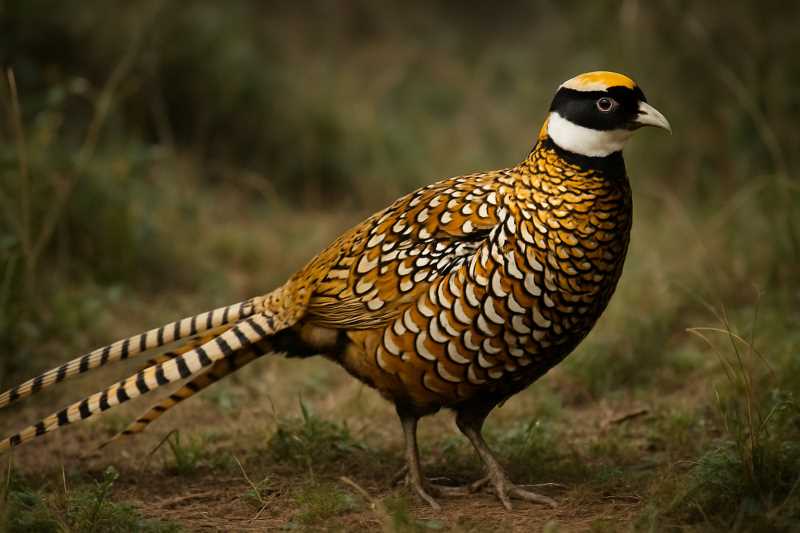
Reeves’s Pheasant shows pronounced sexual dimorphism. Adult males are large birds with a golden-white body marked by black scale-like edging, a white head, a narrow black band through the eyes, reddish bare skin around the eyes and grey legs. The central tail feathers are silvery white with chestnut barring and may reach approximately 2.4 metres, making the tail one of the most extreme examples of elongation among birds.
Adult females are considerably smaller and less conspicuous. They are mainly brown, with darker markings on the crown, a buff-toned face and barred tail feathers. Their shorter tail and cryptic plumage provide better camouflage in woodland undergrowth. Young birds resemble females more closely than adult males and develop the full male plumage progressively as they mature.
Range and Habitat
Reeves’s Pheasant is a non-migratory species endemic to China. Its remaining range is concentrated in fragmented areas of central China, including the Dabie and Qinling mountains and the Shennongjia mountainous region. Historical distribution was broader, but many former localities have experienced declines or local disappearance.
The species is associated with montane forests between approximately 200 and 2,600 metres above sea level. It uses coniferous, broad-leaved and mixed forests, as well as mature plantations, shrubland and forest edges where suitable cover and food are available. Research indicates that a mosaic of forest types and dense understorey is important throughout the year, while breeding birds may use nearby farmland edges and younger conifer plantations.
Captive and introduced populations occur outside China, but these do not form part of the species’ native distribution and should not be confused with its wild range.
Behaviour and Diet
Reeves’s Pheasant is primarily terrestrial and generally forages during the day. It is largely herbivorous, feeding on plant material such as seeds, fruits, leaves and other vegetation. The composition of its diet varies seasonally and may include small amounts of animal food.
Birds may occur singly, in pairs or in small groups. Winter grouping has been recorded in some populations, while males show strong site fidelity and maintain relatively stable home ranges. Activity and movement patterns vary with season, with breeding birds tending to use habitat differently from non-breeding groups.
The breeding period generally extends from late March into early July. Males display their ornamental plumage and long tails during courtship, while females select nesting and brood-rearing sites in areas with suitable vegetation, shelter and access to food. The species is sensitive to disturbance from roads, buildings, livestock and other human activity, particularly where these divide remaining forest habitat.
Identification Tips
- The adult male is unmistakable when seen well: look for the very long, pale tail with chestnut bars, a white head with a black eye-band and a golden, black-edged body.
- The tail is usually the first feature noticed, although it may be difficult to see clearly in dense vegetation or when the bird is moving through steep forest.
- The female is much browner and shorter-tailed, with a barred pattern that blends into woodland litter and undergrowth.
- Do not identify a long-tailed pheasant from tail length alone. Captive birds, hybrids and other ornamental pheasants may occur outside the native range, so location, head pattern and body plumage should also be considered.
Conservation Status
Reeves’s Pheasant is listed as Vulnerable on the IUCN Red List. The population is considered to be declining, and the remaining wild birds are distributed among fragmented subpopulations.
The principal threats are loss and fragmentation of mature forest, infrastructure development, disturbance, illegal hunting and capture, and trade involving feathers, eggs or live birds. Habitat fragmentation can reduce access to breeding and feeding areas and isolate local populations. The species is also listed in Appendix II of the Convention on International Trade in Endangered Species of Wild Fauna and Flora (CITES).
Important conservation measures include protecting and restoring connected forest habitat, maintaining suitable understorey, monitoring remaining populations, reducing hunting and illegal collection, and regulating international trade. Captive breeding may support conservation and research, but it cannot replace protection of wild populations and their habitats.
Frequently Asked Questions
Where does Reeves’s Pheasant live?
It is native to central and eastern China, where it inhabits mountain forests and associated shrubland at elevations of roughly 200 to 2,600 metres.
Is Reeves’s Pheasant endangered?
The species is classified as Vulnerable on the IUCN Red List. Its population is declining because of habitat loss, fragmentation, hunting and illegal collection.
How long is a male Reeves’s Pheasant’s tail?
The tail of a large male may reach approximately 2.4 metres, although length varies between individuals and the longest feathers are not present on every bird.
What does Reeves’s Pheasant eat?
It is largely herbivorous and feeds mainly on seeds, fruits, leaves and other plant material. Its diet changes with season and local food availability.
Can Reeves’s Pheasants fly?
Yes. Although they spend much of their time walking and foraging on the ground, they can fly, especially when escaping danger or moving between nearby areas of cover.
Is Reeves’s Pheasant native outside China?
No. Populations have been introduced or kept in captivity in other countries, but the species’ natural range is restricted to China.
References
- BirdLife International. 2018. Syrmaticus reevesii. The IUCN Red List of Threatened Species 2018: e.T22679340A132057371. International Union for Conservation of Nature. https://www.iucnredlist.org/ (accessed 8 September 2026).
- Gill, F., Donsker, D. and Rasmussen, P. (eds). 2026. IOC World Bird List, version 15.2. International Ornithologists’ Union. https://www.worldbirdnames.org/ (accessed 8 September 2026).
- IUCN and TRAFFIC. 2019. IUCN/TRAFFIC Analyses of Proposals to CoP18: Inclusion of Reeves’s Pheasant Syrmaticus reevesii in Appendix II. International Union for Conservation of Nature and TRAFFIC. https://portals.iucn.org/library/sites/library/files/documents/CITES-007-2019-En.pdf (accessed 8 September 2026).
- Li, S., et al. 2013. Dramatic decline of the Vulnerable Reeves’s pheasant Syrmaticus reevesii, endemic to central China. Oryx, 47(3), 416-421. https://doi.org/10.1017/S0030605312001327.
- Xu, J.-L., Zhang, X.-H., Zhang, Z.-W., Zheng, G.-M., Ruan, X.-F., Zhang, K.-Y. and Xi, B. 2010. Breeding habitat selection of Reeves’s Pheasant (Syrmaticus reevesii) in Dongzhai National Nature Reserve, Henan Province, China. Zoological Research, 31(2), 198-204. https://doi.org/10.3724/SP.J.1141.2010.02198.
- Xu, J., Zhang, Z., Zheng, G., Zhang, X., Ruan, X. and Xu, Y. 2007. Home range and habitat use of Reeves’s Pheasant Syrmaticus reevesii in the protected areas created from forest farms in the Dabie Mountains, central China. Bird Conservation International, 17(4), 319-330. https://doi.org/10.1017/S0959270907000834.
- Xu, J., Zhang, Z., Zheng, G., Zhang, X., Ruan, X. and Xu, Y. 2009. Home range, daily movements and site fidelity of male Reeves’s Pheasants Syrmaticus reevesii in the Dabie Mountains, central China. Wildlife Biology, 15(1), 20-27. https://doi.org/10.2981/08-032.
- Zhang, L., et al. 2020. Human infrastructure development drives decline in suitable habitat for Reeves’s pheasant in the Dabie Mountains in the last 20 years. Global Ecology and Conservation, 22, e00940. https://doi.org/10.1016/j.gecco.2020.e00940.
Related posts