Introduction
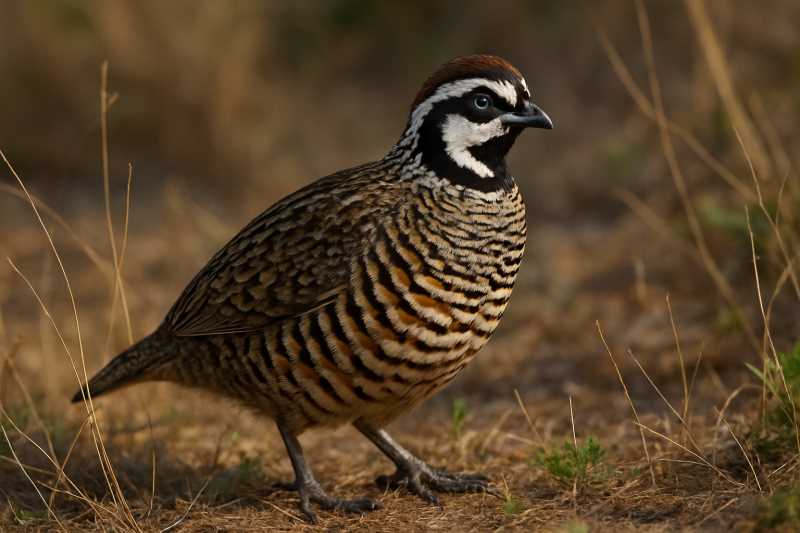
The Banded Quail (Philortyx fasciatus) is a small New World quail endemic to Mexico. It is a resident, ground-dwelling species of dry western and central Mexican landscapes, especially tropical deciduous forest, thorn scrub, open grassland and cultivated areas with suitable cover. Its bold black-and-white barring, dark pointed crest and habit of moving in small groups distinguish it from many other Mexican quails.
Physical Description
The Banded Quail is a compact bird measuring about 20–21 cm in length and weighing approximately 126–130 g. It has a moderately long tail, a short dark bill and a small, pointed crest that may project forwards over the face.
Adults are mainly grey-brown and dark brown above. The underparts are pale, with conspicuous black barring on the flanks, belly and undertail coverts. The head shows a dark crest and a contrasting facial pattern, including a dark stripe behind the eye. The throat is pale, while the head, neck and upper breast may show warm brown or cinnamon tones.
The sexes are similar, although females are generally paler and have less strongly marked facial and crest plumage. Juveniles differ from adults and are initially more heavily streaked. Young birds acquire an adult-like appearance after successive moults, but age-related plumage differences can remain useful when examining a close view.
Range and Habitat
The Banded Quail is endemic to Mexico. Its range extends through parts of western and south-central Mexico, including southern Jalisco, Colima, Michoacán, Morelos, Puebla and Guerrero. The species is strongly associated with the Balsas Basin and adjacent Pacific-slope regions, although published records have refined and extended the boundaries of its known distribution.
It is a non-migratory species. It occurs from near sea level to approximately 1,500–1,800 m, depending on the region. Preferred habitats include tropical deciduous forest, dry scrub, thorn scrub, open hillsides, weedy agricultural land, overgrown pasture and forest edges. It generally benefits from a combination of dense vegetation for shelter and more open ground for feeding.
Although it can use modified landscapes, the presence of cover is important. Agricultural expansion, urban growth and the fragmentation or clearance of dry forest can reduce the quality and continuity of suitable habitat.
Behaviour and Diet
Banded Quails are terrestrial and usually remain close to vegetation that provides concealment. They commonly travel in coveys, with groups often numbering around a dozen birds, although larger groups have also been reported. When disturbed, they may run into cover before taking flight. If a covey does flush, the birds can scatter in different directions.
The diet is dominated by plant material, particularly seeds from grasses, herbs and legumes. Reported food items include seeds of plants such as croton, thistle and sunflower, as well as cultivated grains and other available vegetable matter. Arthropods and other invertebrates are also eaten, especially when adults are feeding growing chicks.
Breeding records indicate activity during the late rainy season, commonly around August and September, although timing may vary geographically and with local rainfall. The nest is a shallow ground scrape concealed by grass or other vegetation. Published accounts report variable clutch sizes, including approximately 5–16 eggs, and an incubation period of about 22–23 days. Evidence from field accounts indicates that males may participate in incubation and nest defence, but the breeding biology of the species remains incompletely documented.
Identification Tips
Look for the following combination of features:
- A small, compact quail with a pointed dark crest.
- Grey-brown upperparts and a comparatively long tail.
- Pale underparts marked with strong black barring.
- A dark stripe behind the eye and a contrasting pale throat.
- A preference for walking through dry scrub, deciduous forest edges, weedy fields and overgrown pasture.
- Small coveys moving quietly through cover rather than remaining in the open.
The bold barred belly and dark pointed crest are particularly useful field marks. In western and south-central Mexico, these features help separate the Banded Quail from other small quails, but views may be brief because the species is secretive and often detected only when a covey moves or flushes.
Conservation Status
The Banded Quail is currently assessed as Least Concern on the IUCN Red List. This global category indicates that the species is not presently considered at immediate risk of extinction, but it does not mean that local populations are free from pressure.
The principal concerns are the loss and fragmentation of tropical dry forest, thorn scrub and other natural cover through agricultural expansion, urban development and land-use change. Hunting for food has also been reported in parts of its range. Maintaining connected dry-forest and scrub habitats, retaining dense cover within agricultural landscapes, monitoring local populations and enforcing applicable hunting regulations are important conservation measures.
The species is endemic to Mexico, so changes within that country account for the whole of its global range. More detailed information on population size and long-term population trends would improve conservation planning.
Frequently Asked Questions
Where does the Banded Quail live?
The Banded Quail lives only in Mexico, mainly in western and south-central states including Jalisco, Colima, Michoacán, Morelos, Puebla and Guerrero.
Is the Banded Quail migratory?
No. It is generally regarded as a resident species, although individuals may make local movements in response to food, cover and seasonal conditions.
What does the Banded Quail eat?
Its diet consists mainly of seeds and other plant material, supplemented by insects and other invertebrates. Animal food may be especially important when adults are feeding chicks.
How can the Banded Quail be identified?
The most useful field marks are its small pointed crest, dark facial stripe, pale throat and strongly black-and-white barred underparts. It is also usually encountered in small coveys in dry, well-covered habitats.
When does the Banded Quail breed?
Breeding has been reported mainly during the late rainy season, often in August and September, although the timing can vary between regions. The nest is placed on the ground and concealed in vegetation.
Is the Banded Quail endangered?
The species is currently listed as Least Concern by the IUCN. Nevertheless, habitat loss, fragmentation and hunting can create local pressures, particularly where dry forest and scrub are heavily altered.
References
- BirdLife International. 2026. Banded Quail Philortyx fasciatus Species Factsheet. BirdLife DataZone. Accessed 8 September 2026. https://datazone.birdlife.org/species/factsheet/banded-quail-philortyx-fasciatus
- Gill, F., Donsker, D. and Rasmussen, P., eds. 2026. IOC World Bird List, version 15.2. International Ornithologists’ Union. Accessed 8 September 2026. https://www.worldbirdnames.org/
- MacGregor-Fors, I. 2006. Nota sobre la distribución de Philortyx fasciatus, una especie endémica de México. Huitzil, Revista Mexicana de Ornitología 7(2): 30–31. https://doi.org/10.28947/hrmo.2006.7.2.33
- Eitniear, J. C., Baccus, J. T. et al., eds. 2003. Conservation of Quail in the Neotropics: Proceedings of a Symposium held during the VI Neotropical Ornithological Congress, Monterrey, Mexico, 4–10 October 1999. Center for the Study of Tropical Birds. https://digitalcommons.unl.edu/galliformes_conferences/3/
- Howell, S. N. G. and Webb, S. 1995. A Guide to the Birds of Mexico and Northern Central America. Oxford University Press.
- Departamento de Zoología, Instituto de Biología, Universidad Nacional Autónoma de México. 2015. Philortyx fasciatus (Gould, 1843), Colección Nacional de Aves, specimen record CNAV:000637. Accessed 8 September 2026. https://datosabiertos.unam.mx/IBUNAM:CNAV:000637
Related posts