Introduction
The White-vented Plumeleteer (Chalybura buffonii) is a medium-sized hummingbird in the family Trochilidae. It is recognised by its robust build, broad white undertail coverts and iridescent green and blue plumage. The species is resident rather than migratory and occurs mainly in northern South America and Panama.
Physical Description
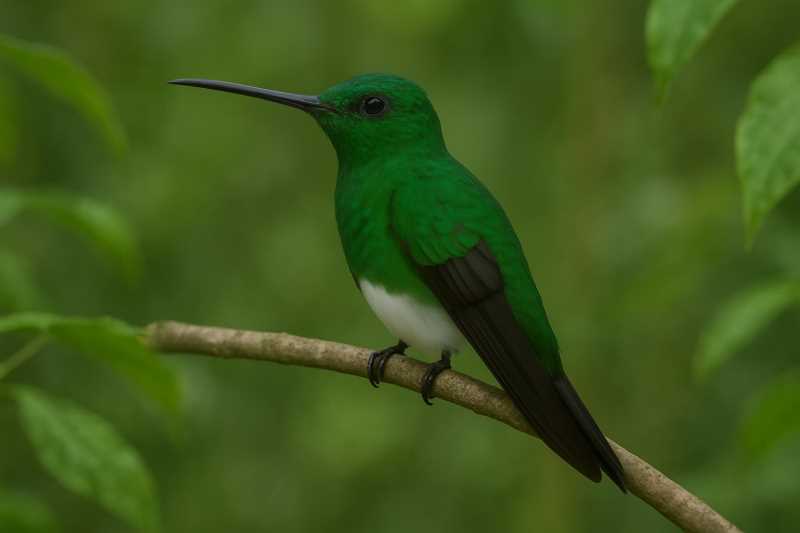
The White-vented Plumeleteer is a heavy-bodied hummingbird measuring about 10.5 cm in length. Its bill is fairly long and straight, and both sexes have prominent pale to white undertail coverts that give the species its common name.
Adult males are generally more brightly coloured, with a glittering green head and body, bluish or violet-blue areas on the throat, breast and belly, and a dark blue tail. Females are duller, with green upperparts and pale grey underparts that may show some green flecking. The extent and tone of the blue and green plumage vary between geographic forms.
The legs are partly concealed by fluffy feathering, a characteristic shared by plumeleteers. Juveniles and immature birds are less richly coloured than adults and may show reduced iridescence and less clearly defined ventral markings.
Range and Habitat
The species is distributed from Panama through Colombia and Venezuela, with additional populations in Ecuador and north-western Peru under taxonomic treatments that recognise the intermedia form as part of the White-vented Plumeleteer. Taxonomic authorities differ in their treatment of some forms, particularly the population in south-western Ecuador and north-western Peru, which some classifications associate with the Bronze-tailed Plumeleteer.
White-vented Plumeleteers inhabit forest edges, clearings, gardens, shaded plantations, secondary growth, scrub and a range of moist, wet and seasonally drier woodland habitats. They may occur from near sea level to approximately 2,000 metres, although local elevation limits vary between populations. Their ability to use disturbed and semi-open habitats helps explain their presence in gardens and at hummingbird feeding stations, but they remain dependent on suitable flowering plants, perches and nesting cover.
Where to See This Species
Hotel Tinamú Birding Nature Reserve, Caldas, Colombia
This privately managed birding reserve near Manizales has documented White-vented Plumeleteers in its forested grounds and feeding areas. The reserve combines humid woodland, gardens and flowering plants, making it a practical location for observing a species that often visits edges and feeders.
Nearby accommodation: The reserve itself provides lodge-style accommodation. Manizales is the nearest major town and offers hotels, guest houses and other visitor accommodation.
Jardín Encantado, Cundinamarca, Colombia
Jardín Encantado near San Francisco de Sales is a publicly accessible hummingbird-viewing garden with records of White-vented Plumeleteer. Its flowering gardens and established feeding areas provide close-range opportunities, although sightings remain dependent on local conditions and bird activity.
Nearby accommodation: San Francisco de Sales has small hotels, guest houses and rural self-catering accommodation. Larger selections of hotels are available around Bogotá for visitors travelling from the capital.
El Paujil ProAves Reserve, Boyacá, Colombia
El Paujil protects humid tropical forest in the Middle Magdalena valley, between approximately 175 and 750 metres. White-vented Plumeleteers have been recorded at the reserve, where forest trails, clearings and flowering plants provide suitable habitat. Access should be arranged in advance because the reserve is reached through Puerto Pinzón and conditions can be difficult during wet weather.
Nearby accommodation: The reserve provides cabins for visitors. Puerto Boyacá is the main gateway town, while Puerto Pinzón is the closer local settlement.
Behaviour and Diet
White-vented Plumeleteers are active during the day and spend much of their time in the understory and lower to middle levels of vegetation. They hover while feeding and regularly perch between visits to flowers.
Nectar is the main energy source. Individuals visit a wide variety of flowering plants and commonly use trap-lining behaviour, following a regular circuit of nectar sources. A bird may also defend a particularly productive patch from other hummingbirds. Small insects and other arthropods provide protein and are taken by hawking from a perch, hovering near vegetation or gleaning prey from leaves and spider webs.
The species is not known for long-distance migration or regular seasonal movements. Breeding timing varies geographically. The female builds a small cup nest from plant down and fibres, bound with spider silk and often decorated externally with moss and lichen. Nests may be placed on a horizontal branch or fork only a few metres above the ground. A closely monitored nest contained two eggs, and the single nestling fledged after about 21 days. Detailed information on incubation and parental care remains limited.
Identification Tips
- Look for a relatively large, robust hummingbird with a broad-bodied profile.
- The conspicuous white undertail coverts are the most useful feature, especially when the bird is perched or turning in flight.
- Adult males show stronger blue and green iridescence than females, while females have paler grey underparts.
- The species often visits flowers at forest edges, gardens and feeders, where its relatively heavy build and powerful flight can be noticeable.
- Take care when identifying plumeleteers by the white vent alone. The Bronze-tailed Plumeleteer and related geographic forms can create identification and taxonomy issues, and the colour of the tail, underparts and legs should also be assessed.
Conservation Status
The White-vented Plumeleteer is assessed as Least Concern on the IUCN Red List. It has a broad geographic range and can tolerate some habitat modification, but the population is considered to be declining and the species is not uniformly common throughout its range.
Habitat loss through deforestation, agricultural expansion and the degradation of humid forest are the principal concerns, particularly for populations with more restricted distributions. Conservation depends on maintaining forest remnants, secondary vegetation, flowering resources and habitat connectivity. Protected areas and privately managed reserves provide important refuges, while further monitoring is needed to clarify population trends and the status of geographically variable forms.
Frequently Asked Questions
Where can the White-vented Plumeleteer be found?
It occurs in Panama, Colombia and Venezuela, with additional populations in Ecuador and north-western Peru depending on the taxonomic treatment used for the intermedia form.
Is the White-vented Plumeleteer migratory?
No. It is generally regarded as a resident hummingbird and is not known to undertake regular long-distance migration, although local movements may occur in response to food availability.
What does the White-vented Plumeleteer eat?
It mainly feeds on nectar from a wide range of flowering plants. It also takes small insects and spiders, which provide important protein and other nutrients.
How can the species be identified in the field?
Look for a large, sturdy hummingbird with green and blue iridescent plumage and conspicuous white undertail coverts. Females are duller and have paler grey underparts.
Where is the best place to see this hummingbird?
Reliable documented locations include Hotel Tinamú Birding Nature Reserve, Jardín Encantado and El Paujil ProAves Reserve in Colombia. Gardens, forest edges and feeding stations are often more productive than dense forest interiors.
References
- BirdLife International
- IOC World Bird List
- Cornell Lab of Ornithology, Birds of the World
Related posts