Introduction
The Caspian Snowcock (Tetraogallus caspius) is a large, ground-dwelling member of the pheasant family, Phasianidae. It is a resident high-mountain bird of the Caucasus and neighbouring ranges in Turkey and Iran, with smaller or more localised populations elsewhere in its range. Its specialised habitat consists of steep, rocky slopes, alpine scrub and sparsely vegetated mountain terrain. (ww.worldbirdnames.org)
Physical Description
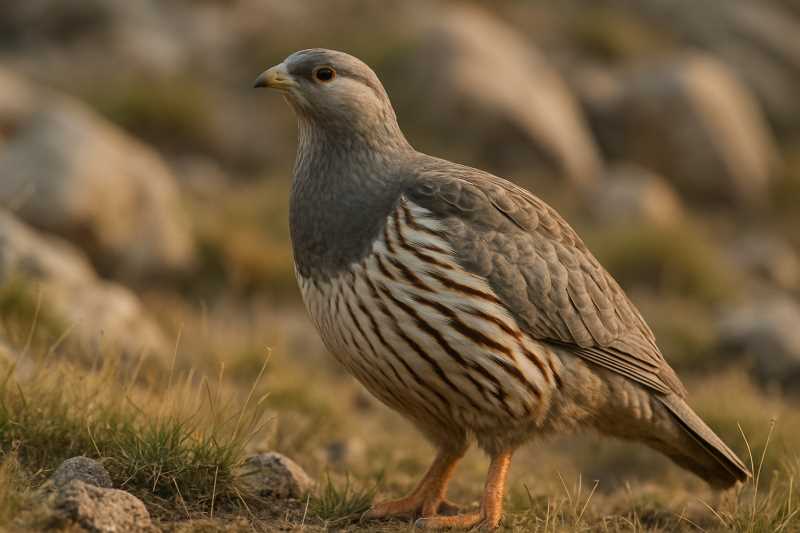
The Caspian Snowcock is a robust, partridge-like bird measuring approximately 56–63 centimetres in length. Its plumage is predominantly pale grey, with finely patterned brown, black and white markings that provide effective camouflage among scree, exposed rock and alpine vegetation. The breast is pale grey, the throat is white, and a conspicuous white patch extends along the side of the neck. The nape is darker grey, while the flight feathers and undertail appear distinctly white in flight. (academic.oup.com)
Males and females are broadly similar in plumage, although males are generally larger and may show stronger colour contrast. Juveniles are smaller and duller than adults. Plumage varies geographically, with some recognised forms becoming paler towards the east. (en.wikipedia.org)
The species has a stout bill, strong legs and broad wings suited to powerful flights between mountain slopes. Its usual posture is upright and alert, but it often remains inconspicuous when viewed against rocky ground.
Range and Habitat
The Caspian Snowcock occurs in mountainous regions of eastern and southern Turkey, Armenia, Azerbaijan, Georgia and Iran. Range accounts also include parts of Iraq and Turkmenistan, although the species is unevenly distributed and some peripheral populations are small or poorly documented. In Iran, it is associated with several major mountain systems, including the Alborz and Zagros. (birdlifedata.blob.core.windows.net)
It usually inhabits steep, stony slopes, rocky ridges, scree, alpine meadows and open scrub with sparse grass or herb cover. Breeding sites are generally found between about 1,800 and 3,000 metres, although the species may occur locally at higher elevations, approaching the snow line. (birdforum.net)
The Caspian Snowcock is considered resident rather than migratory. Seasonal movements are mainly local adjustments in altitude and slope exposure, particularly when snow limits access to food. It remains closely associated with rugged mountain terrain throughout the year. (datazone.birdlife.org)
Behaviour and Diet
This is a wary and elusive bird that usually keeps to the ground. When disturbed, it may run uphill or crouch among rocks before taking flight. Its flight is powerful, with rapid wingbeats followed by gliding, and it commonly uses steep slopes and ridgelines to gain height or move between valleys.
Outside the breeding season, Caspian Snowcocks may form small groups or larger winter flocks. During the breeding season, pairs become more widely spaced and males advertise from exposed slopes with loud, far-carrying whistles. The call has been compared with the distant sound of a Eurasian Curlew, although the vocal repertoire also includes harsher notes and bubbling calls. (birdforum.net)
The diet consists mainly of plant material, including leaves, shoots, buds, seeds and other alpine vegetation. Invertebrates may be taken occasionally, particularly when available to adults or growing young, but the species is principally herbivorous. (birdforum.net)
Breeding begins in spring, with timing influenced by altitude and local snow conditions. The nest is a shallow scrape on the ground, usually placed on a rocky slope and partly sheltered by a rock or low plant. Clutches commonly contain about 6–9 eggs, which are incubated by the female alone. The young are precocial and leave the nest soon after hatching, remaining under the female’s guidance while they feed and develop. (scribd.com)
Identification Tips
- Look for a large, pale-grey snowcock on steep rocky slopes or alpine ridges.
- The white throat and white patch on the side of the neck contrast with the darker grey nape.
- In flight, the white flight feathers and undertail are conspicuous.
- The bird’s cryptic body pattern often makes it difficult to detect when it is stationary among scree.
- Its loud, sustained whistle can reveal its presence before the bird is seen.
- The similar Caucasian Snowcock (Tetraogallus caucasicus) is associated mainly with the Caucasus and can be difficult to separate visually. Vocal differences, range and careful comparison of plumage are more reliable than size alone. (en.wikipedia.org)
Conservation Status
The Caspian Snowcock is currently assessed as Least Concern globally. However, this category does not mean that all populations are secure. BirdLife’s European assessment recorded decreasing trends in Turkey, the principal European range state, while trends in Armenia and Azerbaijan were reported as stable or uncertain and data for Georgia were limited. (cites.org)
Potential and documented local pressures include habitat degradation, disturbance, overgrazing, infrastructure development and hunting or trapping. Because the species depends on specialised high-elevation habitats, climate change is an additional concern. Recent modelling indicates that suitable habitat could decrease substantially under future climate scenarios, although complex terrain may provide local climatic refuges. (birdlifedata.blob.core.windows.net)
Conservation priorities include protecting mountain habitats, maintaining connected areas of suitable alpine terrain, regulating hunting, reducing disturbance during the breeding season and improving population monitoring. Protected areas are important, but further field research is needed because several populations remain poorly surveyed.
Frequently Asked Questions
Where does the Caspian Snowcock live?
It lives in high mountain regions of eastern and southern Turkey, the South Caucasus and Iran. Some range accounts also include Iraq and Turkmenistan, although its distribution is localised in parts of these areas. (birdlifedata.blob.core.windows.net)
What habitat does the Caspian Snowcock prefer?
It prefers steep, rocky slopes, scree, alpine meadows and open scrub with sparse vegetation, generally at elevations of about 1,800–3,000 metres. (birdforum.net)
What does the Caspian Snowcock eat?
Its diet is mainly vegetarian and includes leaves, shoots, buds, seeds and other alpine plant material. Invertebrates may be eaten occasionally. (birdforum.net)
Is the Caspian Snowcock migratory?
No. It is generally regarded as a resident species, although it may make local movements to lower or more sheltered slopes when heavy snow restricts access to food. (datazone.birdlife.org)
How does the Caspian Snowcock nest?
The female lays her eggs in a shallow ground scrape, usually sheltered by a rock or low vegetation. Clutches commonly contain about 6–9 eggs, and the female performs the incubation. The chicks are precocial and leave the nest soon after hatching. (scribd.com)
Is the Caspian Snowcock endangered?
The species is currently classified as Least Concern globally. Nevertheless, some local populations face habitat degradation, hunting pressure and limited monitoring, and climate change may reduce suitable high-elevation habitat in the future. (cites.org)
References
- BirdLife International. 2021. European Red List of Birds: Tetraogallus caspius (Caspian Snowcock), supplementary material. BirdLife International and the European Commission. Available at: https://birdlifedata.blob.core.windows.net/sub-global/133_tetraogallus_caspius.pdf (accessed 8 September 2026).
- BirdLife International. n.d. Caspian Snowcock, Tetraogallus caspius, species factsheet. BirdLife DataZone. Available at: https://datazone.birdlife.org/species/factsheet/caspian-snowcock-tetraogallus-caspius (accessed 8 September 2026).
- Gill, F., Donsker, D. and Rasmussen, P. (eds). 2026. IOC World Bird List, version 15.2. International Ornithologists’ Union. Available at: https://worldbirdnames.org/ (accessed 8 September 2026).
- Madge, S. and McGowan, P. 2002. Pheasants, Partridges and Grouse: A Guide to the Pheasants, Partridges, Quails, Grouse, Guineafowl, Buttonquails and Sandgrouse of the World. Christopher Helm, London. ISBN 978-0-7136-3966-7.
- McGowan, P. J. K., Kirwan, G. M. and Boesman, P. 2015. Caspian Snowcock (Tetraogallus caspius). In: del Hoyo, J., Elliott, A., Sargatal, J., Christie, D. A. and de Juana, E. (eds), Handbook of the Birds of the World Alive. Lynx Edicions, Barcelona. Species account cited in BirdLife International’s European Red List bibliography.
- Ashrafzadeh, M. R., Moradi, M., Khosravi, R., Naghipour, A. A. and Chamberlain, D. 2024. Impacts of climate change on a high elevation specialist bird are ameliorated by terrain complexity. Global Ecology and Conservation 56: e03281. https://doi.org/10.1016/j.gecco.2024.e03281.
- United States Integrated Taxonomic Information System. n.d. Tetraogallus caspius (S. G. Gmelin, 1784). ITIS, Taxonomic Serial No. 175951. Available at: https://www.itis.gov/servlet/SingleRpt/SingleRpt?print_version=PRT&search_topic=TSN&search_value=175951&source=to_print (accessed 8 September 2026).
Related posts