Introduction
The Philippine Swiftlet, Aerodramus mearnsi, is a small swift endemic to the Philippines. It belongs to the family Apodidae and is associated mainly with upland forest, rocky cavities and caves. Like other swiftlets, it spends much of its life in flight, taking flying insects above forested landscapes and mountain valleys.
Physical Description
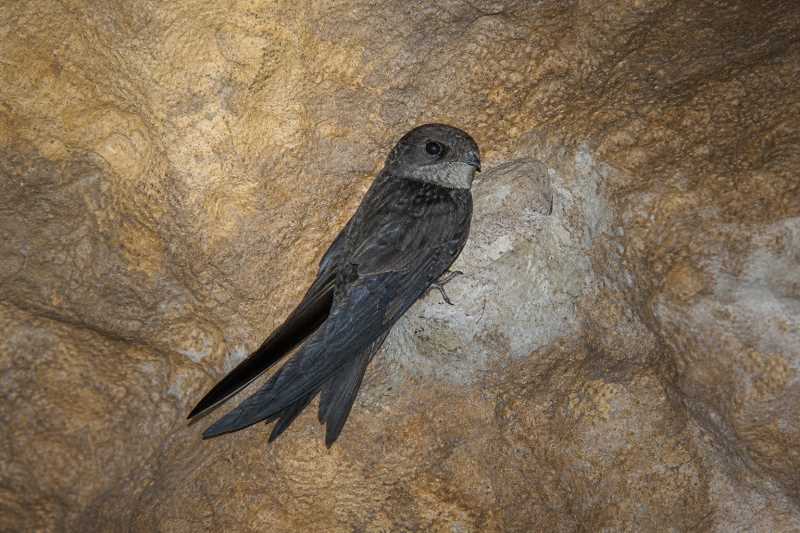
The Philippine Swiftlet is a small, dark swiftlet measuring approximately 10.5 centimetres in length. It has dark brown upperparts, a relatively uniform rump, paler mid-brown underparts, long pointed wings and a slightly forked tail. The plumage is generally subdued and can appear almost black in poor light.
Reliable information on sexual dimorphism, juvenile plumage and age-related variation is limited. Males and females are not known to show obvious differences in the field. The species is difficult to identify visually because several Philippine swiftlets have similarly dark plumage and fast, high flight.
Range and Habitat
The Philippine Swiftlet is endemic to the Philippines. Records are scattered across several islands, including Luzon, Mindoro and Mindanao, with additional historical reports from other parts of the country. Identification has often been difficult, and some older records were reported under former names or may have involved similar swiftlet species.
It is primarily associated with submontane and montane forest, although it may forage over forest edges, clearings and open valleys. Reported records generally come from upland areas, approximately 700 to 1,600 metres above sea level, but the species may occur outside this range. It nests in caves and rock cavities and is considered resident rather than a long-distance migrant.
Where to See This Species
Mount Kitanglad Range Natural Park, Bukidnon, Mindanao, Philippines
Mount Kitanglad is one of the more reliable localities for Philippine Swiftlet in Mindanao. The species has been documented in the mountain range, including records from upland forest and caves at approximately 1,260 to 1,620 metres. Look overhead along forest trails, clearings and mountain slopes, particularly in the morning or late afternoon. Identification should be made cautiously because other dark swiftlets occur in the area.
Nearby accommodation: Malaybalay City and the Dalwangan gateway area offer guest houses, hotels, lodges and homestays, while some birding access points use mountain lodges or camps.
Mount Polis, Cordillera Administrative Region, Luzon, Philippines
Mount Polis is a recognised birdwatching area along the mountain road and forested trails between Banaue and the Cordillera highlands. Philippine Swiftlets have been reported there in upland forest, where they may be seen flying above ridges and road openings. The species is local and can be overlooked among other swiftlets, so visits are best made with an experienced local guide.
Nearby accommodation: Banaue is the main gateway, with a range of guest houses, small hotels, homestays and mountain lodges.
Behaviour and Diet
The Philippine Swiftlet is active during the day and feeds on flying insects. It forages in open airspace above forest, along ridges and around clearings, often moving rapidly and continuously. Its diet has not been studied in detail, but it is presumed to consist mainly of small aerial invertebrates, as in other Aerodramus swiftlets.
The species is usually encountered singly or in small groups, although several birds may gather where flying insects are abundant. It is considered resident, and no regular long-distance migration has been established.
Breeding information is limited. A breeding record from Mindoro involved a nest in a cave and a clutch of four eggs. The nest was described as a shallow structure made from moss bound with hardened saliva. Both adults are presumed to contribute to incubation and care of the young, but detailed information on incubation, fledging and nesting success is lacking.
Some Aerodramus swiftlets can use simple echolocation to navigate in dark caves. The Philippine Swiftlet may possess this ability, but the evidence for the species itself is limited, so this should be treated as probable rather than conclusively documented.
Identification Tips
- Look for a small, dark brown swiftlet with a fairly uniform rump, paler brown underparts and a slightly forked tail.
- Expect fast, agile flight over upland forest, ridges and open valleys.
- Do not rely on size or colour alone. Philippine swiftlets are notoriously difficult to separate in flight.
- Compare carefully with the Uniform Swiftlet, Glossy Swiftlet and other local Aerodramus species, using habitat, elevation, rump pattern, tail shape and, where available, vocalisations.
- Photographs, sound recordings and confirmed locality information are often more useful than a brief visual sighting.
Conservation Status
The Philippine Swiftlet is currently assessed as Least Concern. A reliable national population estimate is not available, and its population trend is difficult to determine because the species is poorly known and can be confused with similar swiftlets.
The main conservation concern is the loss and degradation of forest habitat through deforestation, agricultural expansion, development and other land-use changes. Disturbance of caves and nesting sites may also affect local breeding colonies. Protecting upland forest, maintaining suitable cave habitat and improving field identification and monitoring are important conservation measures.
The Philippine Swiftlet should not automatically be treated as one of the commercial edible-nest swiftlets. Its documented nest contains moss bound with saliva, and claims that its nests are routinely harvested as bird’s-nest soup should be avoided unless supported by site-specific evidence.
Frequently Asked Questions
Where is the Philippine Swiftlet found?
The species is endemic to the Philippines, with records from upland areas on Luzon, Mindoro and Mindanao and historical reports from other islands. Its distribution is likely broader than the limited number of well-documented records suggests.
What habitat does the Philippine Swiftlet prefer?
It is mainly associated with submontane and montane forest, rocky cavities and caves. It may forage above forest edges, clearings and mountain valleys.
What does the Philippine Swiftlet eat?
It is presumed to feed mainly on small flying insects and other aerial invertebrates caught during sustained flight.
Can the Philippine Swiftlet echolocate?
It may use simple echolocation when moving through dark caves, as some related Aerodramus swiftlets do. However, species-specific evidence remains limited, so the claim should be treated cautiously.
Is the Philippine Swiftlet endangered?
It is currently assessed as Least Concern. Nevertheless, habitat loss, cave disturbance and limited knowledge of its distribution remain conservation concerns.
Where is the best place to look for this species?
Mount Kitanglad Range Natural Park in Bukidnon and Mount Polis in the Cordillera highlands are documented birdwatching localities. The species is difficult to identify, so local guides and photographic or acoustic documentation are recommended.
References
- BirdLife International
- IOC World Bird List
- Wild Bird Club of the Philippines
Related posts