Introduction
The Paradise Shelduck, also known as the paradise duck or pūtangitangi, is a large, goose-like waterfowl endemic to New Zealand. Its accepted scientific name is Tadorna variegata. The species is notable for its strong sexual dimorphism, loud calls, long-term pair bonds and frequent use of open farmland as well as natural wetlands. [1][2][3]
Physical Description
The Paradise Shelduck is a heavy-bodied shelduck measuring approximately 63–65 cm in length. Males typically weigh about 1.7 kg and females about 1.4 kg, although body mass varies with sex, age and season. [2][3]
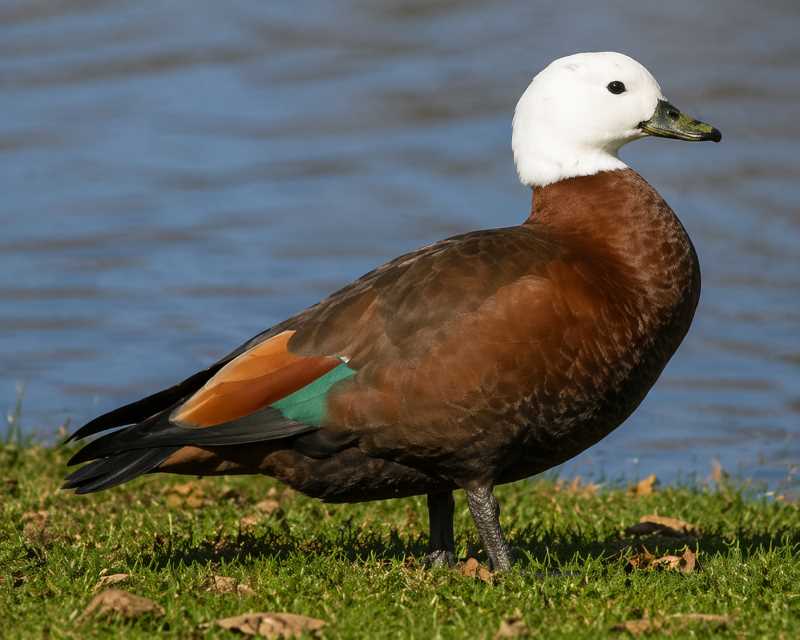
Adult males have a black head and neck with a greenish gloss, a dark grey body finely marked with darker barring, black rump and tail, and chestnut colouring on the undertail. Adult females are more conspicuous, with a brilliant white head and neck, a rich chestnut body and darkly marked upperparts. Both sexes show contrasting white areas on the upperwing in flight, together with dark flight feathers and a metallic green speculum. [2][3]
Juveniles resemble adult males but are duller. Young females gradually develop white feathering around the eyes and at the base of the bill, which expands across the head as they mature. The sexes therefore become increasingly easy to distinguish after fledging. [1][2]
Range and Habitat
The Paradise Shelduck is endemic to New Zealand and breeds throughout the North and South Islands, Stewart Island and several offshore islands. It is widely distributed in pasture, arable land, tussock grassland, wetlands, farm ponds, lakes and high-country riverbeds. It also uses open grassed areas in towns and cities. [1][2][3]
The species is generally resident rather than a long-distance migrant. Adults usually remain near breeding territories, but they leave them during the annual moult and gather at traditional moulting sites on ponds, lakes, tarns and riverbeds. Most birds travel relatively short distances between breeding and moulting areas. [4]
There is no recognised geographical variation in the living species. Paradise Shelducks have benefited from the conversion of native forest to pasture and from the creation of artificial ponds, although the loss or degradation of wetlands remains locally harmful. [1][2]
Behaviour and Diet
Paradise Shelducks are highly vocal and are commonly seen in pairs, family groups or larger flocks. The male has a deep, distinctive call often described as “zonk-zonk”, while the female gives a higher-pitched, sharper call that may sound like “zeek-zeek”. Pairs maintain close contact and commonly fly or graze together. [1][2]
The species is primarily herbivorous. Its diet includes pasture grasses, clover, aquatic vegetation and agricultural crops such as peas and grain. Feeding is usually terrestrial, with birds spending considerable time grazing on open ground, although they also use shallow wetlands and pond margins. [1][2][3]
Paradise Shelducks generally form long-term pair bonds. Breeding commonly occurs from August to December, with egg-laying usually concentrated in August and September. Nests may be placed under logs, in ground holes, haysheds, dense vegetation or occasionally tree cavities, including cavities well above the ground. A clutch may contain up to 10 eggs. [1][2]
The female incubates the eggs for about one month, while the male remains nearby and helps defend the territory. After hatching, both parents care for the ducklings. Young birds can fledge at roughly eight weeks. During the moult, usually from December to February or March, adults gather in large groups before returning to breeding areas. [1][4]
Identification Tips
- Look for a large, upright, goose-like duck grazing on pasture or flying between open fields and wetlands.
- The adult male has a black head and neck with a dark, finely marked body.
- The adult female has a striking white head and neck contrasting with a chestnut body.
- Both sexes show prominent white wing patches in flight.
- Juveniles resemble males, while immature females show developing white patches around the eyes and bill.
- The combination of strong male-female colour contrast, large size and loud calls makes the species distinctive in New Zealand.
The Australian Shelduck, Tadorna tadornoides, is a genuine potential comparison because it is similar in size and may occasionally reach New Zealand. However, it is a rare visitor, and the Paradise Shelduck’s black-headed male, white-headed female and characteristic local distribution usually make identification straightforward. [1]
Conservation Status
The Paradise Shelduck is listed globally as Least Concern on the IUCN Red List and is classified as Not Threatened under New Zealand’s national threat-classification system. It is widespread and common, and its population and distribution increased substantially during the twentieth century, including an increase since about 1990. [1][5][6]
The main conservation concerns are localised over-hunting, introduced predators, wetland drainage and the degradation of breeding or moulting habitat. The species is also managed as a game bird in New Zealand, with regional hunting seasons, permits and bag limits intended to regulate harvest. [1][4][7]
Conservation measures include compliance with hunting regulations, protection and restoration of wetlands, maintenance of suitable pasture and pond habitat, and monitoring of regional abundance, productivity and movements. Although the species has benefited from some human land-use changes, continued habitat management is important, particularly where wetlands are drained or polluted. [1][4]
Frequently Asked Questions
Where is the Paradise Shelduck found?
The Paradise Shelduck is found only in New Zealand. It occurs across the North and South Islands, Stewart Island and several offshore islands, using pasture, tussock grassland, farmland, ponds, lakes, wetlands and high-country riverbeds. [1][2]
How can you tell a male and female Paradise Shelduck apart?
The male has a black head and neck with a dark grey body. The female has a white head and neck with a chestnut-coloured body. This pronounced difference between the sexes is one of the species’ most useful identification features. [1][2]
What does the Paradise Shelduck eat?
It mainly grazes on grasses and clover, but it also eats aquatic vegetation and may feed on crops such as peas and grain. [1][2]
Do Paradise Shelducks migrate?
They are mostly resident and do not undertake regular long-distance migration. They do make seasonal movements to communal moulting sites, after which many return to their breeding territories. [1][4]
Where does the Paradise Shelduck nest?
It may nest under logs, in holes in the ground, in haysheds, among dense vegetation or in tree cavities. Nests are not necessarily close to open water. [1][2]
Is the Paradise Shelduck threatened?
It is currently classified globally as Least Concern and in New Zealand as Not Threatened. Local problems can still arise from excessive hunting, introduced predators and wetland loss. [1][5][6]
References
- [1] Department of Conservation Te Papa Atawhai. n.d. “Paradise duck/pūtakitaki/pūtangitangi: New Zealand native wetland and river birds.” Department of Conservation, New Zealand. Available at: https://www.doc.govt.nz/nature/native-animals/birds/birds-a-z/paradise-duck-putakitaki/ (accessed 8 September 2026).
- [2] Heather, B. D., and H. A. Robertson. 2005. “Paradise Shelduck, Tadorna variegata.” In The Field Guide to the Birds of New Zealand. Penguin Books, Auckland. Species account available through New Zealand Birds Online: https://www.nzbirdsonline.org.nz/assets/95597/1691919878-tadvar_fg.pdf (accessed 8 September 2026).
- [3] New Zealand Birds Online. n.d. “Paradise shelduck | Pūtangitangi, Tadorna variegata.” New Zealand Birds Online, hosted by Birds New Zealand, Te Papa and the New Zealand Department of Conservation. https://www.nzbirdsonline.org.nz/species/paradise-shelduck (accessed 8 September 2026).
- [4] Department of Conservation Te Papa Atawhai. 2025. “Bird species of concern at wind farms.” Department of Conservation technical report, New Zealand. https://www.doc.govt.nz/globalassets/documents/science-and-technical/drds317entire.pdf (accessed 8 September 2026).
- [5] BirdLife International. n.d. “Paradise Shelduck Tadorna variegata Species Factsheet.” BirdLife DataZone. https://datazone.birdlife.org/species/factsheet/paradise-shelduck-tadorna-variegata (accessed 8 September 2026).
- [6] World Bird Names. 2026. “Paradise Shelduck / Tadorna variegata.” IOC World Bird List, version 15.2. https://www.worldbirdnames.com/bird/paradise-shelduck/346.html (accessed 8 September 2026).
- [7] Department of Conservation Te Papa Atawhai. n.d. “Game bird licences and permits.” Department of Conservation, New Zealand. https://www.doc.govt.nz/parks-and-recreation/things-to-do/hunting/permits-and-licences/game-bird-licences-and-permits/ (accessed 8 September 2026).
Related posts