Introduction
Archbold’s Nightjar (Eurostopodus archboldi) is a poorly known, nocturnal nightjar endemic to the highlands of New Guinea. It occurs in montane forests and adjoining open areas, where its dark, mottled plumage provides effective camouflage during the day. The species is also known as the Mountain Eared-Nightjar and Cloud-forest Nightjar. (datazone.birdlife.org)
Physical Description
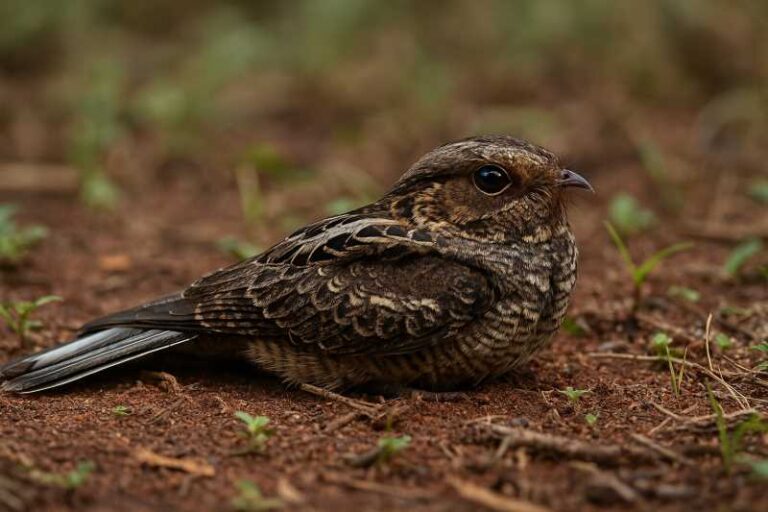
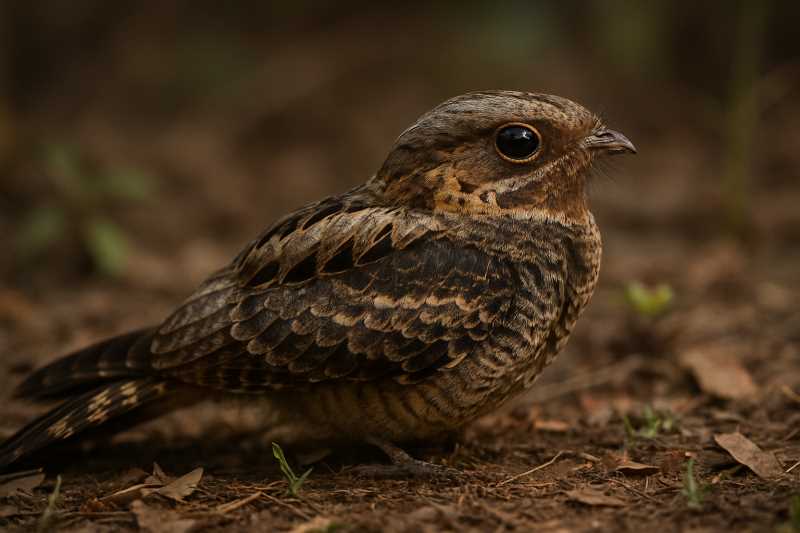
Archbold’s Nightjar is a dark, heavily marked nightjar with predominantly brown, blackish and grey-brown plumage. Buff and pale markings on the eyebrows, collar, mantle, wing coverts and underparts break up the bird’s outline among leaf litter, stones and low vegetation. The species has the broad bill, large eyes and long, pointed wings typical of nightjars.
There is no well-established evidence of pronounced sexual dimorphism, and the species is so rarely observed that detailed information on age-related plumage variation remains limited. A documented breeding bird was described as dark toffee-brown or blackish, with prominent dull-buff eyebrows, a broken white collar, and buff or white feather tips on the underparts and mantle. Unlike some related nightjars, it lacks obvious white patches in the wings and tail. (birder.travel)
Range and Habitat
Archbold’s Nightjar is endemic to New Guinea. Its distribution is patchy and follows high-elevation areas of the Central Cordillera and other montane ranges, including the Arfak Mountains in Indonesian New Guinea. Published records place it broadly at about 1,800–3,260 metres above sea level, although local records and survey coverage are uneven. (datazone.birdlife.org)
It is associated with montane and cloud-forest landscapes, particularly forest edges, clearings, open heathy areas and sites with low vegetation or exposed ground. Documented nests and roosting birds have been found in or near clearings and among stones, shrubs and leaf litter. The species is regarded as a breeding endemic rather than a regular long-distance migrant. (datazone.birdlife.org)
Behaviour and Diet
Archbold’s Nightjar is nocturnal. During daylight, it may roost on the ground or on a low perch, remaining motionless while relying on its cryptic plumage. It becomes active around dusk and forages by making short aerial sallies from a perch, taking insects in flight before returning to a nearby branch, log or other lookout point.
Its recorded prey includes relatively large flying insects such as beetles, moths and cicadas. It may forage over grassy ground, forest clearings and open margins, as well as among the lower and middle levels of the forest. Precise details of its daily movements, social behaviour and population ecology remain poorly known. (en.wikipedia.org)
The species is generally quiet, but a soft, short, trilled or guttural call has been reported around dusk. Adults disturbed near a nest may give alarm calls or perform distraction displays, including fluttering movements intended to draw attention away from the egg. (en.wikipedia.org)
Breeding information is limited. The species does not construct a conventional nest. A single white egg is laid directly on the ground, usually among leaf litter, stones or low vegetation. One documented nest was found in October, but the full breeding season and the roles of the sexes during incubation and chick care are not sufficiently known. Nightjar young hatch in a relatively developed, down-covered condition rather than as fully helpless altricial nestlings. (birder.travel)
Identification Tips
- Look for a dark, densely mottled nightjar in high-elevation forest, especially near clearings, forest edges and open heath.
- The combination of dark brown-black plumage, buff facial and body markings, and a broken pale collar is useful when the bird is seen at close range.
- Its habit of sitting motionless on the ground or a low perch during the day makes it easy to overlook.
- At dusk, listen for a soft, short trill or guttural call rather than expecting a loud, persistent song.
- Elevation and habitat are important clues. In New Guinea, a nightjar encountered in high montane forest is more likely to be Archbold’s Nightjar than the lower-elevation Papuan Nightjar, although identification should also consider structure, plumage and vocalisations.
Conservation Status
Archbold’s Nightjar is currently assessed as Least Concern on the IUCN Red List. BirdLife International identifies the population trend as decreasing, while also noting that the species remains poorly studied and that its population size has not been adequately quantified. (datazone.birdlife.org)
The principal conservation concern is the loss and degradation of montane forest through deforestation, logging, agricultural expansion and associated development. Its restricted highland distribution and dependence on specialised montane habitats may increase its vulnerability if suitable forest and open-edge habitat continue to decline. Protecting high-elevation forests, maintaining habitat within protected areas and improving field surveys are important conservation measures.
Frequently Asked Questions
Where does Archbold’s Nightjar live?
It lives in the highlands of New Guinea, including montane ranges in both Indonesian New Guinea and Papua New Guinea. It is associated mainly with high-elevation forest, forest margins, clearings and open heathy areas.
Is Archbold’s Nightjar migratory?
It is treated as a breeding endemic of New Guinea rather than a regular long-distance migrant. Seasonal movements are poorly documented, so local movement cannot be ruled out.
What does Archbold’s Nightjar eat?
It feeds on flying insects caught during short aerial flights. Recorded prey includes beetles, moths, cicadas and other relatively large insects.
Where does Archbold’s Nightjar nest?
It lays a single egg directly on the ground without building a conventional nest. Nest sites may be placed among leaf litter, stones or low vegetation, often near a forest clearing or edge.
What does Archbold’s Nightjar look like?
It is a dark, heavily mottled nightjar with brown, blackish and grey-brown plumage, buff facial markings and a broken pale collar. Its patterning helps it blend into forest-floor debris and low vegetation.
Is Archbold’s Nightjar endangered?
The species is currently classified as Least Concern by the IUCN. Nevertheless, its population is considered to be decreasing, and habitat loss in New Guinea’s montane forests remains a significant concern.
References
- BirdLife International. 2024. Eurostopodus archboldi. The IUCN Red List of Threatened Species 2024: e.T22689680A264111164. International Union for Conservation of Nature. Available at: https://datazone.birdlife.org/species/factsheet/archbolds-nightjar-eurostopodus-archboldi. Accessed 8 September 2026.
- Gill, F., Donsker, D. and Rasmussen, P. (eds). 2026. IOC World Bird List, version 15.2. International Ornithologists’ Union. Available at: https://www.worldbirdnames.org/. Accessed 8 September 2026.
- Cleere, N. 2010. Nightjars, Potoos, Frogmouths, Oilbird, and Owlet-nightjars of the World. Princeton University Press, Princeton, New Jersey. ISBN 978-0-691-14857-1.
- Gibbs, D. 1996. Mountain Eared Nightjar in Arfak Mountains, Irian Jaya: range extension and first description of nest and egg. Dutch Birding 18(5): 246–247.
- Rowland, R. 1994. Mountain Nightjar Eurostopodus archboldi breeding at Ambua. Muruk 6(3).
- International Union for Conservation of Nature. 2024. The IUCN Red List of Threatened Species. Species assessment for Eurostopodus archboldi. Available through the BirdLife International species account. Accessed 8 September 2026.
Related posts