Introduction
The Karoo Korhaan, also known as the Karoo Bustard, is a ground-dwelling member of the bustard family, Otididae. Its accepted scientific name is Heterotetrax vigorsii. Well adapted to dry shrublands, it is strongly associated with the Karoo and other arid habitats of western South Africa and southern Namibia.
Physical Description
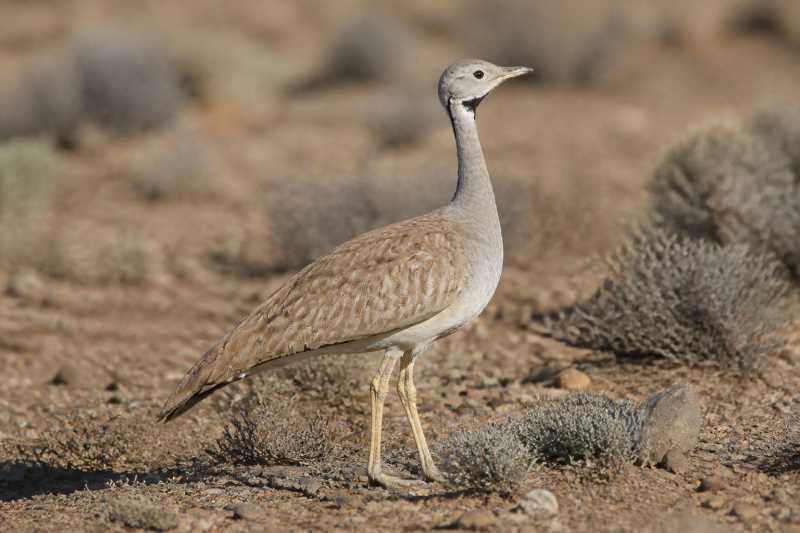
The Karoo Korhaan is a medium-sized bustard measuring approximately 56–60 cm in length and weighing about 1.4–1.6 kg. Its sandy grey-brown plumage is finely mottled and provides effective camouflage among stones, dwarf shrubs and dry vegetation.
The head, neck and upperparts are relatively plain grey-brown. A black patch on the nape and a more prominent black throat patch are important identification features. The throat patch is more extensive in males, often extending down the fore-neck, while females generally show less black. A pale moustachial stripe and a narrow pale border around the throat may also be visible at close range.
The wings are brown and finely patterned when the bird is on the ground. In flight, the darker flight feathers contrast with pale cream-coloured areas on the outer wing. Juveniles resemble adults but are generally paler and more heavily marked with whitish blotches and indistinct barring.
Range and Habitat
The Karoo Korhaan occurs mainly in western South Africa and southern Namibia. In South Africa, its range includes parts of the Northern Cape, Western Cape and Eastern Cape, with records extending into adjoining dry interior regions.
It favours flat or gently undulating terrain with stony ground, sparse grass and dwarf shrubland. Preferred vegetation is usually between about 10 and 40 cm high, with moderate plant cover and a diversity of perennial shrubs and annual plants. It may also occur in suitable Karoo-like fynbos and, in some areas, lightly disturbed agricultural landscapes.
The species is generally resident rather than a long-distance migrant, although local movements may occur in response to rainfall, food availability and changing conditions. Its distribution is closely linked to arid and semi-arid habitats, particularly the Nama Karoo and Succulent Karoo biomes.
Where to See This Species
Karoo National Park, Western Cape, South Africa
Karoo National Park near Beaufort West includes extensive open Karoo shrubland and lists the Karoo Korhaan among its bird species. Look across open plains, gently sloping ground and low shrubland, particularly during quiet early-morning or late-afternoon drives.
Nearby accommodation: Beaufort West is the main gateway town, with hotels, guest houses, self-catering accommodation and campsites, while the park itself offers visitor accommodation and camping.
Tankwa Karoo National Park, Northern and Western Cape, South Africa
Tankwa Karoo National Park is a realistic place to search for the species because its open, arid shrublands are typical Karoo Korhaan habitat. SANParks records the species as occurring year-round, and birds are often looked for on flatter areas and along suitable park roads.
Nearby accommodation: Calvinia and Ceres are the principal gateway towns, with guest houses, self-catering accommodation and small lodges in the wider area. The park also provides basic camping and park accommodation options.
Camdeboo National Park, Eastern Cape, South Africa
Camdeboo National Park near Graaff-Reinet includes open Karoo veld and records the Karoo Korhaan on its bird list. Search the open plains and low shrublands away from heavily wooded sections, especially during cooler parts of the day.
Nearby accommodation: Graaff-Reinet is the nearest practical base, offering hotels, guest houses, self-catering accommodation, lodges and camping facilities.
Behaviour and Diet
Karoo Korhaans are usually encountered in pairs. Small family groups may also occur, while solitary birds are less frequent. They spend much of their time walking slowly through low vegetation, pausing to feed or survey their surroundings. Their cryptic plumage and cautious behaviour can make them difficult to detect until they move or call.
The species is largely resident, but local movements may take place after rainfall or when food conditions change. Its diet is omnivorous, although plant material is important. It feeds on flowers, leaves, fruit, seeds and underground plant parts, supplementing these foods with insects and other small invertebrates.
Breeding has been recorded from June to February, with activity peaking during October and November. The female lays a single egg in a simple ground nest, usually a shallow scrape concealed among low vegetation. Males and females may maintain contact through distinctive, far-carrying calls, and calling can include responses between neighbouring birds.
Identification Tips
- Look for a fairly large, long-legged bird with uniform sandy grey-brown plumage in low Karoo scrub.
- The black throat patch is the most useful feature, especially when the bird raises its throat feathers while calling.
- The male usually has a more extensive black throat and fore-neck than the female.
- The black nape patch, plain grey-brown face and pale moustachial stripe help separate it from more boldly marked korhaans.
- In flight, look for the contrast between the dark flight feathers and the paler cream-coloured wing panel.
- Do not confuse it with the Southern Black Korhaan or Blue Korhaan. Those species show much stronger black, white or bluish-grey patterning, whereas the Karoo Korhaan is generally duller and more cryptically coloured.
Conservation Status
The Karoo Korhaan is assessed as Near Threatened in the South African regional Red Data Book assessment. This reflects concern about a suspected decline in range and population, although the causes and extent of the decline are not fully understood.
Potential threats include habitat loss and degradation caused by cultivation, mining, infrastructure development and renewable-energy projects. Power-line collisions, disturbance around nests, predation of eggs and chicks, and the possible effects of locust-control poisons have also been identified as concerns. Climate change may further affect the availability and quality of arid shrubland habitat.
No major species-specific conservation programme is currently identified. Protection of remaining Karoo shrublands, careful planning of new infrastructure, sustainable farming practices and improved monitoring are important measures for the species.
Frequently Asked Questions
Where does the Karoo Korhaan live?
The species occurs mainly in western South Africa and southern Namibia, especially in open Karoo and Nama Karoo shrublands with stony ground and low vegetation.
Is the Karoo Korhaan endemic to South Africa?
No. Although most of its range is in South Africa, the species also occurs in southern Namibia.
What does the Karoo Korhaan look like?
It is a sandy grey-brown bustard with finely mottled plumage, a black nape patch and a black throat patch. Males usually have more black on the throat and fore-neck than females.
What does the Karoo Korhaan eat?
Its diet includes flowers, leaves, fruit, seeds and other plant material, supplemented by insects and small invertebrates.
When is the best time to see a Karoo Korhaan?
The species is present throughout the year in suitable habitat. Early morning and late afternoon are usually the most comfortable times to search, when birds are more likely to be active and visible.
Is the Karoo Korhaan threatened?
It is listed as Near Threatened in South Africa. Habitat degradation, infrastructure, power lines, agricultural activity and other human pressures may contribute to local declines.
References
- BirdLife South Africa
- South African National Biodiversity Institute
- SANParks
Related posts