Exploring the Javan Owlet: An Insight into Indonesia’s Nocturnal Jewel
In the lush, vibrant forests of Indonesia, where the flora and fauna create a symphony of biodiversity, resides the enigmatic Javan Owlet (Glaucidium castanopterum). This diminutive bird of prey, with its captivating gaze and unique adaptations, is a testament to the diverse avian life that inhabits the island of Java. As conservationists and bird enthusiasts alike strive to understand and protect this species, the Javan Owlet presents a fascinating case study of survival and adaptation in a rapidly changing world.
Physical Characteristics and Identification
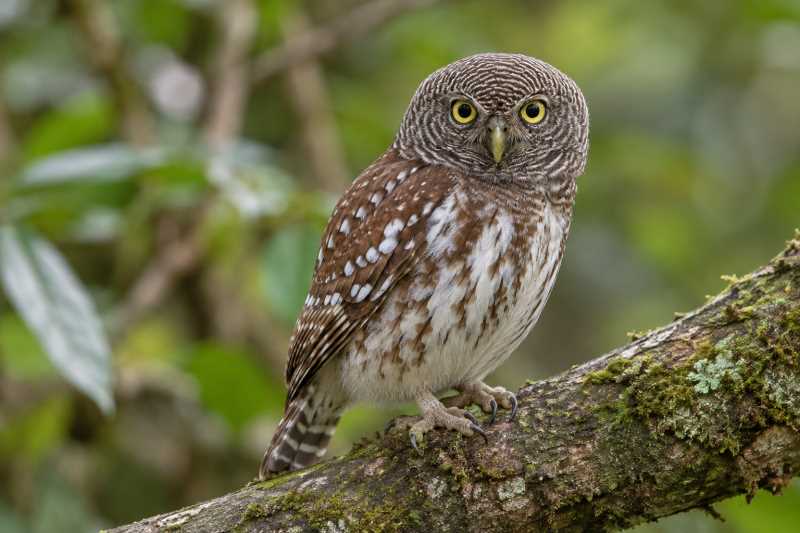
The Javan Owlet is a small, stocky bird, measuring approximately 22-25 centimeters in length. It features a rounded head with no ear tufts, piercing yellow eyes, and a sharp, hooked beak designed for its carnivorous diet. Its plumage is predominantly brown, with rufous tones on the wings and back, providing excellent camouflage against the forest backdrop. The underparts are lighter, often streaked or spotted with white, adding to its distinctive appearance.
One of the most striking features of the Javan Owlet is its facial disc—a circle of feathers that enhances its acute hearing by channeling sound towards the ears. This adaptation is crucial for hunting in the dense, dark environments of its habitat. The owlet’s call, a series of mellow, whistling notes, is often heard echoing through the forest at dusk, signaling the start of its nocturnal activities.
Habitat and Distribution
The Javan Owlet is endemic to the island of Java, Indonesia, where it inhabits a variety of forested environments. It is most commonly found in lowland and montane forests, often at elevations ranging from sea level to 2,000 meters. These forests provide a rich hunting ground for the owlet, supporting a diverse array of prey species.
Deforestation and habitat degradation pose significant threats to the Javan Owlet’s habitat. The expansion of agriculture, urbanization, and illegal logging have led to the fragmentation of forest ecosystems, making it increasingly challenging for the owlet to find suitable nesting sites and hunting grounds. Despite these challenges, the owlet has shown a remarkable ability to adapt to various forest types, including secondary and degraded forests.
Behavior and Diet
As a nocturnal hunter, the Javan Owlet is primarily active during the night. It employs a stealthy hunting strategy, using its acute vision and hearing to detect prey in the darkness. The owlet’s diet is diverse, consisting mainly of insects, small mammals, and occasionally birds and reptiles. Its hunting technique often involves perching silently on a branch before swooping down to capture unsuspecting prey with its sharp talons.
Breeding behavior in the Javan Owlet is not well-documented, but it is believed to nest in tree cavities, a common practice among owls. During the breeding season, the owlet’s call becomes more frequent, serving as both a territorial marker and a means of attracting a mate.
Conservation Status and Efforts
The Javan Owlet is currently classified as Near Threatened by the International Union for Conservation of Nature (IUCN). The primary threats to its survival include habitat loss and fragmentation, driven by human activities. Conservation efforts are crucial to ensuring the continued existence of this species.
Several initiatives are underway to protect the Javan Owlet and its habitat. These include habitat restoration projects, legal protection of key forest areas, and community-based conservation programs that involve local populations in preservation efforts. Raising awareness about the importance of protecting Indonesia’s unique biodiversity is also a critical component of these strategies.
Conclusion
The Javan Owlet, with its unique adaptations and ecological role, is a vital part of Java’s rich biodiversity. As pressures on its habitat continue to mount, understanding and conserving this species becomes increasingly important. Through concerted conservation efforts and sustainable management practices, there is hope that future generations will also be able to marvel at this nocturnal jewel of Indonesia.
In conclusion, the Javan Owlet serves as a reminder of the delicate balance that exists within ecosystems and the continuous effort required to maintain it. By protecting this small yet significant bird, we contribute to the broader goal of preserving the natural heritage of one of the world’s most biodiverse regions.
Related posts