Introduction
The African Pitta, Pitta angolensis, is a brightly coloured but remarkably elusive forest-floor bird in the pitta family, Pittidae. It is also known as the Angola Pitta in some regional literature. The species is recognised by the IOC World Bird List under the English name African Pitta, although taxonomic treatments have differed over the limits of the African pitta complex and the rank of some geographically distinct populations. (ww.worldbirdnames.org)
Despite its vivid plumage, the African Pitta is difficult to observe. It spends much of its time in dense undergrowth, moving quietly through leaf litter and low vegetation. A distinctive, far-carrying call may be the first sign that the bird is present. In southern Africa, it is principally associated with the rainy season, when breeding activity and calling increase in suitable riverine woodland, thicket and forest margins.
The species has a broad but discontinuous distribution across tropical and subtropical Africa. It is resident in parts of western and central Africa, while populations in south-eastern Africa undertake regular or partial intra-African movements. These seasonal movements, together with its secretive habits, mean that the African Pitta can be locally difficult to find even where it is known to occur.
Physical Description
The African Pitta is a compact, short-tailed passerine measuring approximately 18–20 centimetres in length. It has the characteristic pitta shape: a relatively large head, stout bill, strong legs, rounded wings and a very short tail. The body is low-slung when the bird is walking on the forest floor, and its posture can appear almost thrush-like at a distance.
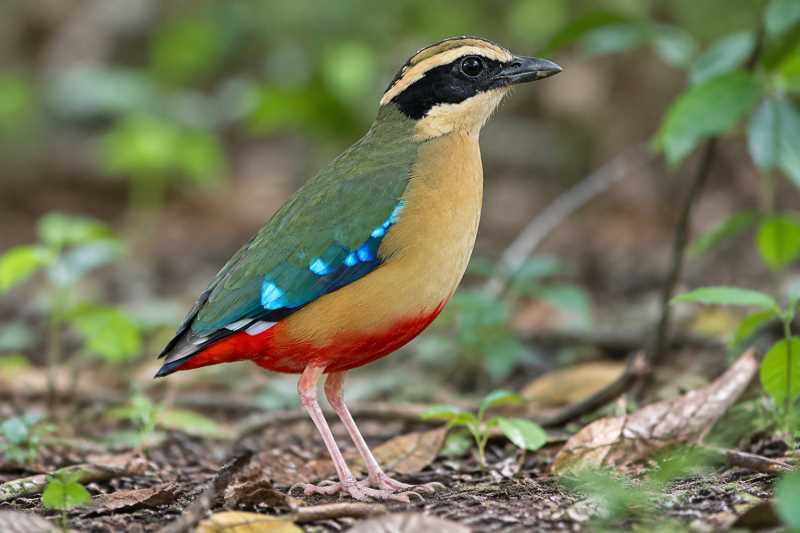
Adult plumage is striking. The crown, forehead and facial area are predominantly black, with a broad buff to brownish-buff supercilium extending behind the eye. The throat is pale salmon or pinkish buff, while the breast and upper flanks are yellowish, mustard or olive-toned. In some western populations the breast can appear distinctly greener or more olive than in birds from south-eastern Africa.
The mantle and back are green. The rump and upper tail coverts show turquoise or blue-green tones, and the wing coverts are deep green with blue or turquoise edging. The folded wing can therefore look surprisingly subdued in shadow, but flashes of blue become conspicuous when the bird moves, displays or flies. The primaries are dark, with pale or whitish markings that may form a noticeable white panel at the base of the flight feathers in flight.
The lower belly, vent and undertail coverts are rich crimson-red. This red underpart, combined with the green back, dark head and blue wing markings, is the most memorable feature of an adult African Pitta. The legs and feet are generally pinkish or flesh-coloured, while the bill is mostly dark.
Males and females are considered alike in plumage. There is no dependable field character that allows the sexes to be separated under ordinary viewing conditions. Juveniles and recently fledged birds are much duller. Young birds tend to have less intense green and blue on the upperparts, a browner or buffier head and throat, and a less vivid reddish vent and undertail. Their plumage is better suited to concealment in leaf litter than the saturated colours of adults.
The species is more often detected by movement or sound than by a prolonged view. On the ground, it may hop, pause and then disappear beneath foliage. When flushed, it usually flies only a short distance before dropping back into cover. The combination of a short tail, rounded wings and powerful legs is typical of pittas and distinguishes them from most woodland passerines.
Reliable published information on body mass, wing length and other detailed measurements is less consistent than the available information on plumage and range. Regional accounts commonly place the mass at roughly 45–60 grams, but such figures should be treated as approximate because measurements vary between subspecies, sex, season and source.
Range and Habitat
The African Pitta occurs across a wide belt of sub-Saharan Africa. Its range includes parts of West Africa, Central Africa and eastern and south-eastern Africa, with records from countries including Sierra Leone, Liberia, Côte d’Ivoire, Ghana, Nigeria, Cameroon, the Central African Republic, Equatorial Guinea, Gabon, the Republic of the Congo, the Democratic Republic of the Congo, Uganda, Kenya, Tanzania, Rwanda, Burundi, Zambia, Malawi, Mozambique, Zimbabwe, Angola and South Africa. Country occurrence and seasonal status vary considerably across this broad range. (thewebsiteofeverything.com)
The species is not uniformly distributed throughout these countries. It is generally associated with moist habitats, particularly the edges of lowland forest, riverine forest, dense woodland, thickets and mature secondary growth. In parts of West and Central Africa it may occur as a resident in humid forest landscapes. Farther south and east, it is often associated with river valleys, wooded floodplains, deciduous woodland and dense thickets that retain sufficient ground cover during the breeding season.
African Pittas may also use forest margins, plantations, gardens and other modified habitats where dense cover remains available. Oil-palm and raffia-palm areas can be important in some regions, especially where palms occur near water and are interspersed with natural vegetation. This does not mean that the species favours heavily simplified plantations. Rather, it can exploit food resources in modified landscapes when understorey, shade and suitable nesting habitat remain nearby.
Elevation is generally low to moderate. Most records come from near sea level to approximately 1,500 metres, although the species has been recorded higher in some parts of Africa, including local reports from Malawi. The elevation range is therefore broad enough to include coastal forest, lowland river systems, inland woodland and some upland valleys, but the species is not primarily a montane bird. (tanzaniabirds.net)
Geographic variation is reflected in plumage, wing proportions, migration and breeding timing. The southern and south-eastern populations are commonly described as intra-African migrants or seasonal visitors. In Zambia, Malawi, Mozambique, Zimbabwe and adjacent areas, birds may arrive with the rains and breed during the warmer, wetter months. Some populations move north or west after breeding, while others may remain in suitable habitats outside the breeding season. The exact pattern is not identical across the species’ range, and the terms resident, partial migrant and intra-African migrant may all appear in regional accounts.
The southern African breeding habitat is often described as deciduous lowland riparian forest, woodland or dense thicket with a well-developed understorey and occasional openings beneath the canopy. Such areas provide leaf litter for foraging, low branches for display and suitable vegetation for the distinctive ball-shaped nest. In dry landscapes, the availability of riverine vegetation and the timing of seasonal rainfall are likely to be especially important.
Where to See This Species
The African Pitta is a difficult bird to find, but several publicly accessible protected areas have documented records and are recognised birding destinations. Sightings are most likely when birds are calling or breeding after seasonal rain. Local guides are often valuable because the species may remain hidden even when it is close to a track or camp.
Kruger National Park, Limpopo and Mpumalanga, South Africa
South African National Parks includes the African Pitta on the official Kruger National Park bird checklist. The park’s northern regions, particularly the Pafuri and Punda Maria areas, are among the country’s most productive birding zones, with extensive riverine vegetation, woodland, thickets and forest-edge habitats. The species is a scarce and localised target rather than a routine sighting, but the park provides one of the most accessible protected-area opportunities in South Africa. (sanparks.org)
The best prospects are likely to be in the warmer, wetter part of the year, when seasonal migrants are present and heavy rain can stimulate calling. Birders should listen carefully at dawn and after rain, especially in dense riverine vegetation and shaded thickets. A sighting may consist only of a brief movement across a track or a glimpse of the red underparts as the bird slips through cover.
Nearby accommodation: Public rest camps, campsites and safari lodges are available within Kruger National Park, while the gateway settlements outside the park provide additional hotels, guest houses, lodges and self-catering accommodation.
South Luangwa National Park, Eastern Province, Zambia
South Luangwa is one of the better-known African Pitta destinations in southern Africa. BirdLife South Africa has specifically promoted the Luangwa Valley, including the area around Bilimungwe Bushcamp, as a strong location for this elusive species. The bird has been recorded around riverine vegetation and camp habitats, and local birding experience can significantly improve the chances of locating it. (birdlife.org.za)
The most productive period is generally linked to the arrival of summer rains. BirdLife South Africa reported that the first part of December, particularly the first few days after heavy rain, has historically offered good opportunities around Bilimungwe. This timing should be regarded as a practical guide rather than a guarantee, since rainfall and bird movements vary between years. Listening for the call and checking leafy trees, thickets and forest edges are usually more productive than searching open woodland.
Nearby accommodation: The park has safari camps and lodges, while Mfuwe is the main gateway settlement with lodges, guest houses, camps and other visitor accommodation.
Mana Pools National Park, Mashonaland West, Zimbabwe
Mana Pools lies in the lower Zambezi Valley, where riverine woodland, floodplain vegetation and dense thickets create suitable habitat for African Pittas. BirdLife Zimbabwe lists the species among the birds found in the park’s thickets, making Mana Pools a genuine destination for birders seeking it. (birdlifezimbabwe.org)
The species is most likely to be encountered during the rainy season, when summer conditions bring increased bird activity and seasonal migrants to the valley. Dense thickets should be checked slowly and quietly, but observers should also listen from camp edges and woodland clearings. The bird’s call can carry farther than the bird can be seen, and its habit of remaining low makes patient observation essential.
Nearby accommodation: Mana Pools offers park campsites and safari accommodation, with additional lodges, guest houses and other visitor facilities available in the wider lower Zambezi Valley and around Chirundu.
Behaviour and Diet
The African Pitta is primarily terrestrial. It spends much of the day on or close to the ground, moving through leaf litter, low vegetation and shaded clearings. Its strong legs are well suited to hopping and short bursts of movement, while its short tail and rounded wings reflect a life in dense understorey rather than sustained flight across open country.
The species is secretive and usually solitary or found in pairs. It does not normally form large feeding flocks. During the breeding season, pairs defend territories and may become more conspicuous because of calling, display and nest building. Outside the breeding period, birds can be particularly difficult to detect and may remain silent for long periods.
The African Pitta’s diet is dominated by invertebrates found in leaf litter and soil. Beetles, ants, termites, grasshoppers, caterpillars, earthworms, snails and other small invertebrates are likely to form the core of the diet. It may also take small vertebrates or other prey opportunistically, but the species is not primarily a predator of large animals.
Foraging typically involves short hops, pauses and sudden probing or pecking movements. The bird may turn or flick leaves while searching for prey. Damp conditions can improve feeding opportunities by bringing invertebrates closer to the surface, which may help explain the increased activity observed after heavy rain.
The call is often described as a distinctive, repeated, frog-like or whistled note. Regional descriptions vary, and the exact vocal form may differ among populations. In practice, listeners should learn the local call rather than rely on a single phonetic spelling. Calling birds may remain hidden in foliage or call from a low perch before dropping silently to the ground.
Breeding takes place during regionally appropriate wet seasons. In southern Africa it is generally associated with the spring and summer rains, while breeding dates vary in West, Central and East Africa. The nest is a large, roughly spherical structure made from sticks, roots, leaves and other plant material. It is usually placed low in dense vegetation, often in a thorny shrub, sapling or low tree, although nest height varies between regions.
Both adults are believed to participate in nest construction and parental care. Clutches commonly contain several eggs, but published accounts differ in the details of clutch size, incubation and fledging. The nest’s bulky structure and concealed position can make it difficult to detect without disturbing the surrounding vegetation. Responsible observers should avoid approaching or handling nests, especially in dense breeding habitat.
The species’ movements are complex. Some populations are resident, while others undertake seasonal movements within Africa. In south-eastern Africa, birds are often associated with breeding during the rainy season and may disperse or migrate after breeding. Young birds may travel farther than adults, and occasional records outside the usual range may reflect post-breeding dispersal rather than a stable breeding population.
Identification Tips
Look for the following combination of features:
- A compact, short-tailed bird with strong legs and a stout bill.
- A black crown and facial mask, contrasting with a broad buff eyebrow.
- Green upperparts and blue or turquoise markings on the rump and wings.
- A salmon or pinkish throat, yellowish to olive breast and vivid crimson-red belly and undertail.
- Pinkish legs and a mostly dark bill.
- A preference for moving on the ground in dense cover rather than perching openly.
The African Pitta is unlikely to be confused with most other birds when seen clearly. Its colour pattern is distinctive, particularly the combination of green upperparts, blue wing markings, black head and red lower underparts. The main difficulty is not separating it from a similar species, but seeing enough of the bird to identify it confidently.
A fleeting glimpse can be misleading. Blue-green flashes may belong to the wing or rump, while the red underparts may be hidden when the bird is walking away. Do not identify the species solely from a brief blue or red movement in thick vegetation. Confirmation should ideally include the black-and-buff head pattern, short-tailed shape or characteristic call.
In regions where other pittas occur, vocalisations, range and habitat are useful supporting clues. However, field observers should be cautious with sound-only identifications because pitta calls can be unfamiliar, local variation may occur and other forest birds may produce similarly brief, penetrating notes.
The species is most easily detected by combining methods: listen at first light, watch shaded track edges after rain, scan low branches and dense shrubs, and pause frequently rather than walking continuously. Local guides who know the call and seasonal movements can be more useful than an extended search by an inexperienced observer.
Conservation Status
The African Pitta is currently assessed as Least Concern on the IUCN Red List framework. This classification reflects its broad geographic range and the absence of evidence that its global population is declining rapidly enough to meet a higher threat category. A Least Concern assessment does not mean that every population is secure or that local threats are unimportant. (portals.iucn.org)
The principal potential threats are habitat loss and degradation, particularly where moist forest, riverine woodland and dense thickets are cleared or fragmented. Logging, agricultural expansion, drainage, burning, settlement growth and the simplification of woodland can all reduce the dense understorey on which the species depends. In West and Central Africa, forest conversion remains an important regional concern.
The African Pitta appears able to use some secondary growth, plantations, gardens and other modified habitats when suitable cover remains. This adaptability may reduce the impact of moderate habitat change in some landscapes, but it should not be interpreted as evidence that intensive land conversion is harmless. Dense understorey, leaf litter, mature trees and access to moist habitats remain important for feeding and breeding.
Hunting and trapping may affect local populations in some parts of the range, although the scale of this threat is not well quantified for the species. Because African Pittas are secretive and often occur at low densities, local declines may go unnoticed. Better monitoring of seasonal abundance, breeding distribution and habitat use would improve understanding of the species’ status.
Conservation measures should focus on protecting remaining lowland forest, riverine corridors, woodland thickets and other wet-season refuges. Maintaining habitat connectivity is particularly important for populations that move seasonally. Protected areas such as Kruger, South Luangwa and Mana Pools provide valuable safeguards, but conservation outside protected areas is also significant because the species uses secondary and human-modified habitats in some regions.
Frequently Asked Questions
What is the scientific name of the African Pitta?
The scientific name is Pitta angolensis. It belongs to the pitta family, Pittidae, within the order Passeriformes. The IOC World Bird List uses African Pitta as the accepted English name. (ww.worldbirdnames.org)
Where does the African Pitta live?
It occurs across parts of West, Central, East and southern Africa. Typical habitats include moist forest edges, riverine woodland, dense thickets, mature secondary growth, forest margins and some palm-dominated landscapes with good understorey cover.
Is the African Pitta migratory?
Its movement pattern varies geographically. Some populations are resident, while others undertake intra-African seasonal movements. In southern and south-eastern Africa, birds are commonly associated with wet-season breeding and may move after the breeding season.
What does the African Pitta eat?
The diet consists mainly of invertebrates collected from the ground and leaf litter, including insects, worms and snails. It may also take other small prey opportunistically and can feed on fruit or seeds in some circumstances.
When is the best time to see an African Pitta?
The best opportunities are generally during or shortly after the rainy season, when birds are calling, breeding and foraging actively. In southern Africa, December can be productive at some sites, but local rainfall and seasonal movements vary between years.
Is the African Pitta endangered?
No. The species is currently assessed as Least Concern. Nevertheless, local populations may be affected by forest clearance, loss of riverine vegetation, habitat fragmentation and hunting, so protecting suitable habitat remains important.
References
- BirdLife International
- IUCN Red List of Threatened Species
- IOC World Bird List
Related posts