Introduction
The Indian Nightjar, Caprimulgus asiaticus, is a small nocturnal bird in the family Caprimulgidae. It is recognised by its cryptic, mottled plumage, broad gape, moth-like flight and distinctive repetitive call. The species is primarily resident and occurs across parts of South Asia and mainland Southeast Asia. (datazone.birdlife.org)
Physical Description
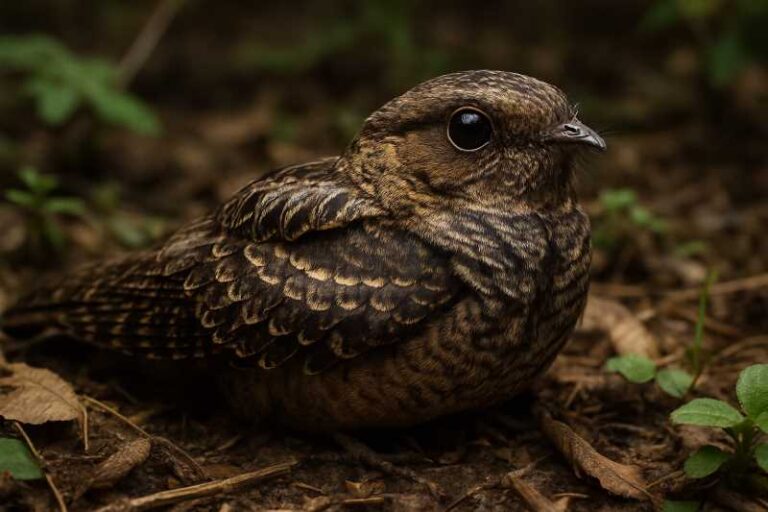
The Indian Nightjar is about 24–28 cm long. Its soft plumage is intricately mottled and barred with grey, brown, buff, rufous and black, providing effective camouflage against dry leaves, soil and scrub. The crown is streaked, the hindneck has a broad buff collar, and pale or whitish patches are present on the sides of the throat.
It has a large head, large dark eyes, a short bill and an exceptionally wide gape fringed with stiff bristles. These bristles are associated with the capture of flying insects. The wings are long and pointed, while the legs are short and adapted mainly for perching and brief movement on the ground.
The sexes are broadly similar, but males generally show more conspicuous white markings on the outer wing and tail. Females tend to have smaller or more buff-coloured markings, although the extent of sexual differences varies with wear, age and geographic form. Juveniles are usually duller and less distinctly marked than adults. (indiabiodiversity.org)
Range and Habitat
The Indian Nightjar is distributed from Pakistan and India through Nepal, Bangladesh and Sri Lanka to parts of mainland Southeast Asia, including Myanmar, Thailand, Laos and Vietnam. It is generally regarded as a resident species, although local movements may occur and seasonal occurrence can vary between regions. (sufal.bforest.gov.bd)
It favours open or lightly wooded habitats, including dry scrub, stony ground, open woodland, grassland, dry riverbeds, cultivated margins, groves and areas near villages or settlements. It is often associated with habitats that provide bare ground or sparse vegetation for daytime roosting and breeding. The species may also occur in suitable gardens, plantations and other human-modified landscapes, provided that open ground and insect-rich habitat remain available. (indiabiodiversity.org)
Behaviour and Diet
The Indian Nightjar is mainly active from dusk through the night, with additional activity around dawn. During daylight it usually rests motionless on the ground, relying on its cryptic plumage to avoid detection. When disturbed, it may flush suddenly and fly low before settling again.
It feeds chiefly on flying insects, including moths, beetles and other large insects. Its feeding flight is buoyant, irregular and moth-like, with periods of wingbeats followed by glides. The wide gape enables it to take prey in the air, particularly around dusk and near open clearings.
The call is a distinctive series of rapid, mechanical or churring notes, sometimes described as a repeated chuk-chuk sequence. Calling is especially useful for locating the species because the bird is often much easier to hear than to see. (indiabiodiversity.org)
Breeding takes place during the warmer part of the year, although the timing varies across the species’ range. The female normally lays two eggs directly on bare ground or in a shallow scrape, without constructing an elaborate nest. The eggs are cryptically marked, and both adults may contribute to incubation and care of the young. Published observations indicate an incubation period of approximately 19–21 days, but detailed breeding information remains limited in some parts of the range. (researchgate.net)
Identification Tips
- Look for a small, compact nightjar with heavily mottled grey-brown and buff plumage.
- Note the broad buff collar on the hindneck and pale patches on the sides of the throat.
- White or pale markings on the outer wing and tail are most evident when the bird is in flight, especially in males.
- At rest, the bird often lies lengthwise on bare ground, stones or leaf litter and can be extremely difficult to detect.
- Listen for the repeated, mechanical churring or clicking call around dusk and dawn.
- The Indian Nightjar can be confused with other regional nightjars. Comparison should focus on size, the buff hindneck collar, throat pattern, wing and tail markings, habitat and especially the call. Identification is not always reliable from plumage alone because several nightjar species are variable and cryptically coloured. (indiabiodiversity.org)
Conservation Status
The Indian Nightjar is currently assessed as Least Concern on the IUCN Red List. A global population estimate is not provided in the sources used here, and the species’ population trend is not sufficiently documented for a confident numerical assessment. (datazone.birdlife.org)
Potential local pressures include the loss and degradation of open scrub, grassland and woodland, agricultural intensification, urban expansion, disturbance at breeding sites and declines in insect availability caused by habitat change or pesticide use. These pressures do not currently place the species in a globally threatened category, but maintaining a network of natural and semi-natural open habitats is important for its long-term conservation.
Useful conservation measures include protecting dry scrub and open woodland, retaining undisturbed ground cover during the breeding season, reducing unnecessary pesticide use and improving knowledge of local distribution and population trends. Conservation assessments should remain regionally cautious because the species is widespread but can be locally uncommon and difficult to survey.
Frequently Asked Questions
Where does the Indian Nightjar live?
The Indian Nightjar occurs across South Asia and parts of mainland Southeast Asia, including India, Pakistan, Nepal, Bangladesh, Sri Lanka, Myanmar, Thailand, Laos and Vietnam. It prefers open woodland, dry scrub, grassland, stony ground and cultivated margins.
Is the Indian Nightjar migratory?
It is generally considered a resident species. Local movements may occur, and seasonal patterns can differ between regions, but it is not normally treated as a long-distance migrant.
What does the Indian Nightjar eat?
It mainly eats flying insects, especially moths, beetles and other sizeable insects captured during nocturnal flight.
Where does the Indian Nightjar lay its eggs?
It lays its eggs directly on bare ground or in a shallow scrape, usually in a well-camouflaged site among dry leaves, stones or sparse vegetation. A typical clutch contains two eggs.
How can the Indian Nightjar be identified at night?
Its repetitive mechanical or churring call is often the most reliable clue. If seen, look for a small mottled nightjar with a buff hindneck collar, pale throat patches and a low, moth-like flight.
Is the Indian Nightjar endangered?
No. The species is currently assessed as Least Concern, although local populations may be affected by habitat loss, disturbance and changes in insect abundance.
References
- BirdLife International. n.d. “Indian Nightjar Caprimulgus asiaticus Species Factsheet.” BirdLife DataZone. Accessed 8 September 2026. https://datazone.birdlife.org/species/factsheet/indian-nightjar-caprimulgus-asiaticus
- Gill, F., D. Donsker and P. Rasmussen, eds. 2026. IOC World Bird List, version 15.2. International Ornithologists’ Union. Accessed 8 September 2026. https://www.worldbirdnames.org/
- Ali, S., and S. D. Ripley. 1983. Handbook of the Birds of India and Pakistan, Together with Those of Bangladesh, Nepal, Bhutan and Sri Lanka, Volume 4: Frogmouths to Pittas. Oxford University Press.
- Ali, S. 1941. The Book of Indian Birds. Bombay Natural History Society and Oxford University Press. Species account for the Indian Nightjar, Caprimulgus asiaticus.
- Rasmussen, P. C., and J. C. Anderton. 2005. Birds of South Asia: The Ripley Guide, Volume 2: Attributes and Status. Smithsonian Institution and Lynx Edicions.
- India Biodiversity Portal. 2016. “Caprimulgus asiaticus Latham, 1790.” India Biodiversity Portal. Accessed 8 September 2026. https://indiabiodiversity.org/species/show/239990
- IUCN Bangladesh. 2015. Red List of Bangladesh, Volume 3: Birds. Ministry of Environment and Forests, Government of the People’s Republic of Bangladesh. Species account for Caprimulgus asiaticus. https://sufal.bforest.gov.bd/redlist/wp-content/uploads/2023/03/Volume-3-Birds-Full-Book.pdf
- Tiwari, J. K., and R. Dadu. 2020. “Observations on Habitat Use and Breeding Biology of Indian Nightjar: Caprimulgus asiaticus (Latham, 1790), Caprimulgidae.” International Refereed Journal of Engineering and Science 9(5): 6–9. https://irjes.com/Papers/vol9-issue5/B09050609.pdf
Related posts