White’s Thrush: An Enigmatic Avian Marvel of the Forests
The White’s Thrush, scientifically known as *Zoothera aurea*, is a captivating and somewhat elusive species of bird that resides primarily in the dense, temperate forests of Asia. Its presence is felt across a vast range, from the eastern parts of Russia stretching through the Korean Peninsula, Japan, and even parts of China. This article delves into the intricate details of this fascinating species, exploring its habitat, behavior, and the conservation challenges it faces.
Classification and Physical Description
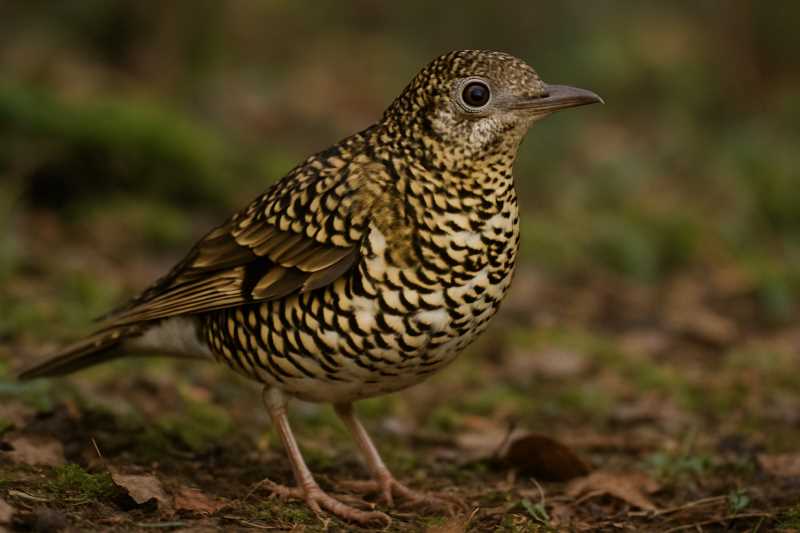
Belonging to the family Turdidae, the White’s Thrush is a medium-sized bird that is easily distinguished by its striking plumage and distinct song. Adults typically measure between 27 to 30 centimeters in length, boasting a wingspan of approximately 45 to 50 centimeters. The bird’s plumage is a beautiful mix of golden-brown and black, with intricate patterns that provide excellent camouflage among the forest floor’s leaves and branches.
The underparts are adorned with scalloped patterns of black and gold, while the upperparts are a more uniform brown with subtle hints of the same golden tones. The White’s Thrush also possesses a long, slightly curved bill and strong legs, which are well-suited for its terrestrial lifestyle.
Habitat and Distribution
The White’s Thrush is predominantly a forest-dwelling species, thriving in the dense, humid woodlands of East Asia. It prefers areas with a rich undergrowth, where it can forage for its primary diet of insects, earthworms, and other invertebrates. During the breeding season, which occurs from May to July, these birds are particularly abundant in the boreal and mixed forests of Siberia and the Russian Far East.
Migration is a significant aspect of the White’s Thrush’s life cycle. As the colder months approach, the birds embark on a southward journey to wintering grounds in Southeast Asia, including Vietnam, Thailand, and parts of Indonesia. This migratory behavior is essential for their survival, allowing them to exploit different ecological niches throughout the year.
Behavior and Ecology
White’s Thrushes are predominantly solitary, though they may occasionally be observed in small, loose flocks during migration. They are ground feeders, using their keen eyesight and quick reflexes to catch unsuspecting prey. Their diet mainly comprises insects, but they are also known to consume berries and seeds during the non-breeding season.
The song of the White’s Thrush is a hauntingly beautiful series of melodic whistles and trills, often heard resonating through the forest canopy. This vocalization serves multiple purposes, from marking territory to attracting mates. Males are particularly vocal during the breeding season, showcasing their repertoire to potential partners.
Nesting occurs on or near the ground, with the female constructing a cup-shaped nest out of moss, leaves, and twigs. She lays a clutch of 3 to 5 eggs, which are incubated for about two weeks. Both parents are involved in feeding the fledglings, which leave the nest within 15 to 20 days after hatching.
Conservation Status and Threats
Currently, the White’s Thrush is classified as Least Concern by the International Union for Conservation of Nature (IUCN). However, like many forest-dependent species, it faces several conservation challenges. Habitat destruction due to logging, agricultural expansion, and urbanization poses a significant threat to their preferred forest habitats.
Climate change is another pressing issue, affecting migration patterns and the availability of food resources. Conservation efforts are crucial to ensure the survival of this species, with a focus on habitat preservation and the establishment of protected areas.
Cultural Significance
In many Asian cultures, the White’s Thrush holds a special place in folklore and tradition. Its melodious song and elusive nature have inspired countless stories and legends. In Japan, for instance, the bird is associated with autumn and is often depicted in traditional art and poetry, symbolizing the changing seasons and the transient beauty of nature.
Conclusion
The White’s Thrush is a remarkable example of avian adaptation and survival. Its ability to thrive in diverse environments, coupled with its mesmerizing song and striking appearance, makes it a subject of great interest for ornithologists and bird enthusiasts alike. Protecting this species and its habitat is not only crucial for maintaining biodiversity but also for preserving the cultural heritage of the regions it inhabits.
As we continue to study and appreciate the White’s Thrush, it serves as a reminder of the delicate balance within our ecosystems and the importance of conservation efforts to safeguard these natural treasures for future generations.
Related posts