Introduction
The Hoary Puffleg (Haplophaedia lugens) is a small hummingbird of the humid western Andes. It belongs to the family Trochilidae and has a restricted distribution spanning south-western Colombia and north-western Ecuador. Although it can be locally common, it is generally localised and difficult to find because it usually feeds low within dense forest vegetation.
Physical Description
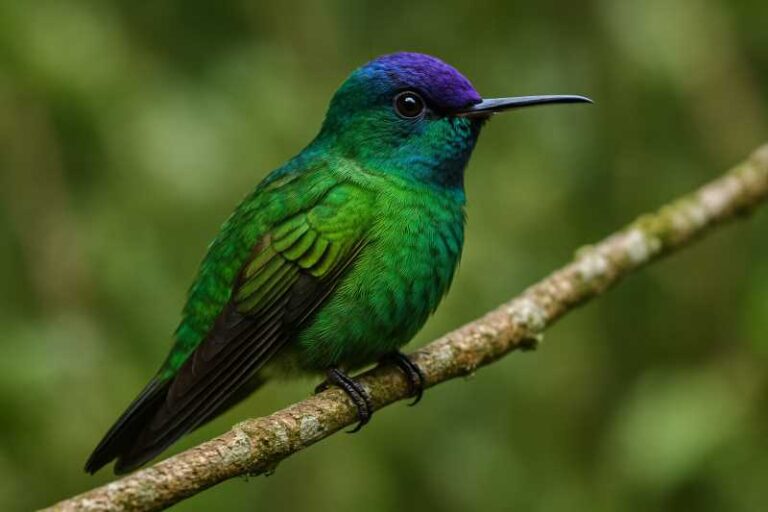
The Hoary Puffleg is a small hummingbird measuring approximately 9–10 cm in length. Its plumage is subdued compared with that of many brilliantly coloured hummingbirds. The upperparts are mainly greenish with bronze or coppery tones on the head and rump, while the underparts are greyish. The leg feathers form the soft, puffed tufts characteristic of the genus, although these may be inconspicuous in the field.
Males and females are similar, but the male is generally darker grey on the front, whereas the female is paler and more distinctly hoary-looking. The bill is straight and medium-length. The tail is relatively short and only slightly forked. Rufous or coppery tones on the head and rump can be difficult to see unless the bird is in good light.
Range and Habitat
The Hoary Puffleg is restricted to the Pacific slope of the Andes in south-western Colombia and north-western Ecuador. In Colombia, it occurs principally in Nariño, while in Ecuador it has been recorded south to Pichincha and in adjacent Andean areas.
It inhabits humid and very humid montane forest, cloud forest, forest edges, secondary growth and dense vegetation beside streams or rocky ravines. It is usually associated with the lower and middle levels of the forest, rather than the high canopy. Recorded elevations are approximately 1,100–2,500 metres, with many records concentrated between about 1,500 and 2,100 metres. The species is resident within its range, and no regular long-distance migration is generally recognised.
Where to See This Species
La Planada Nature Reserve, Nariño, Colombia
La Planada is one of the best-documented places to look for the Hoary Puffleg. The species has been regularly recorded there, including in secondary growth and along forest trails. Early morning walks through humid montane forest, forest edges and epiphyte-rich vegetation offer the most realistic opportunity. The reserve’s own birding information lists the Hoary Puffleg among its representative species.
Nearby accommodation: Ricaurte is the nearest practical gateway, with guest houses, small hotels and rural accommodation available in the surrounding area.
Las Gralarias Reserve, Pichincha, Ecuador
The Hoary Puffleg has been documented at Las Gralarias in the montane forests near Mindo. The reserve’s elevation and dense cloud-forest habitat fall within the species’ known range. Look along forest paths and edges, particularly in shaded lower vegetation and areas with flowering plants.
Nearby accommodation: Mindo is the main gateway settlement, offering lodges, guest houses, hotels and self-catering accommodation.
Bellavista Cloud Forest Reserve, Pichincha, Ecuador
Bellavista is a publicly accessible cloud-forest reserve with documented records of the Hoary Puffleg. Its humid montane forest, forest edges and birding trails provide suitable habitat. The species is local and should not be expected on every visit, but careful observation of shaded vegetation and flowering areas may produce sightings.
Nearby accommodation: Tandayapa and Mindo provide the nearest practical accommodation areas, including cloud-forest lodges, guest houses and small hotels.
Behaviour and Diet
The Hoary Puffleg is usually encountered singly and can be unobtrusive. It often perches within dense vegetation close to the ground or at low to medium height. Like other hummingbirds, it can hover while feeding and may defend productive feeding areas from other hummingbirds through short chases and aerial displays.
Its diet consists primarily of nectar from flowers, especially flowers with relatively short corollas. It also takes small insects and spiders, which provide protein and other nutrients. The species may occasionally join mixed-species bird flocks, despite its generally solitary habits.
Breeding information is limited. The female builds the nest and cares for the young. A documented nest in Carchi, Ecuador, was placed low above the ground and constructed from moss and spider web, with surrounding vegetation helping to protect it from heavy rain. Two nestlings were recorded in that observation.
Identification Tips
- Look for a small, relatively subdued puffleg with greyish underparts and greenish upperparts.
- Check for coppery or rufous tones on the head and rump, although these may be difficult to see in poor light.
- The leg puffs can be small or partly hidden, so their absence at first glance does not rule out the species.
- It is usually found inside forest or in dense secondary vegetation, often lower than many more conspicuous hummingbirds.
- The Greenish Puffleg (Haplophaedia aureliae) is the most relevant comparison where the ranges meet. The Hoary Puffleg is generally greyer and less vividly green, with a more subdued appearance. Careful attention to the grey front, pale underparts and coppery head or rump is useful.
Conservation Status
The Hoary Puffleg is currently classified as Near Threatened on the IUCN Red List. It has a restricted range and is affected by the loss, degradation and fragmentation of humid Andean forest, including clearance for agriculture and other land uses.
The species can persist in some secondary growth and forest-edge habitat, but remaining forest is still important for feeding, nesting and movement between suitable sites. Protecting reserves, maintaining connections between forest remnants and restoring degraded montane forest are important conservation measures. The total population has not been reliably quantified, so precise population figures should not be assumed.
Frequently Asked Questions
Where does the Hoary Puffleg live?
It occurs on the Pacific slope of the Andes in south-western Colombia and north-western Ecuador, mainly in humid montane and cloud forests.
What elevation does the Hoary Puffleg prefer?
It has been recorded from roughly 1,100 to 2,500 metres, with many observations concentrated between about 1,500 and 2,100 metres.
What does the Hoary Puffleg eat?
It feeds mainly on nectar, particularly from flowers with short corollas, and also takes small insects and spiders.
Is the Hoary Puffleg endangered?
It is classified as Near Threatened. Habitat loss and fragmentation across its restricted Andean range are the main conservation concerns.
Where is the best place to see a Hoary Puffleg?
La Planada Nature Reserve in Nariño, Colombia, and cloud-forest reserves near Mindo and Tandayapa in Ecuador are among the better-documented places to search for it.
How can the Hoary Puffleg be identified?
Look for a small hummingbird with greyish underparts, greenish upperparts, subtle coppery or rufous tones on the head and rump, and small feathered leg tufts. It is often found low in dense forest vegetation.
References
- IUCN Red List of Threatened Species
- IOC World Bird List
- Revista Ecuatoriana de Ornitología
Related posts