Introduction
The Blue-mantled Thornbill (Chalcostigma stanleyi) is a small hummingbird of the high Andes. It is associated mainly with páramo, jalca and high-elevation shrub habitats, where it feeds among low vegetation and flowering plants. The species is resident across most of its range, although it may move to lower elevations during severe weather or seasonal changes in food availability.
Physical Description
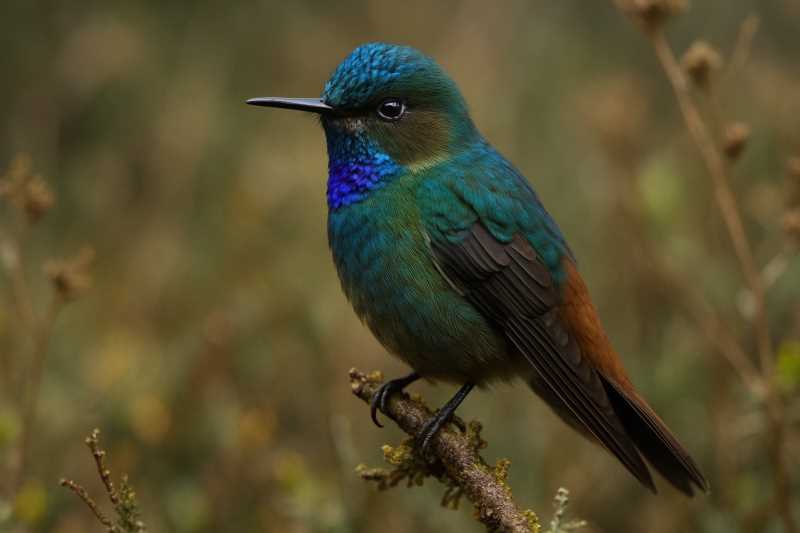
The Blue-mantled Thornbill is approximately 12–13 centimetres long and has a short, straight, black bill and a noticeably forked tail. Adult males are generally dark sooty brown below, with a bronzy or greenish sheen on the head and nape, violet-blue reflections on the back and turquoise upper-tail coverts. The tail is usually blue or steel-blue in appearance.
The male’s most distinctive feature is a narrow iridescent gorget. It is emerald green beneath the chin and grades into pink, violet or blue-violet lower down the throat. Adult females are duller and lack the male’s strongly contrasting lower gorget. They are typically brownish or grey below, with paler markings on the outer tail feathers. Juveniles resemble females and develop the brighter adult male plumage with age.
Some regional variation occurs. The nominate subspecies in Ecuador is generally associated with the Ecuadorian Andes, while the Peruvian and Bolivian subspecies may show differences in the extent and colour of the blue or violet plumage and gorget.
Range and Habitat
The species occurs in the Andes of Ecuador, Peru and Bolivia, with records from the far south of Colombia near the Ecuadorian border. The nominate subspecies is found in Ecuador, while other recognised subspecies occur mainly in Peru and Bolivia.
It usually occupies high-elevation páramo and jalca between about 3,000 and 4,500 metres, although occasional records occur lower, to approximately 2,200 metres. It favours steep, rocky slopes, humid grassland, low shrubbery and scattered patches of Polylepis or Gynoxys woodland. In Ecuador, it is particularly associated with open páramo and low vegetation around lakes, rocky ground and montane shrubs.
The Blue-mantled Thornbill is not considered migratory in the conventional long-distance sense. Local or seasonal movements to lower elevations may occur during periods of harsh weather or when feeding conditions change.
Where to See This Species
El Cajas National Park, Azuay Province, Ecuador
El Cajas is one of the most reliable documented locations for the Blue-mantled Thornbill. The species occurs in the park’s high páramo, including areas around Laguna Toreadora, where it uses low shrubs, rocky slopes and flowering plants. It has been recorded at roughly 3,900 metres and may be seen perched or feeding close to the ground.
Nearby accommodation: Cuenca is the practical gateway, with hotels, guest houses, hostels and self-catering accommodation, while camping is available in designated areas of the park subject to local rules.
Quimsacocha National Recreation Area, Azuay Province, Ecuador
The Blue-mantled Thornbill is documented in the páramo of Quimsacocha, where it has been recorded as a common species between approximately 3,600 and 4,100 metres. Look in open high-elevation vegetation, especially around shrubs and flowering plants on exposed slopes.
Nearby accommodation: Cuenca is the most practical base for a wider choice of hotels and guest houses. The smaller settlements around San Fernando and Chumblín may provide more limited rural accommodation and services.
Behaviour and Diet
Blue-mantled Thornbills are usually encountered alone or in pairs rather than in large groups. They may defend productive feeding areas and can be assertive around flowers used by other hummingbirds. Their flight is fast and manoeuvrable, but they often perch conspicuously between feeding bouts.
Nectar forms the main part of the diet. In Ecuadorian páramo, recorded food plants include species of Pentacalia, Disterigma, Ribes, Gentianella, Monnina, Diplostephium, Monticalia and Gynoxys. The bird may also visit introduced flowering plants. Small arthropods, including insects and spiders, provide additional protein, and individuals may forage close to the ground or interact with mosses while searching for food and moisture.
Breeding information is limited. Nesting has been reported in the rainy season, but the timing may vary across the species’ extensive elevational and geographic range. At El Cajas, active nests have been observed in March, although local breeding has not been fully documented.
Identification Tips
- Look for a small, dark hummingbird with a short, straight black bill and a forked blue or steel-blue tail.
- The male is recognised by the narrow, highly iridescent green, violet and pink gorget beneath the chin.
- Turquoise or violet-blue reflections on the back and upper-tail coverts are particularly useful in good light.
- Females and juveniles are less colourful, with greyer or browner underparts and pale markings on the outer tail feathers.
- The species often feeds low to the ground in páramo shrubs or open grassland, unlike many hummingbirds that remain mainly in taller vegetation.
- In Ecuador, compare it carefully with the Rainbow-bearded Thornbill, which occupies some of the same broad Andean region but has different throat and plumage characters.
Conservation Status
The Blue-mantled Thornbill is currently assessed as Least Concern. No reliable global population estimate is available in the sources consulted.
The species occupies a broad Andean range, but its high-elevation habitats can be affected by agricultural expansion, grazing, burning, road construction, habitat fragmentation and the loss or degradation of Polylepis and shrub vegetation. Changes in temperature, rainfall and flowering patterns may also affect nectar availability at higher elevations. Protecting páramo, jalca and high-Andean woodland, together with maintaining habitat connectivity, is important for the species and the wider mountain bird community.
Frequently Asked Questions
Where is the Blue-mantled Thornbill found?
It occurs mainly in the high Andes of Ecuador, Peru and Bolivia, with records from the far south of Colombia near the Ecuadorian border.
What habitat does the Blue-mantled Thornbill use?
It favours humid páramo and jalca, rocky slopes, low shrubs and scattered high-Andean woodland, especially patches of Polylepis and Gynoxys.
How high does the Blue-mantled Thornbill live?
It is usually found between about 3,000 and 4,500 metres, although occasional records occur at lower elevations.
What does the Blue-mantled Thornbill eat?
It feeds mainly on nectar from high-elevation flowers and supplements this diet with small insects, spiders and other arthropods.
How can the male be identified?
The male has dark plumage, blue or turquoise reflections on the back and tail, and a narrow iridescent gorget that changes from green beneath the chin to violet or pink lower on the throat.
Is the Blue-mantled Thornbill endangered?
No. It is currently classified as Least Concern, although habitat loss and degradation in high-Andean ecosystems remain important conservation concerns.
References
- IUCN Red List of Threatened Species
- IOC World Bird List
- Universidad del Azuay
Related posts