Introduction
The Bronzy Inca (Coeligena coeligena) is a medium-sized hummingbird of the Andes. It inhabits humid montane forests, forest edges and adjacent secondary growth from Venezuela south through Colombia, Ecuador and Peru to Bolivia. Its long, straight bill enables it to feed from tubular flowers, while its visits also transfer pollen between plants.
Physical Description
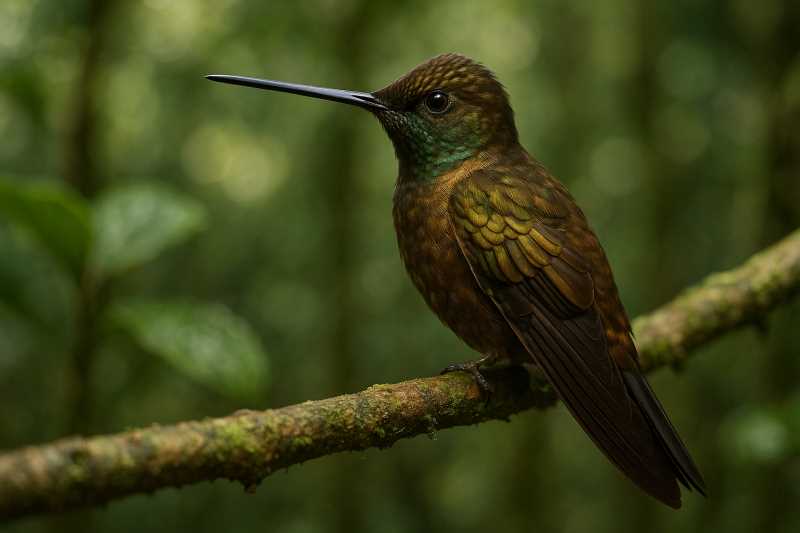
The Bronzy Inca measures approximately 11.4–14 centimetres in length. It is a relatively subdued member of the Coeligena genus, with dark bronzy-brown to bronze-green upperparts, a darker tail and reddish-brown, greyish or buff-brown underparts depending on the subspecies and viewing conditions.
The male typically shows a white spot behind the eye, a long black bill that may have a yellowish base to the lower mandible, and a pale or whitish throat and upper breast marked with dusky streaks or spots. The tail is slightly forked and generally dark bronze rather than white-tipped. Females are similar but usually have a slightly longer bill, shorter wings and tail, and a less deeply forked tail. Immature birds resemble females and are generally less strongly marked.
Plumage varies geographically. Birds in some populations appear more olive or greenish, while others are darker, browner or more rufous. This variation means that colour alone is not always sufficient for identification.
Range and Habitat
The Bronzy Inca occurs in the northern and central Andes, from northern Venezuela through Colombia, Ecuador and Peru to central and south-eastern Bolivia. Several recognised subspecies occupy different parts of this range, including populations on both the eastern and western slopes of the Andes.
It is usually found in humid montane and cloud forest, particularly along forest edges, in clearings and in dense secondary vegetation. It may also occur among scattered trees and flowering shrubs in coffee-growing landscapes. Recorded elevations vary across the range, broadly from about 1,000 to 3,000 metres, with local populations occupying different altitudinal zones. The species is considered resident, although local or seasonal movements may occur when flowering patterns change.
Where to See This Species
Otún Quimbaya Fauna and Flora Sanctuary, Risaralda, Colombia
The sanctuary near Pereira protects humid sub-Andean forest and provides publicly accessible trails through suitable forest and edge habitat. The Bronzy Inca has been documented at Otún Quimbaya, where birders should check flowering plants, shaded paths and forest margins. The sanctuary operates as a day-visit site, and access to trails is accompanied by park staff or authorised guides.
Nearby accommodation: Pereira and the rural La Florida area provide hotels, guest houses, lodges and other practical accommodation options.
Cayambe-Coca National Park, Napo and Pichincha, Ecuador
The eastern Andean cloud forests and páramo edges of Cayambe-Coca National Park support the Bronzy Inca, particularly in the lower and middle elevations where humid forest meets open vegetation. Birding records from the park indicate that it can be encountered while travelling through suitable east-slope forest, although sightings are not guaranteed.
Nearby accommodation: Papallacta and nearby communities provide hotels, guest houses, cabins, lodges and self-catering accommodation.
Tapichalaca Wildlife Reserve, Zamora-Chinchipe, Ecuador
Tapichalaca protects humid montane forest on the eastern Andean slope and includes the Bronzy Inca on its reserve bird checklist. The species may be found along forest roads, trails and flowering edges at middle elevations. Visits are generally arranged through the reserve or its associated lodge, making local guidance useful for locating hummingbirds.
Nearby accommodation: The reserve lodge is the most practical base, with additional guest houses and small lodges available in nearby communities such as Valladolid and Yangana.
Behaviour and Diet
The Bronzy Inca is active during the day and is most often encountered alone while feeding. It may also occur in mixed-species feeding flocks, especially where several hummingbird species gather around flowering plants. Individuals generally follow a circuit between dependable nectar sources, a behaviour known as trap-line foraging. They may defend particularly rich flowers, but the strength of this behaviour varies between individuals and locations.
Nectar provides most of the bird’s energy. The Bronzy Inca also captures small insects and other arthropods by hawking from a perch or gleaning among foliage. These animal foods are especially important during breeding and while feeding young.
Breeding information is limited and varies geographically. The female builds a small cup-shaped nest from moss and plant fibres, usually concealed in vegetation. A clutch normally contains two white eggs. The female alone incubates the eggs for approximately 15–16 days, and young birds fledge about 22–24 days after hatching. Breeding activity has been recorded during periods of local flower abundance, but the timing differs across the species’ extensive range.
Identification Tips
- Look for a medium-sized, long-billed hummingbird with an overall dark bronze, brown or bronzy-green appearance.
- The straight black bill is conspicuously long in proportion to the head.
- A white spot behind the eye, a pale or streaked throat and a slightly forked dark tail are useful field marks on well-seen birds.
- Do not rely on a white tail band, as the tail is generally dark bronze or dusky rather than broadly white-tipped.
- The species can resemble the Brown Inca (Coeligena wilsoni), but the Brown Inca is generally browner and shows more obvious white patches on the sides of the chest or neck.
- It may also be confused with the much larger Giant Hummingbird (Patagona gigas). The Giant Hummingbird is larger, has a longer-looking bill and is more associated with open, often drier habitats at higher elevations.
Conservation Status
The Bronzy Inca is currently assessed as Least Concern. Its global population has not been quantified, but its very large range means that it does not currently meet the thresholds for a threatened category. BirdLife International records the population trend as decreasing, with a precautionary estimate that tree-cover loss across the mapped range may have contributed to a modest decline.
Habitat loss and fragmentation caused by agricultural expansion, logging, road construction and other infrastructure remain potential threats, particularly where humid montane forest is cleared or isolated. Protected forests, sustainable land-use practices, habitat restoration and the retention of flowering vegetation along forest edges can help maintain local populations.
Frequently Asked Questions
Where does the Bronzy Inca live?
It occurs in humid montane and cloud forests from Venezuela through Colombia, Ecuador and Peru to Bolivia. It also uses forest edges, clearings, secondary growth and some shaded agricultural landscapes.
What does the Bronzy Inca look like?
It is a 11.4–14 centimetre hummingbird with dark bronzy-brown or bronze-green upperparts, darker wings and tail, a long straight black bill, and brownish, greyish or streaked underparts.
Is the Bronzy Inca migratory?
It is generally regarded as resident rather than a long-distance migrant. Local or seasonal movements may occur in response to changes in flowering, weather and food availability.
What does the Bronzy Inca eat?
Its diet consists mainly of nectar from flowering plants. It also catches small insects and other arthropods, which provide protein and other nutrients.
How does the Bronzy Inca breed?
The female builds a concealed cup nest, usually lays two eggs and incubates them alone for about 15–16 days. Young birds generally leave the nest around 22–24 days after hatching.
Is the Bronzy Inca endangered?
No. The species is currently classified as Least Concern, although its population trend is considered decreasing and the loss and fragmentation of montane forest remain conservation concerns.
References
- BirdLife International
- Cornell Lab of Ornithology, Birds of the World
- Parques Nacionales Naturales de Colombia
Related posts