Introduction
The Grey Peacock-Pheasant (Polyplectron bicalcaratum) is a resident forest pheasant in the family Phasianidae. It occurs from Bangladesh and north-eastern India through mainland South-East Asia and southern China. Although related to peafowl, it is a smaller, ground-dwelling pheasant and is named for the metallic ocelli, or eye-spots, on its wings and tail. (ww.worldbirdnames.org)
Physical Description
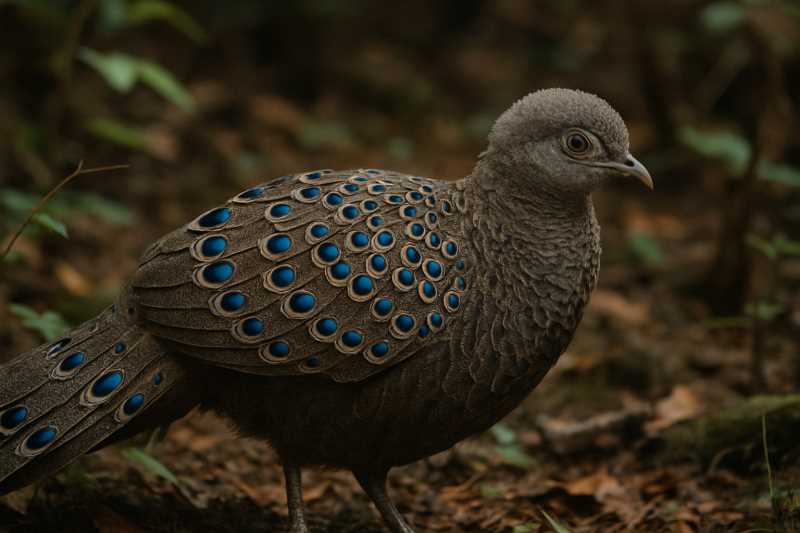
The Grey Peacock-Pheasant is a compact, long-tailed pheasant measuring up to approximately 76 cm in total length. Its plumage is predominantly greyish brown, finely marked and well suited to the forest floor. The male has numerous metallic blue-green ocelli on the wing and tail feathers, together with an elongated crest, pale or pinkish facial skin, and prominent leg spurs.
Females are smaller, darker and less heavily ornamented than males, although they retain the species’ characteristic fine patterning. Juveniles generally resemble females and have less conspicuous ornamentation. The sexes are therefore similar in basic colour, but adult males are usually identifiable by their larger size, brighter ocelli, longer tail and more developed spurs. (nhmo-birds.collectionexplorer.org)
Range and Habitat
The species is distributed across Bangladesh, Bhutan, north-eastern India, Myanmar, Thailand, Laos, Cambodia, Vietnam and southern China. The Hainan Peacock-Pheasant is now generally treated as a separate species, Polyplectron katsumatae, rather than as a population of the Grey Peacock-Pheasant. (cites.org)
Grey Peacock-Pheasants are resident rather than migratory. They inhabit subtropical and tropical forests, including lowland evergreen, dry evergreen and hill evergreen forest. They usually remain in dense undergrowth and forest-floor vegetation, where leaf litter and cover provide feeding opportunities and protection. In Thailand, detailed fieldwork has recorded them in hill evergreen and dry evergreen forest between about 700 and 1,500 metres, while broader habitat accounts also record the species at lower elevations. (link.springer.com)
Behaviour and Diet
Grey Peacock-Pheasants are secretive, primarily terrestrial birds. They are often encountered alone, in pairs or in small family groups, and tend to move quietly through dense vegetation. Their mottled plumage provides effective camouflage against fallen leaves and shaded forest-floor cover.
The diet is omnivorous. Recorded and reported food items include seeds, fruits, fallen berries, figs, insects, termites, snails and other small invertebrates. Field research in Thailand found that both insects and fruit formed important components of the species’ feeding environment. (link.springer.com)
During the breeding season, males maintain cleared display scrapes in relatively flat, open patches of the forest understorey. They use these sites for calling and courtship displays, spreading or presenting the ocellated tail and wing feathers. The breeding season varies geographically, but is commonly reported from approximately January or March to June. Pairs have been observed in the wild, and the species is generally regarded as probably monogamous, although the strength of this evidence is limited.
The nest is placed on or close to the ground among dense vegetation. A normal clutch consists of two eggs, and incubation is carried out by the female for about 21 days. (link.springer.com)
Identification Tips
Look for the following combination of features:
- A medium-sized, grey-brown pheasant with a long tail.
- Numerous small metallic blue-green ocelli on the wings and tail.
- A noticeable crest and pale facial skin.
- A strongly terrestrial habit in dense forest undergrowth.
- A tendency to remain concealed, making calls, movement and brief views important for detection.
The Grey Peacock-Pheasant is unlikely to be confused with a true peafowl in the field. Unlike peafowl, it is smaller, more cryptically coloured and usually encountered walking through forest undergrowth rather than displaying in open ground. It can be separated from other Polyplectron species by its grey-brown overall appearance, geographic range and pattern of ocelli, although accurate identification may require location and careful comparison of plumage details.
Conservation Status
The Grey Peacock-Pheasant is currently assessed as Least Concern on the IUCN Red List. This global assessment reflects the species’ relatively broad distribution, but it does not mean that all populations are secure. Habitat loss and degradation caused by logging, agricultural expansion and the opening of forest can reduce suitable habitat, while hunting and trapping may create additional local pressure. The species’ dependence on dense forest cover and its low reproductive output make local populations vulnerable to sustained disturbance. (nhmo-birds.collectionexplorer.org)
Important conservation measures include protecting remaining evergreen and hill forests, maintaining habitat connectivity, managing hunting and trapping, and monitoring populations in protected areas. The species is also listed in CITES Appendix II, which regulates international trade in specimens and products. Conservation priorities should be guided by local population information, because national or regional assessments may differ from the global category. (cites.org)
Frequently Asked Questions
Where does the Grey Peacock-Pheasant live?
It occurs in forested parts of Bangladesh, Bhutan, north-eastern India, Myanmar, Thailand, Laos, Cambodia, Vietnam and southern China. It is associated mainly with evergreen and hill forests containing dense undergrowth.
Is the Grey Peacock-Pheasant a type of peacock?
No. It is a pheasant in the family Phasianidae. Its name refers to the peacock-like metallic eye-spots on the wings and tail, not to membership of the peafowl genus Pavo.
What does the Grey Peacock-Pheasant eat?
It eats a mixture of plant and animal food, including seeds, fruits, figs, berries, termites, insects, snails and other small invertebrates. It usually forages on or near the forest floor.
How can the Grey Peacock-Pheasant be identified?
The most useful field marks are its grey-brown body, long tail, crest, cryptic forest-floor behaviour and metallic blue-green ocelli on the wings and tail. Adult males are generally larger and more brightly marked than females.
How many eggs does it lay?
A normal clutch contains two eggs. The female incubates them for approximately 21 days in a nest placed on or near the ground among dense vegetation.
Is the Grey Peacock-Pheasant endangered?
Globally, it is currently classified as Least Concern on the IUCN Red List. However, habitat destruction, forest degradation, hunting and trapping can threaten local populations, so regional conservation action remains important.
References
- BirdLife International. 2024. Grey Peacock-pheasant Polyplectron bicalcaratum Species Factsheet. BirdLife DataZone. Accessed 8 September 2026. https://datazone.birdlife.org/species/factsheet/grey-peacock-pheasant-polyplectron-bicalcaratum
- Gill, F., Donsker, D. and Rasmussen, P., eds. 2026. IOC World Bird List, version 15.2. International Ornithologists’ Committee. Accessed 8 September 2026. https://www.worldbirdnames.org/
- Kimball, R. T., Braun, E. L., Ligon, J. D., Lucchini, V. and Randi, E. 2001. A molecular phylogeny of the peacock-pheasants, Galliformes: Polyplectron spp., indicates loss and reduction of ornamental traits and display behaviours. Biological Journal of the Linnean Society 73(2): 187–198. https://doi.org/10.1006/bijl.2001.0536
- Morris, D. W., Sukumal, N., Ngoprasert, D., Gale, G. A. and Savini, T. 2018. Spatial distribution of display sites of Grey Peacock-pheasant in relation to micro-habitat and predators during the breeding season. Avian Research 9: 31. https://doi.org/10.1186/s40657-018-0107-8
- Wildlife Institute of India. 2016. National Studbook of Grey Peacock-pheasant, Polyplectron bicalcaratum, third edition. Wildlife Institute of India, Dehradun. https://wii.gov.in/images/images/documents/publications/rr_2016_studbook_grey_peacock-II_revised.pdf
- Wildlife Institute of India and United States Forest Service. 2003. Grey Peacock Pheasant Polyplectron bicalcaratum. In Wildlife Habitat Relationships in Conservation Areas, volume 2. Wildlife Institute of India. https://digitalrepository.wii.gov.in/server/api/core/bitstreams/2a10057d-dd8e-41cf-a612-a0880033fea0/content
- Convention on International Trade in Endangered Species of Wild Fauna and Flora. 2025. Grey peacock-pheasant Polyplectron bicalcaratum, species overview and trade information. CITES Animals Committee document AC26 Doc. 13.2.1. Accessed 8 September 2026. https://cites.org/sites/default/files/common/com/ac/26/E26-13-02-01-A.pdf
Related posts