Exploring the Green-tailed Sunbird: A Vibrant Jewel
The Green-tailed Sunbird (Aethopyga nipalensis) is a small, vibrant bird that has captured the fascination of ornithologists and bird lovers alike. This article delves into the world of this magnificent species, exploring its habitat, behavior, breeding patterns, and the conservation efforts needed to ensure its survival.
Habitat and Distribution
The Green-tailed Sunbird is primarily found in the montane forests of Southeast Asia, with its range extending across countries like Nepal, Bhutan, India, Myanmar, Thailand, Laos, Vietnam, and southern China. These birds thrive in altitudinal ranges from 1,200 to 3,400 meters, preferring subtropical or tropical moist montane forests. The dense, flower-rich environments of these regions provide the perfect habitat for the Green-tailed Sunbird.
The presence of a variety of flowering plants is crucial for these nectarivorous birds, which have co-evolved with their floral environments. The birds are particularly fond of rhododendron and other high-altitude flowering plants that provide both nectar and insects, which are vital components of their diet.
Physical Description
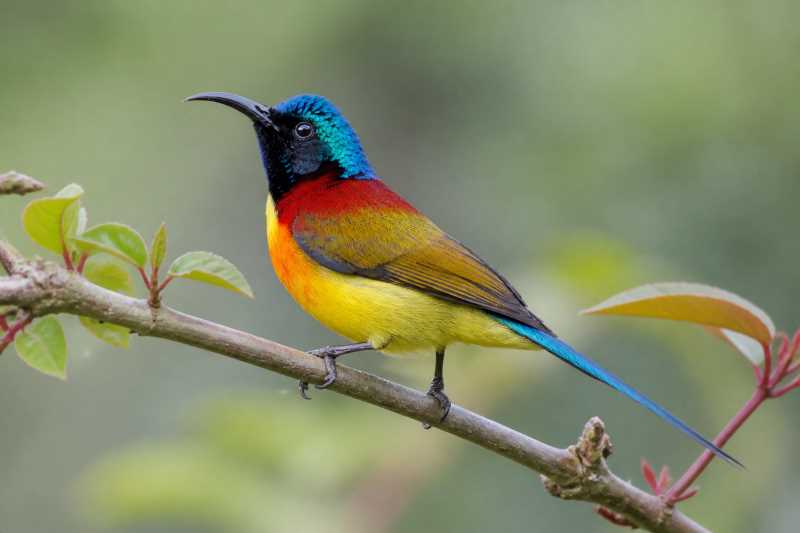
The Green-tailed Sunbird is a striking bird, easily recognizable by its iridescent plumage. Males are adorned with a vibrant metallic green crown and upperparts, contrasting sharply with their deep blue wings and tail. The underparts are a brilliant yellow, accented by a crimson breast band, which adds to their allure. Females, while less vividly colored, boast olive-green upperparts and yellowish underparts, providing a more camouflaged appearance that aids in nesting.
Both sexes possess a slender, curved bill adapted perfectly for probing flowers for nectar. This adaptation is a testament to their specialized feeding habits and ecological role as pollinators.
Feeding and Behavior
Green-tailed Sunbirds are primarily nectarivores, relying on their specialized bills to extract nectar from a variety of flowers. Their feeding habits play a critical role in the pollination of many high-altitude plant species, making them an integral part of the ecosystem. In addition to nectar, these birds supplement their diet with insects and spiders, especially during the breeding season when protein demands are higher.
These sunbirds are generally active and acrobatic, often seen flitting between flowers and performing impressive aerial maneuvers. They are known for their territorial behavior, especially during the breeding season, when males become particularly aggressive in defending their feeding territories from intruders.
Breeding and Nesting
The breeding season for the Green-tailed Sunbird typically occurs from April to August, coinciding with the peak flowering period in their habitats. Males engage in elaborate courtship displays to attract females, showcasing their vibrant plumage and singing complex songs.
Nesting is primarily the responsibility of the female, who constructs a cup-shaped nest using moss, lichen, and spider silk, often suspended from tree branches or nestled within dense foliage. Clutch size usually ranges from two to three eggs, which are incubated solely by the female for about 14-16 days. Once hatched, both parents participate in feeding the chicks, which fledge approximately 18-21 days after hatching.
Conservation Status and Challenges
Currently, the Green-tailed Sunbird is listed as a species of Least Concern by the International Union for Conservation of Nature (IUCN), primarily due to its wide range and stable population. However, like many forest-dwelling species, it faces threats from habitat loss and degradation. Deforestation for agriculture, logging, and infrastructure development poses significant risks to their habitats.
Climate change also presents a looming challenge, as alterations in temperature and precipitation patterns could affect the flowering cycles of the plants they rely on, potentially disrupting their food supply and breeding success.
Conservation Efforts
Conservation efforts for the Green-tailed Sunbird focus on habitat preservation and restoration. Protecting montane forest habitats through the establishment of protected areas and sustainable land management practices is crucial. Additionally, raising awareness about the ecological role of sunbirds as pollinators can help garner support for their conservation.
Research initiatives aimed at understanding the species’ ecology, population dynamics, and response to environmental changes are vital. Such knowledge can inform targeted conservation strategies and policy decisions to ensure the long-term survival of the Green-tailed Sunbird.
Conclusion
The Green-tailed Sunbird is a vibrant and vital component of its ecosystem, serving as both a pollinator and an indicator of forest health. By understanding and protecting this species, we contribute to the conservation of the rich biodiversity of montane forests. The continued efforts to preserve their habitats and mitigate threats are essential in ensuring that future generations can enjoy the beauty and ecological benefits of the Green-tailed Sunbird.
Related posts