Introduction
The Green-crowned Plovercrest (Stephanoxis lalandi) is a small hummingbird endemic to Brazil. It occurs mainly in the Atlantic Forest region of southeastern Brazil, where it uses montane forest, scrub, streamside vegetation and high-elevation grassland. Its scientific name honours the French naturalist Pierre Antoine Delalande. The species belongs to the hummingbird family Trochilidae and is one of the two recognised species in the genus Stephanoxis.
Physical Description
The Green-crowned Plovercrest is a small hummingbird measuring approximately 8.5–9 centimetres in length.
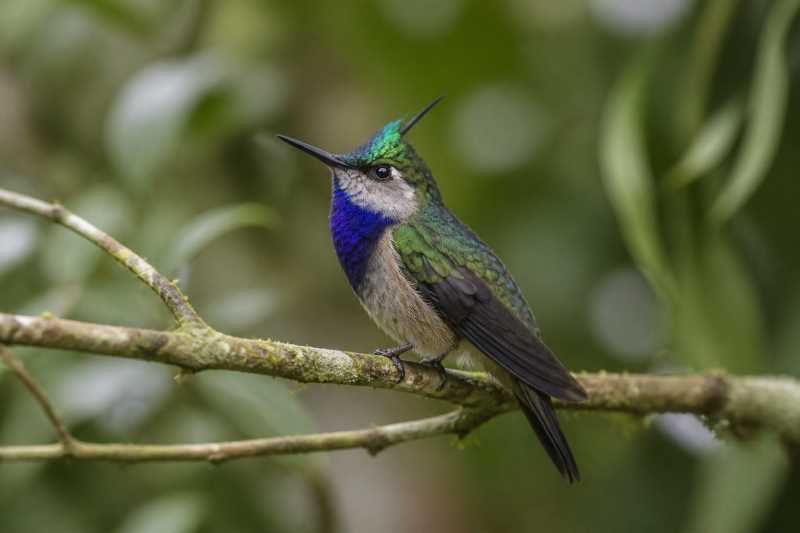
Adult males are distinguished by a green crown and raised crest, green upperparts and an iridescent violet-blue throat and breast. The face is greyish, and the body may show golden-green tones depending on the light. The bill is short, straight and dark.
Females are less brightly coloured. They have green upperparts, paler underparts and a much shorter crest. Juveniles resemble females but are generally duller and less strongly marked. The difference between the sexes is therefore usually clear when an adult male and female are seen together.
Range and Habitat
The Green-crowned Plovercrest is endemic to Brazil. Its range extends through parts of Espírito Santo, Minas Gerais, Rio de Janeiro and São Paulo, mainly in the southeastern Atlantic Forest region. Its distribution is patchy, with populations associated with mountain ranges and suitable areas of remaining native vegetation.
It uses the understorey of humid forest, forest edges, scrub, vegetation along streams and high-elevation fields. Most records are from low to middle elevations, but the species can occur much higher in the mountains. In the Serra do Caparaó and Itatiaia region, it has been recorded at approximately 2,900 metres, while records in Itatiaia National Park include elevations of about 1,600–2,600 metres.
The species is generally resident, although local or seasonal movements may occur in response to flowering conditions and changes in food availability.
Where to See This Species
Itatiaia National Park, Rio de Janeiro and Minas Gerais, Brazil
Itatiaia National Park is one of the most reliable publicly accessible places to look for the Green-crowned Plovercrest. The species is documented within the park, particularly in the high-elevation environments where shrubland, montane vegetation and flowering plants provide suitable habitat. The best opportunities are likely along accessible mountain roads and trails in the upper part of the park, especially during periods of good flowering activity.
Nearby accommodation: The towns of Itatiaia and Resende provide hotels, guest houses and self-catering accommodation. Visconde de Mauá is another practical gateway for visitors exploring the wider mountain region.
REGUA, Guapimirim, Rio de Janeiro, Brazil
The Reserva Ecológica de Guapiaçu, commonly known as REGUA, records the Green-crowned Plovercrest among the birds encountered through its birdwatching programme. The reserve protects Atlantic Forest, wetlands and regenerating habitats, and local guides can also take visitors to nearby higher-elevation sites where the species is easier to find. Look for it around flowering vegetation, forest edges and suitable montane habitat rather than only in the reserve’s wetland areas.
Nearby accommodation: Guapimirim and Cachoeiras de Macacu are the nearest practical accommodation centres, with guest houses, small hotels, lodges and self-catering options.
Behaviour and Diet
The Green-crowned Plovercrest feeds mainly on nectar taken from flowering plants. It may forage from low vegetation to the forest canopy and also takes small insects and spiders, which provide additional protein. Like other hummingbirds, it can hover while feeding and manoeuvre rapidly between flowers.
Males defend feeding areas during the breeding season. They may gather in small display groups, or leks, where they sing and perform visual displays for females. Courtship includes raised-crest displays and agile flight around the female.
The female builds a small cup-shaped nest low in vegetation, often on a slender branch or bamboo stem. The nest is made from soft plant material and is secured with spider silk. Two eggs are normally laid, and the female is responsible for incubation and care of the young.
Identification Tips
- Look for a small, compact hummingbird with a noticeably raised crest.
- In adult males, the green crown contrasts with the violet-blue throat and breast.
- Females are greener above and much paler below, with a shorter crest.
- The species is often associated with mountain scrub, forest edges, streamside vegetation and high-elevation fields.
- Do not confuse it with the Violet-crowned Plovercrest (Stephanoxis loddigesii). The Violet-crowned Plovercrest has a violet rather than green crown and occupies a different part of southeastern and southern Brazil.
- The Green-crowned Plovercrest can be inconspicuous when perched, so listen for its repeated song and watch flowering shrubs, forest margins and open mountain vegetation.
Conservation Status
The Green-crowned Plovercrest is currently classified as Least Concern. Its global population size and population trend have not been reliably quantified, and the species is considered locally common in suitable areas but patchily distributed.
Habitat loss remains a concern in parts of the Atlantic Forest, where urban expansion, agriculture, logging and the degradation of mountain vegetation have reduced and fragmented native habitat. The species can use some modified landscapes when patches of forest or scrub remain, but intensive agricultural development may remove the cover and flowering plants it requires.
Protected areas, ecological corridors, restoration of degraded Atlantic Forest and continued monitoring of records are important conservation measures. Sightings submitted through recognised bird-monitoring and citizen-science programmes can also help improve knowledge of the species’ distribution.
Frequently Asked Questions
Where does the Green-crowned Plovercrest live?
It is endemic to Brazil and occurs mainly in the Atlantic Forest mountains of Espírito Santo, Minas Gerais, Rio de Janeiro and São Paulo.
What does the Green-crowned Plovercrest eat?
It feeds primarily on nectar from flowers and supplements its diet with small insects and spiders.
How can males and females be distinguished?
Adult males have a green crown and crest with a vivid violet-blue throat and breast. Females are duller, with paler underparts and a shorter crest.
Is the Green-crowned Plovercrest migratory?
It is generally regarded as resident, although local or seasonal movements may occur when flowering conditions and food availability change.
Where is the best place to see this hummingbird?
Itatiaia National Park is a particularly useful destination because the species is documented there at high elevations. REGUA and nearby montane sites in Rio de Janeiro also offer opportunities with local guidance.
Is the Green-crowned Plovercrest threatened?
It is currently classified as Least Concern, but habitat loss and fragmentation in the Atlantic Forest remain important local conservation concerns.
References
- IOC World Bird List
- IUCN Red List of Threatened Species
- Papéis Avulsos de Zoologia
Related posts