Introduction
The great spotted kiwi, or roroa, is a flightless, nocturnal bird endemic to New Zealand’s South Island. Its accepted scientific name is Apteryx maxima. The species was formerly widely known as Apteryx haastii, but genetic research showed that the specimens on which that name was based were hybrids, leading to the restoration of A. maxima for the great spotted kiwi.
Roroa is one of New Zealand’s largest kiwi species and is associated mainly with remote forests, scrub, tussock grasslands and subalpine habitats. Like other kiwi, it has a highly developed sense of smell, nostrils near the tip of its bill, and strong legs adapted for walking, probing and defence.
Physical Description
Great spotted kiwi are about 45 centimetres tall. Adult males weigh approximately 2.2 kilograms, while females average about 3 kilograms and are generally larger than males. Females also have longer bills.
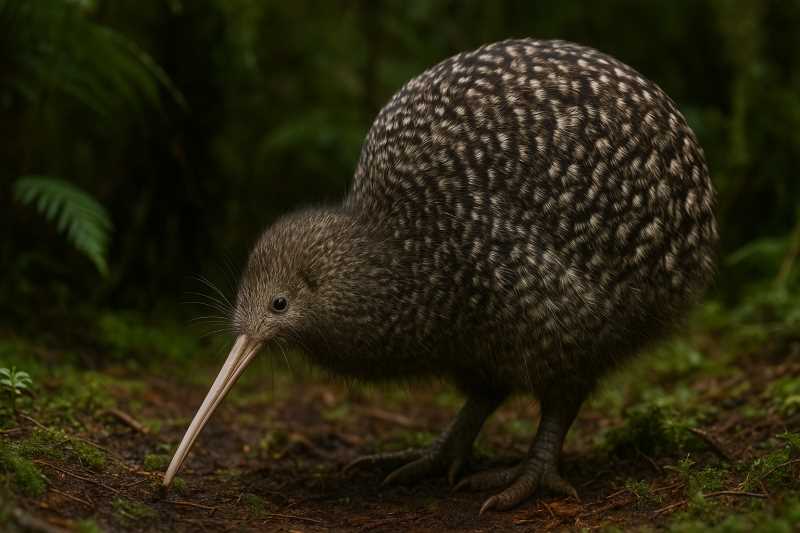
The plumage is shaggy, brownish-grey and finely mottled or horizontally banded with pale markings. The long, pale bill has nostrils near its tip, a distinctive feature among birds. Long tactile bristles surround the base of the bill and help the bird investigate its surroundings.
The wings are extremely small and hidden beneath the body plumage. They retain a small claw, but the species is flightless and has no visible tail. The short, powerful legs and toes have strong claws used for walking, digging and territorial conflicts. Juveniles are smaller and may resemble little spotted kiwi until they mature.
Range and Habitat
The great spotted kiwi is endemic to New Zealand and occurs only in the north-western and central South Island. Its main populations are in North-west Nelson, the Paparoa Range, Westport and the Arthur’s Pass–Hurunui region, including areas of Kahurangi and Arthur’s Pass national parks.
The species uses a broad range of habitats, including native forest, scrub, upland tussock grassland and subalpine vegetation. Although it has been recorded from near sea level to about 1,500 metres, it occurs most often in subalpine areas between approximately 700 and 1,100 metres.
The four principal populations are genetically distinct. No formally recognised subspecies are currently described, although average bill length varies geographically, with birds in North-west Nelson tending to have longer bills than those in the Southern Alps.
Behaviour and Diet
Great spotted kiwi are nocturnal and usually leave their daytime shelter shortly after nightfall. During the day they rest in burrows, rock crevices, hollow logs, hollow tree bases or other sheltered sites. They are sedentary and territorial rather than migratory.
They forage by walking slowly through leaf litter and probing soil, rotten wood and other substrates with the bill. Their diet consists mainly of earthworms, insect larvae, beetles, cicadas, wētā, centipedes, spiders, snails and other invertebrates. Fallen fruit, leaves and occasional freshwater crayfish may also be eaten.
Pairs maintain contact and defend territories through repeated calls. The male’s call is usually a higher-pitched ascending whistle, while the female’s is lower and slower. Pairs may call alternately, creating a duet, and individuals can defend themselves or their territories with their powerful legs and claws.
Breeding generally occurs from July to December. A nest may be placed in a burrow, rock crevice, hollow log, tree base or dense vegetation. The usual clutch is one very large white or pale green egg. Incubation is shared by the parents, although the male commonly undertakes more daytime incubation. The chick is precocial and leaves the nest soon after hatching, but young birds remain vulnerable to predators.
Identification Tips
- Look for a large, pale, flightless kiwi with shaggy brownish-grey plumage marked by fine mottling or pale horizontal bands.
- The long, pale bill has nostrils close to the tip, and the bird has no visible tail.
- Short dark legs, strong toes and dark or partly dark claws help distinguish many adults.
- Great spotted kiwi are more often heard than seen. Listen after dark for a repeated ascending whistle from the male or a slower, lower-pitched call from the female.
- Immature great spotted kiwi can resemble little spotted kiwi. Size and proportions are useful, but young birds may be difficult to identify confidently without close examination or supporting information.
Conservation Status
The great spotted kiwi is assessed globally as Vulnerable and is listed as Nationally Vulnerable in New Zealand. The New Zealand Department of Conservation gives an estimated population of about 14,000 birds and reports an overall decline of approximately 1.6% per year.
Predation is the principal conservation threat. Stoats can kill chicks, particularly when high seed production causes prey populations and predator numbers to increase. Dogs and feral cats also pose serious risks, while habitat loss, disturbance and the small size and isolation of some populations add to the species’ vulnerability.
Conservation measures include aerial and ground-based predator control, protection and restoration of habitat, monitoring, translocations and community involvement. Recovery planning focuses on increasing all four main populations, restoring the species across parts of its former range and maintaining genetic diversity. Predator control is generally more important for roroa than intensive egg or chick-rearing programmes because the species still occupies relatively extensive, remote habitat.
The kiwi is also a taonga, or treasured species, in Māori culture. Its feathers have traditionally been used in tā moko and ceremonial cloaks, and the bird has enduring cultural and national significance in Aotearoa New Zealand.
Frequently Asked Questions
Where does the great spotted kiwi live?
It lives only on New Zealand’s South Island, mainly in North-west Nelson, the Paparoa Range, Westport and the Arthur’s Pass–Hurunui region. It favours remote forest, scrub, tussock and subalpine habitats.
Is the great spotted kiwi the largest kiwi?
It is one of the largest kiwi species. Adult females are usually heavier than males, with average weights of about 3 kilograms and 2.2 kilograms respectively. Some sources differ in how they rank kiwi species by size because body mass varies between populations.
Can great spotted kiwi fly?
No. Great spotted kiwi are completely flightless. Their wings are extremely reduced and hidden beneath the body feathers, and the species has no visible tail.
What does the great spotted kiwi eat?
Its diet consists mainly of invertebrates, including earthworms, insect larvae, beetles, cicadas, wētā, spiders, centipedes and snails. It also eats some fallen fruit, leaves and other small food items.
Why is the great spotted kiwi threatened?
Predation is the main threat, especially to chicks. Stoats, dogs and feral cats can kill kiwi, while habitat disturbance and the isolation of genetically distinct populations create additional conservation challenges.
What is the scientific name of the great spotted kiwi?
The accepted name is Apteryx maxima. The species was formerly widely called Apteryx haastii, but that name was reassessed after genetic analysis found that its original type specimens were hybrids.
References
- Department of Conservation. 2019. Roroa / great spotted kiwi (Apteryx maxima) species plan 2019–2029. New Zealand Department of Conservation. Stable PDF source.
- Department of Conservation. n.d. Great spotted kiwi/roroa: Kiwi. New Zealand Department of Conservation. Accessed 8 September 2026. Species account.
- Gill, F., Donsker, D. and Rasmussen, P., eds. 2026. IOC World Bird List, version 15.2. International Ornithologists’ Union. Accessed 8 September 2026. Taxonomic updates.
- Robertson, H. A. 2013, updated 2022. Great spotted kiwi | roroa. In C. M. Miskelly, ed., New Zealand Birds Online. Accessed 8 September 2026. Species account.
- Robertson, H. A., McLennan, J. A., Colbourne, R. M. and McCann, A. J. 2005. Population status of great spotted kiwi (Apteryx haastii) near Saxon Hut, Heaphy Track, New Zealand. Notornis 52: 27–33. Publication record.
- Shepherd, L. D., Tennyson, A. J. D., Robertson, H. A., Colbourne, R. M. and Ramstad, K. M. 2021. Hybridisation in kiwi (Apteryx; Apterygidae) requires taxonomic revision for the Great Spotted Kiwi. Avian Research 12(1): 24. https://doi.org/10.1186/s40657-021-00257-6.
- BirdLife International. 2024. Handbook of the Birds of the World and BirdLife International Digital Checklist of the Birds of the World, version 9. BirdLife International. Accessed 8 September 2026. Checklist source.
Related posts