Introduction
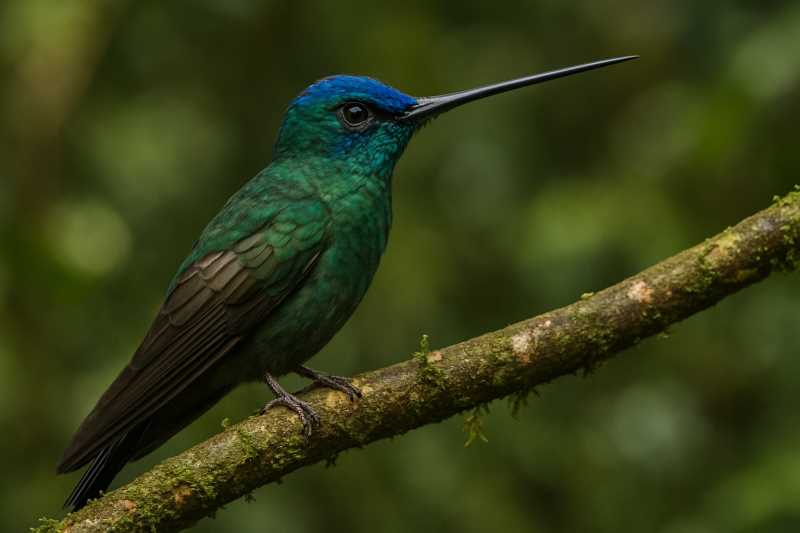
The Blue-fronted Lancebill (Doryfera johannae) is a small hummingbird in the family Trochilidae. It is recognised by its long, spear-like bill, green upperparts and iridescent blue or blue-green forehead. The species occurs in two broadly separated South American regions: the eastern Andes and the Guiana Shield.
Physical Description
The Blue-fronted Lancebill is approximately 9.6–11 cm long. It has a long, straight to slightly upcurved black bill, which is often held at a noticeable upward angle. The tail is short, rounded and dark, with subtle bronzy or greyish edging.
Adult males of the nominate form have dark bronzy-green upperparts, a brilliant violet-blue or blue frontlet, and deep blue-black underparts with greenish reflections on the throat and breast. Females are generally duller, with a greenish-blue forehead and greyish or bronzy-green underparts. The sexes are therefore distinguishable in good views, although lighting can affect the apparent colour of the iridescent feathers.
The species has two recognised subspecies, and birds of the Guiana Shield form, D. j. guianensis, are generally paler and have a somewhat shorter bill than the nominate form. Detailed information on juvenile and immature plumages is limited, so age-related identification should be treated cautiously.
Range and Habitat
The Blue-fronted Lancebill has a disjunct distribution. The nominate subspecies occurs along the eastern slopes of the Andes from south-eastern Colombia through eastern Ecuador to central and south-eastern Peru. A separate population, D. j. guianensis, occurs in the tepui region of southern Venezuela, western Guyana and adjacent northern Brazil.
It inhabits wet tropical forest, lower Andean foothills and adjacent lowland forest. In the Andes it is most often associated with elevations of roughly 500–1,400 metres, although local records may extend beyond this range. Tepui populations occupy suitable humid forest and woodland around the highland formations.
The Blue-fronted Lancebill is not regarded as a long-distance migrant. Its distribution is closely associated with humid forest and reliable flowering resources rather than with a single narrowly defined plant community.
Where to See This Species
Arena Blanca Reserve, San Martín, Peru
Arena Blanca Reserve near Aguas Verdes is a documented site for the species. Its forested foothill habitat and hummingbird feeders provide a realistic opportunity to look for Blue-fronted Lancebill alongside other Amazonian and Andean hummingbirds. The bird may still be uncommon, so sightings are not guaranteed.
Nearby accommodation: Aguas Verdes is the nearest practical settlement, with guest houses, small lodges and basic accommodation available in the wider Rioja and northern San Martín area.
Manu Biosphere Reserve, Madre de Dios, Peru
The Blue-fronted Lancebill has been documented in the Manu Biosphere Reserve and its buffer-zone forests, including localities associated with the Manu Learning Centre and Pantiacolla. The reserve’s humid foothill and lowland forests provide suitable habitat, although access is generally organised through authorised lodges, camps or guided programmes.
Nearby accommodation: Accommodation is available through forest lodges and camps in the reserve and buffer zone, with Puerto Maldonado serving as the main recognised gateway for many visits.
Behaviour and Diet
Like other hummingbirds, the Blue-fronted Lancebill feeds mainly on nectar and supplements its diet with small insects and spiders. Arthropods provide important protein, particularly for growing birds and breeding females.
It can hover while feeding and may visit flowers in the forest understorey, along edges and around clearings. The long bill is suited to flowers with tubular corollas, although the species is not restricted to a single group of flowering plants.
Individuals are usually encountered alone rather than in flocks. Males may defend productive feeding areas or perches, but detailed information on territorial behaviour and courtship displays remains limited. The species’ breeding biology is also poorly documented. As in other hummingbirds, the female is expected to undertake the main duties of nest construction, incubation and care of the young, but species-specific information on clutch size, incubation and fledging should not be assumed without direct evidence.
Identification Tips
- Look for a small, compact hummingbird with a conspicuously long, straight or slightly upcurved bill.
- The male has a striking violet-blue or blue frontlet, dark bronzy-green upperparts and deep blue-black underparts.
- Females are duller, with a greenish-blue frontlet and greyer, less strongly contrasting underparts.
- The bill is often held slightly upward when the bird is perched.
- The most relevant comparison is the Green-fronted Lancebill, Doryfera ludovicae. Blue-fronted Lancebill is generally smaller, has a blue rather than green frontlet, and the male is darker below. Female lancebills can be more difficult to separate, so size, frontlet colour, underpart tone and location should all be considered together.
Conservation Status
The Blue-fronted Lancebill is currently assessed as Least Concern. It has a broad, though discontinuous, distribution and occurs in a number of protected areas and forest reserves.
The principal potential threats are the loss and fragmentation of humid forest through agricultural expansion, logging, mining, road development and other land-use changes. The population trend is not well quantified, and reliable global population estimates are not available. Protecting forest in the eastern Andes and the Guiana Shield remains important for this species and the wider hummingbird community.
Frequently Asked Questions
Where is the Blue-fronted Lancebill found?
It occurs in eastern Colombia, eastern Ecuador, central and south-eastern Peru, and in parts of southern Venezuela, western Guyana and northern Brazil.
What habitat does the Blue-fronted Lancebill use?
It is associated mainly with wet tropical forest, lower Andean foothills and nearby lowland forest. In the Guiana Shield, it also occurs in humid habitats around the tepuis.
How can the Blue-fronted Lancebill be identified?
The combination of a long spear-like bill, green upperparts and a blue or blue-green forehead is distinctive. Males are especially recognisable because of their dark blue-black underparts and vivid blue frontlet.
What does the Blue-fronted Lancebill eat?
Its diet consists mainly of flower nectar, supplemented by small insects and spiders. It usually obtains nectar while hovering or perching near flowers.
Is the Blue-fronted Lancebill endangered?
No. It is currently classified as Least Concern, although habitat loss and fragmentation remain potential threats, especially in areas where humid forest is being cleared or degraded.
Where can birdwatchers look for this species?
Documented sites include Arena Blanca Reserve in San Martín, Peru, and the Manu Biosphere Reserve in Madre de Dios, Peru. Both areas contain suitable humid forest, but the species can be uncommon and sightings are not guaranteed.
References
- BirdLife International
- IOC World Bird List
- Check List, Journal of Species Lists and Distribution
Related posts